
 Despite differences of the actual themes, three national contributions stand out for their treatment of light and colour. In the Canadian Pavilion dominates the pink of the Victoria amazonica water lilies, while the Spanish one is multicoloured, due to countless postcards. Whereas the paintings in the Ethiopian exhibition are radiating bright tints. Additionally, there is a small side note to the Italian participation and a short portray of the Japanese one.
The Pavilion of Canada – A Greenhouse in the Twilight
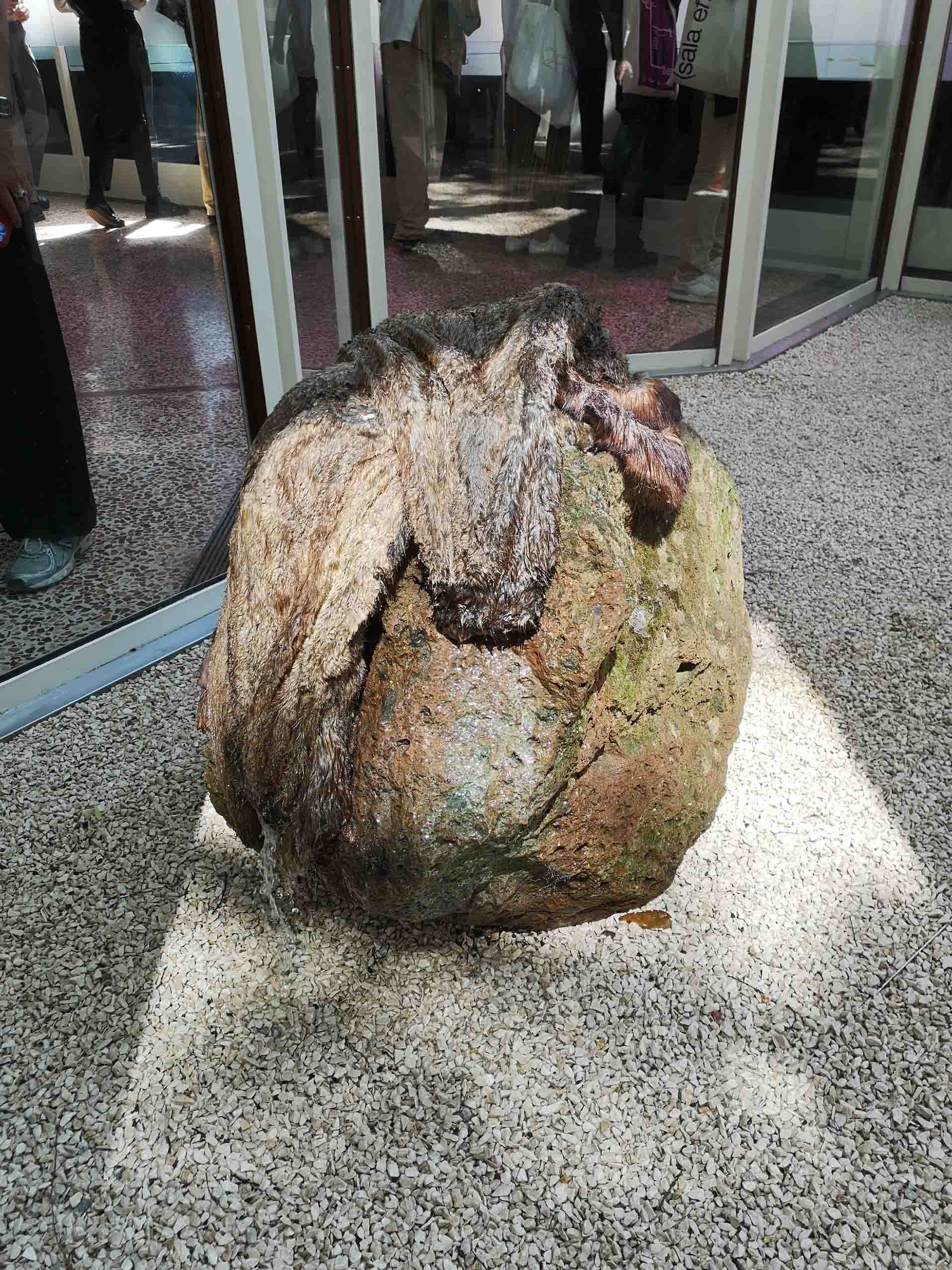
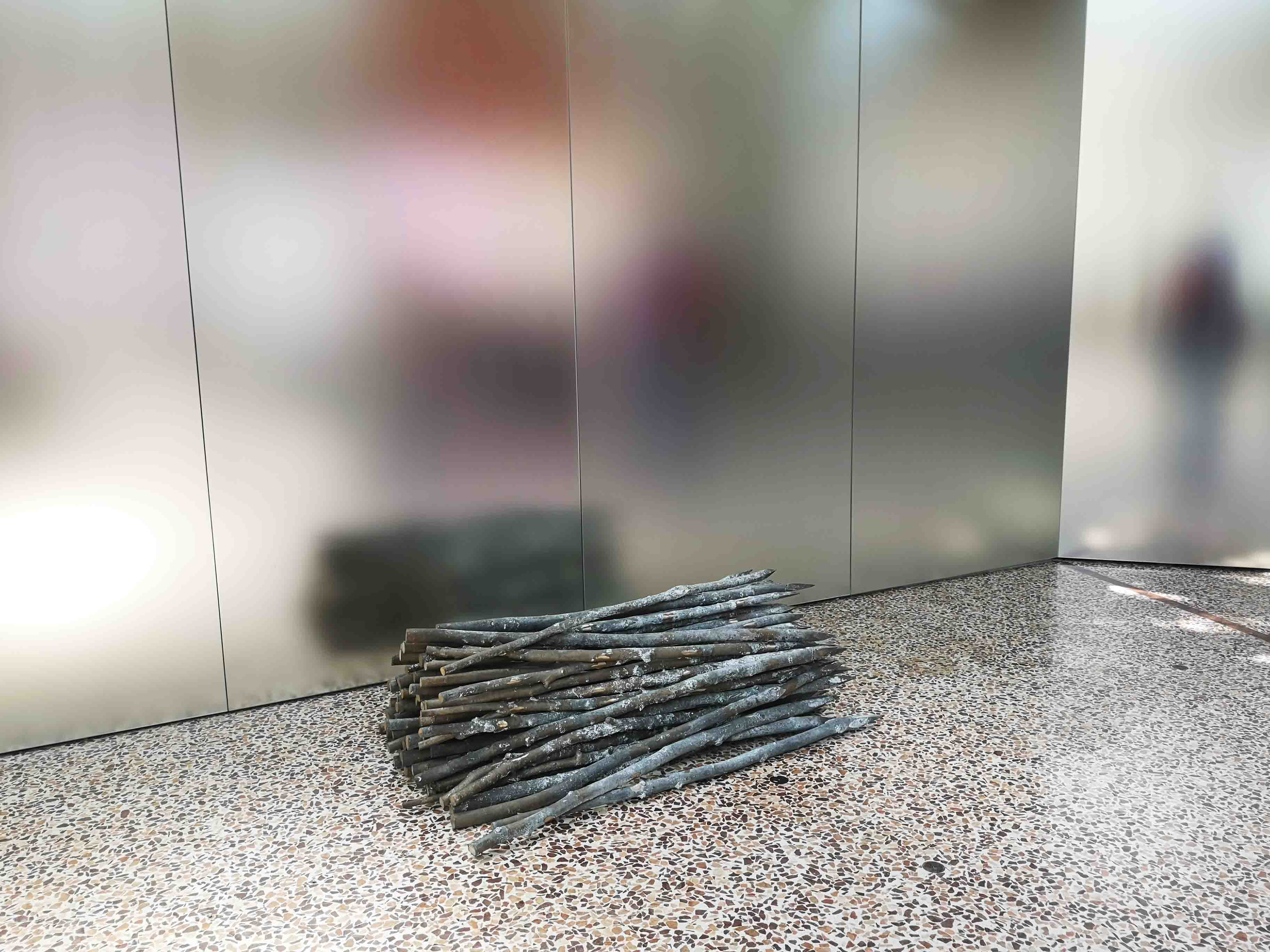
Already before entering the Canadian Pavilion in the Giardini questions arise. There are these two stones, one left “natural”, the other partly covered with fur fabric. Has someone left their old fur coat there? The next surprising element is a bundle of weathered wooden spears. Were these weapons meant to hunt the animal from which the fur outside came? Perhaps helps the title: “Entre Chien et Loup” (Between Dog and Wolf) This French expression, coming from the medieval Latin, describes the time of twilight, when it is difficult to distinguish between a dog and a wolf. Had the hunter this problem? Is the fur fabric from a dog or from a wolf?
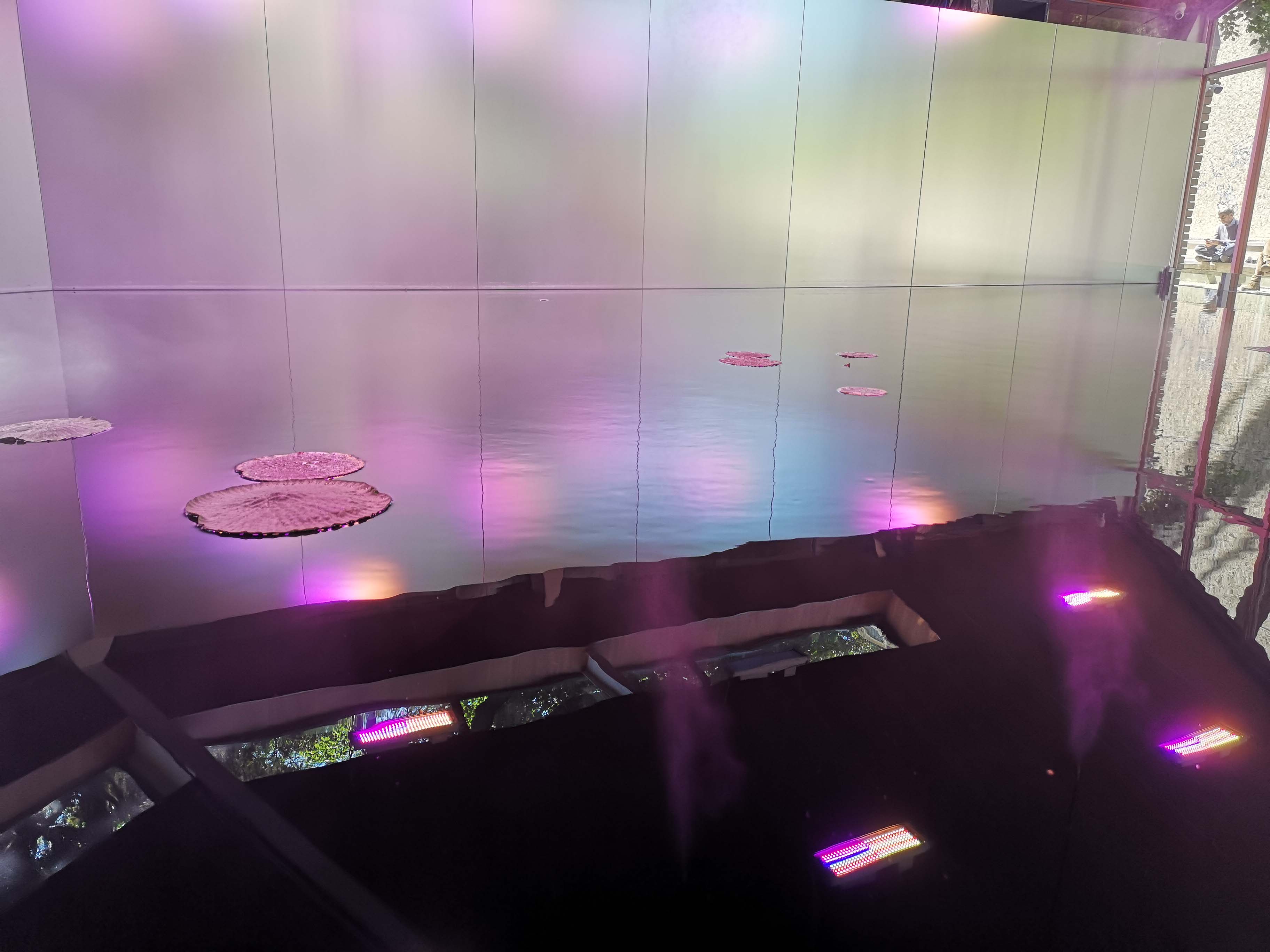
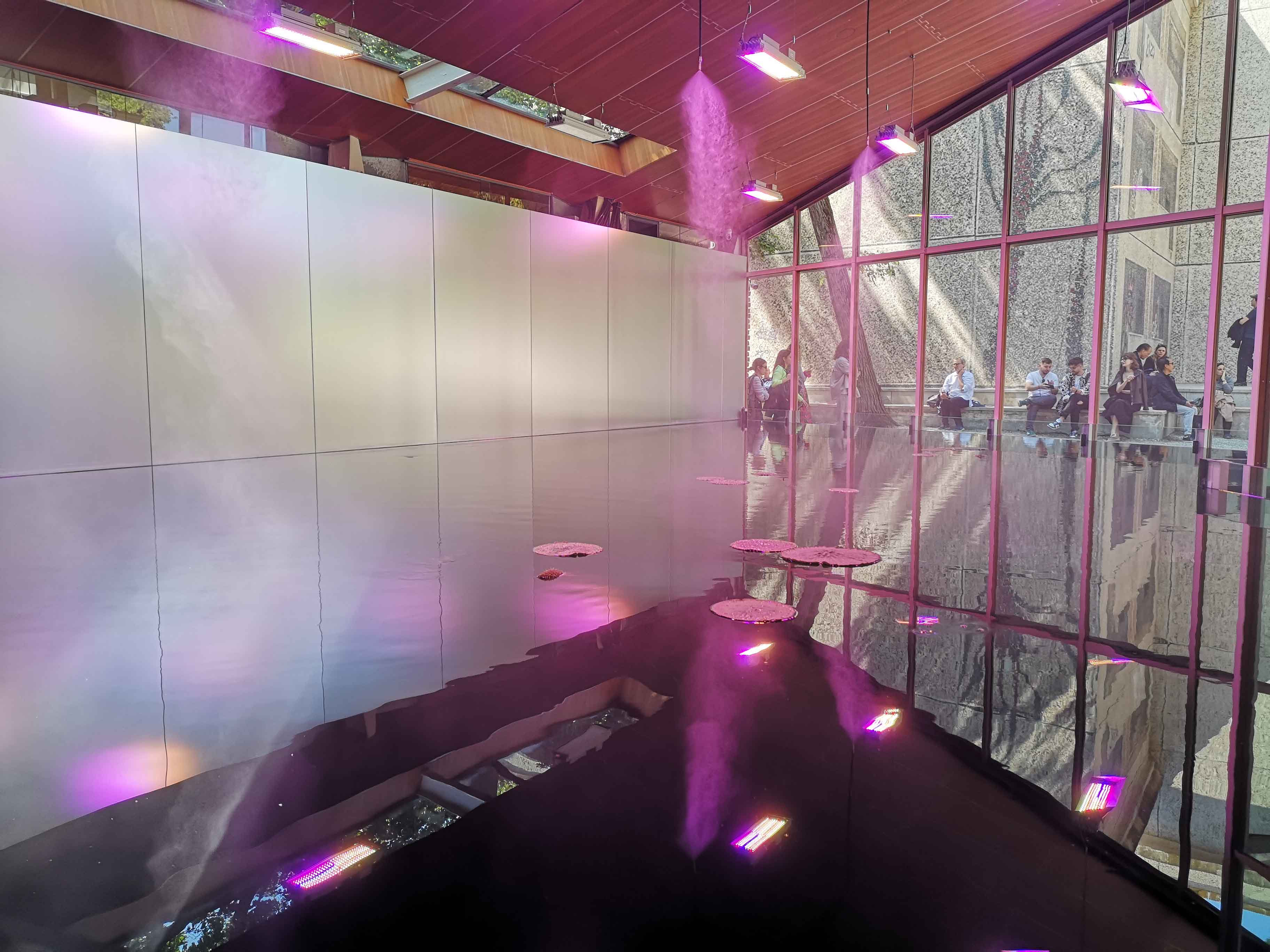
However, quickly attention turns to the atmosphere inside the pavilion. It is warm and humid, like in a greenhouse. Pink lights are reflected on the surface of a water basin, which takes up about a third of the pavilion. Nozzles above emit a fine mist of water. The back wall of the artificial lake is covered with matt metal panels, which also reflect the pink lights and the shimmers of the surface. Water lily leaves are floating on the water. Later they should bloom, first in white and afterwards hopefully in pink similar to the light. Even with the building’s large glass façade, the light above the pool is dim, almost like twilight.
Abbas Akhavan, the author of this site-specific installation “wanted to address the idea of world fairs, notably the 1851 Great Exhibition in London, where Victoria amazonica water lilies were featured in the iconic Crystal Palace.” (1) The allusion to Crystal Palace is evident, due to the window front, enlarged by the artist. Also the metal panels reflected in the water contribute to this impression. They recall the supporting ribs, used in 1851 by the architect Joseph Paxton as structural elements for the glass exhibition building.
Still, the water lilies are even more important, not just because they served with their characteristic support ribs of the leaves as a source of inspiration for Paxton. Named after the British Queen Victoria, these flowers were presented at the World Exhibition in London. Becoming the Queen’s emblem, they should showcase the British Empire’s power. Due to the colonial power, the kingdom was able to import various plants and animals, which contributed to the economic promotion. By referring to the Great Exhibition from 1851, Abbas Akhavan “wanted to draw parallels with the international art and architecture biennales, of which Venice is the oldest and most established.” (1)
Besides, the seeds of the Victoria amazonica water lilies were sent from the Royal Botanic Gardens, Kew to the Orto Botanico di Padova, where they were germinated. Later the plants were transferred to the Canadian Pavilion. Since the Kew Garden’s Waterlily House is closed for renovation the whole year 2026, the pavilion became a sort of satellite from the Royal Botanic Gardens.
But there’s still the question of the connection between the twilight and the water lilies installation. Perhaps the time between dog and wolf is important, because dusk is the moment when the Victoria amazonica flowers and gives off a scent reminiscent of pineapple. This attracts beetles for pollination, who remain trapped inside the flower until the following evening. Then the flower reopens and releases them. By the second evening, the flower, which was originally white, has turned pink. For the human spectator the sight of the Victoria amazonica is awesome, like the contact with a friendly dog. Whereas the enclosed beetle might think more of a wolf.
While pink is dominant in the Canadian Pavilion, the Spanish contribution is more colourful.
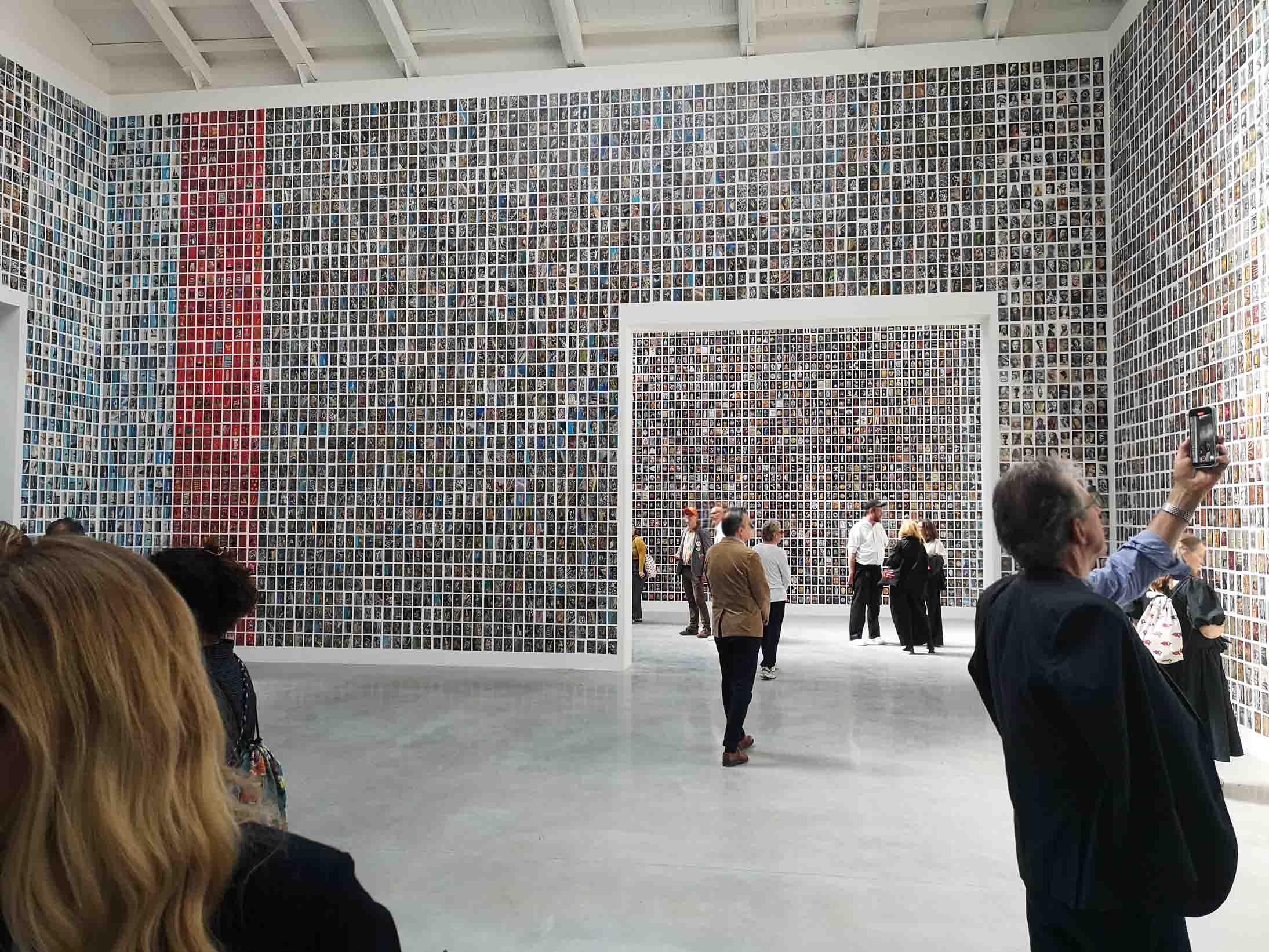
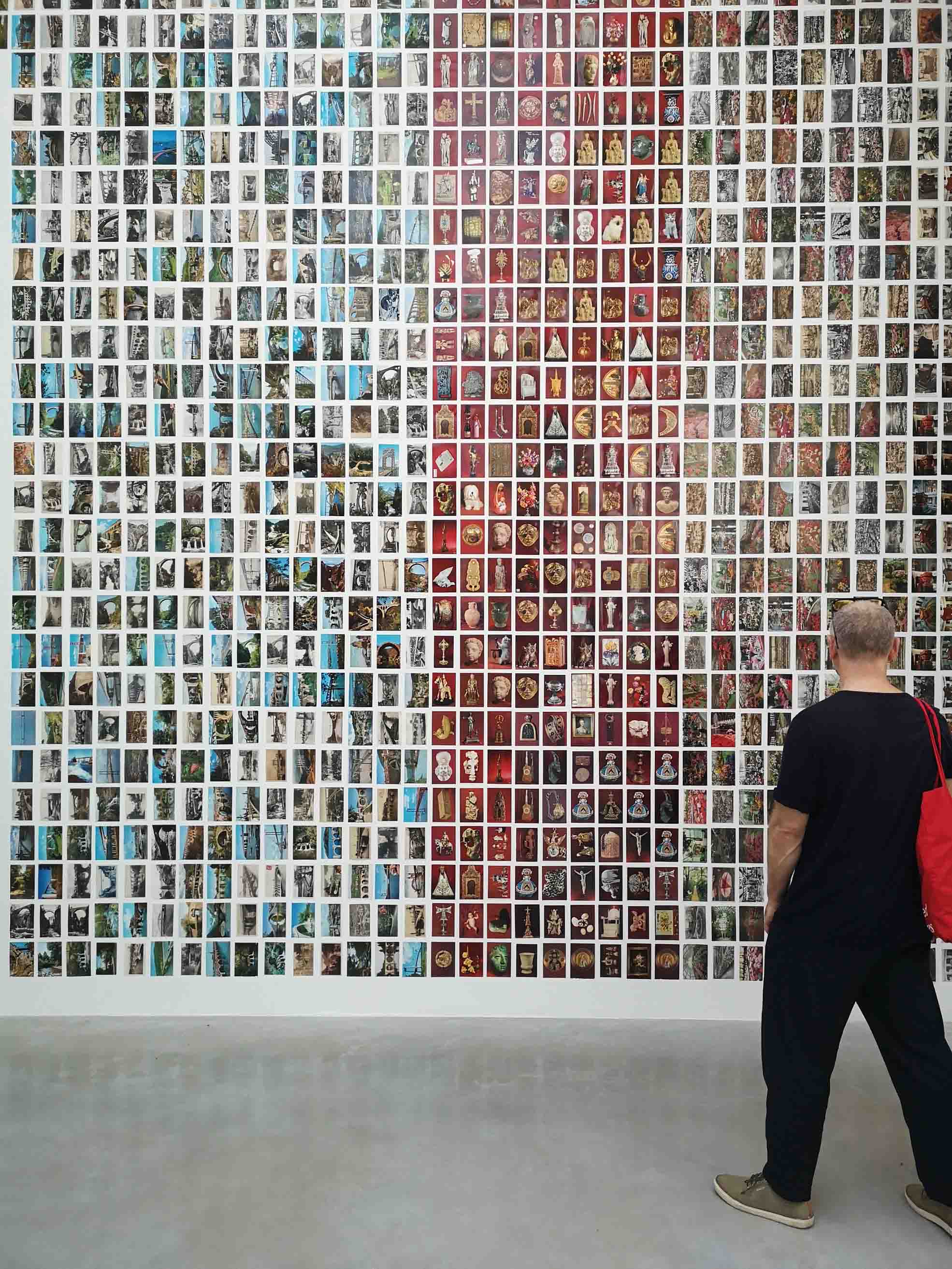
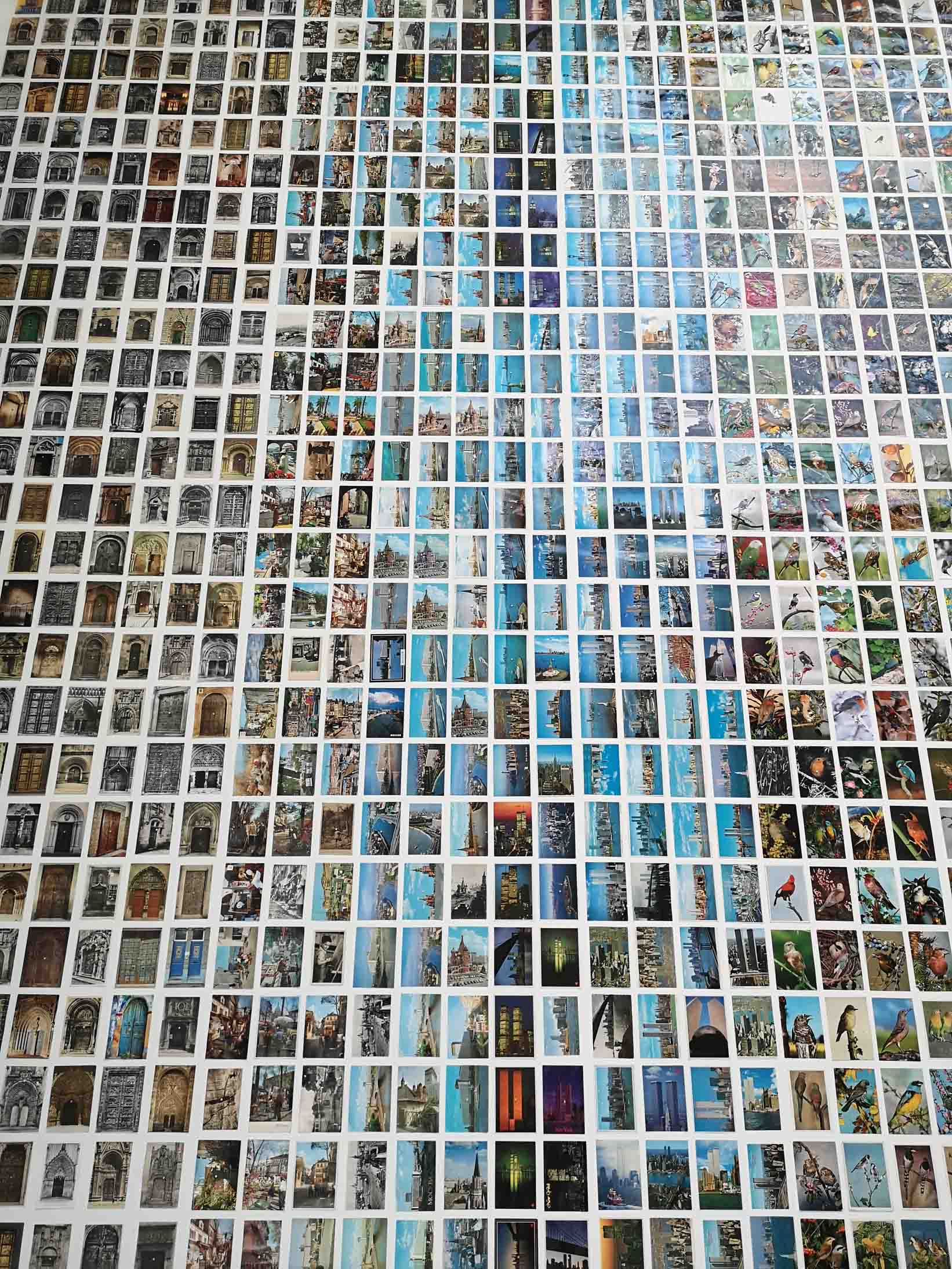
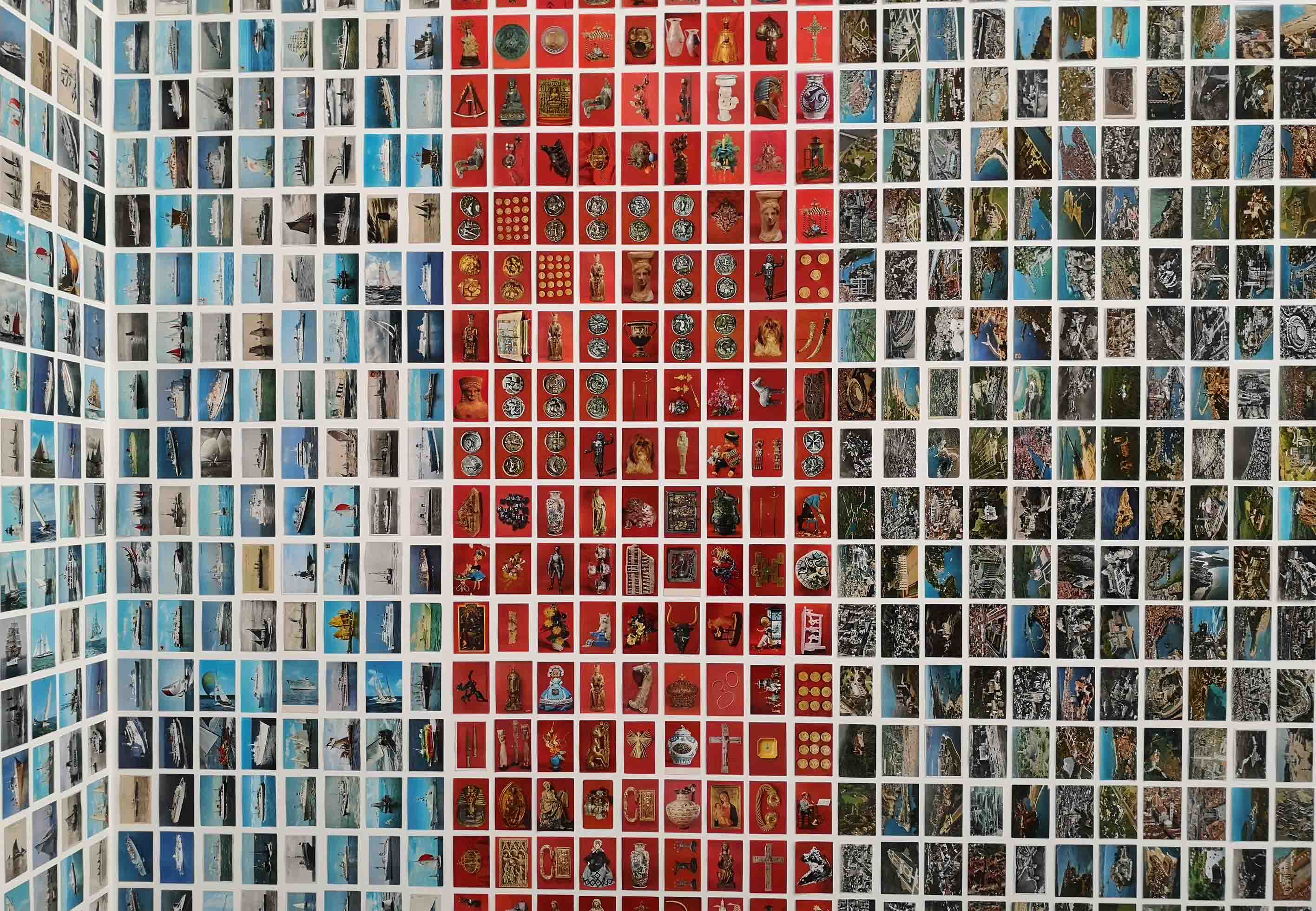
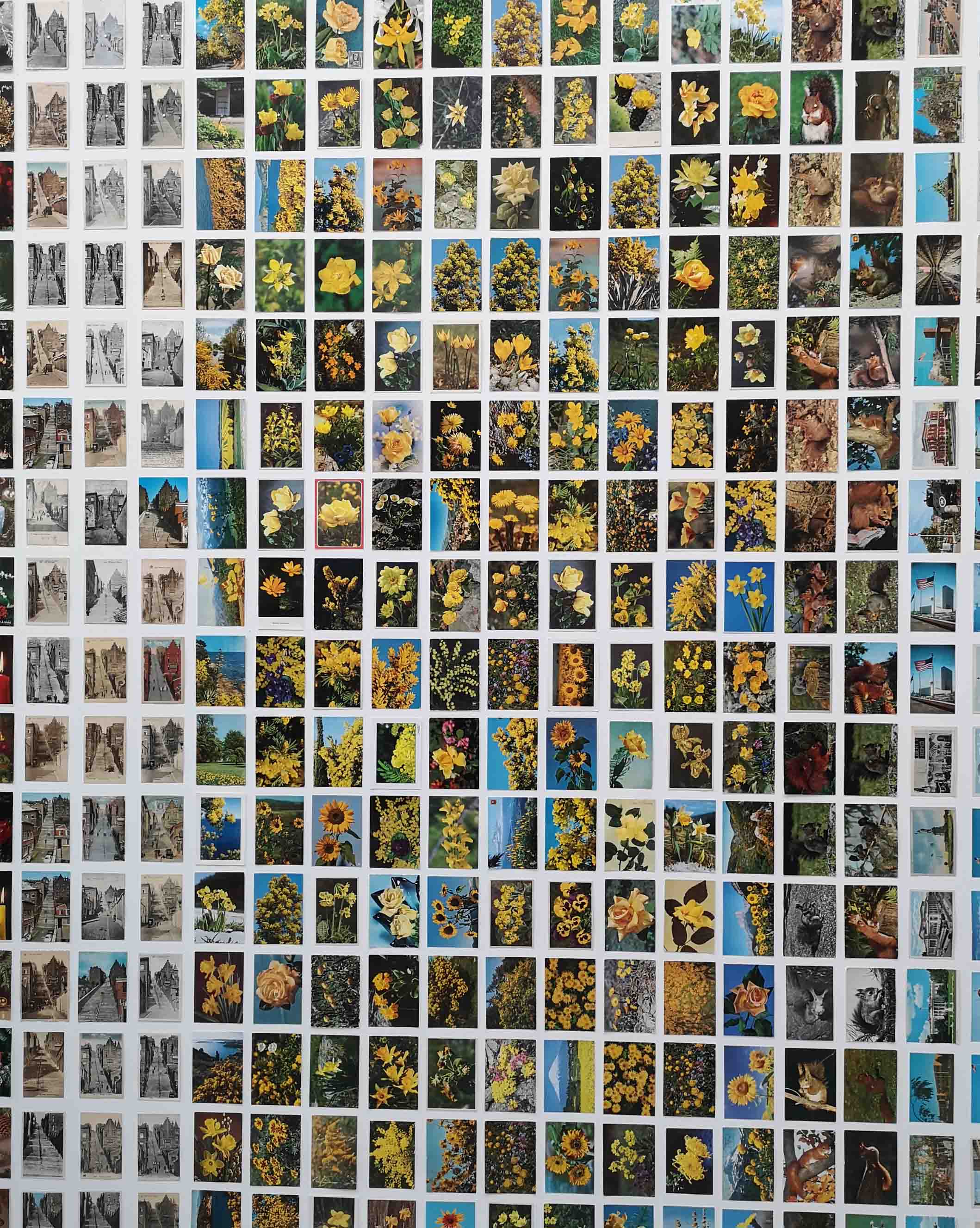
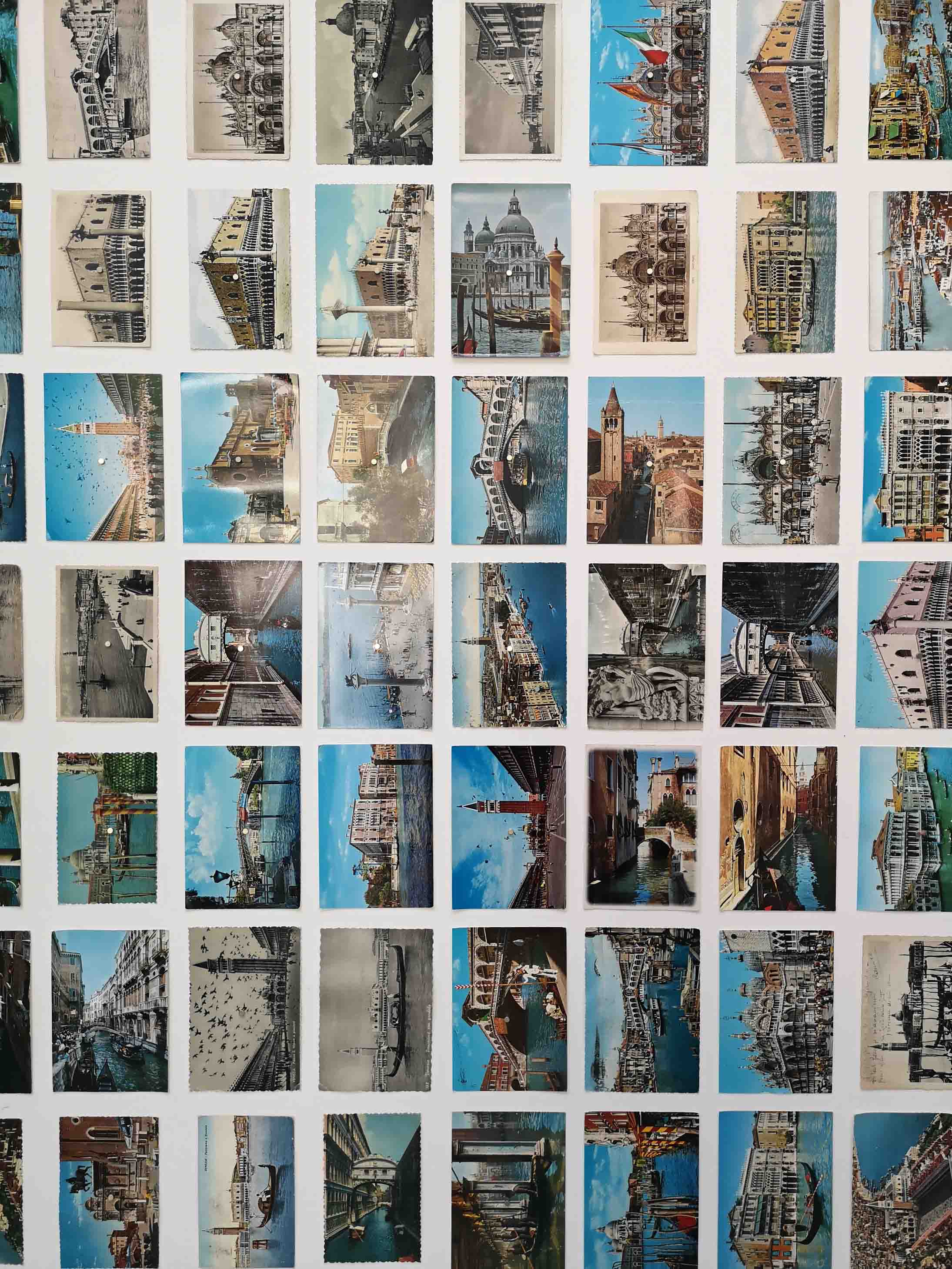
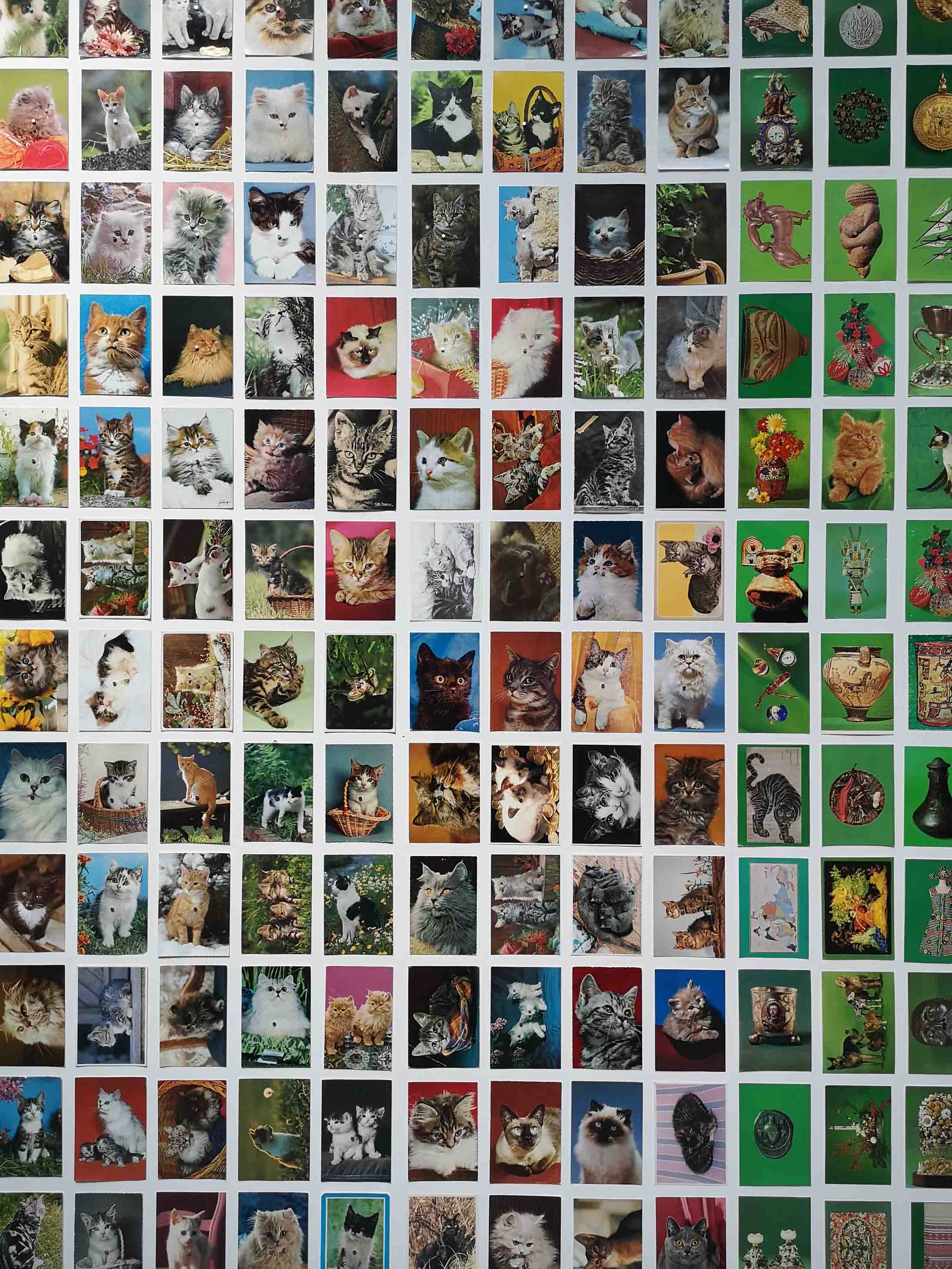
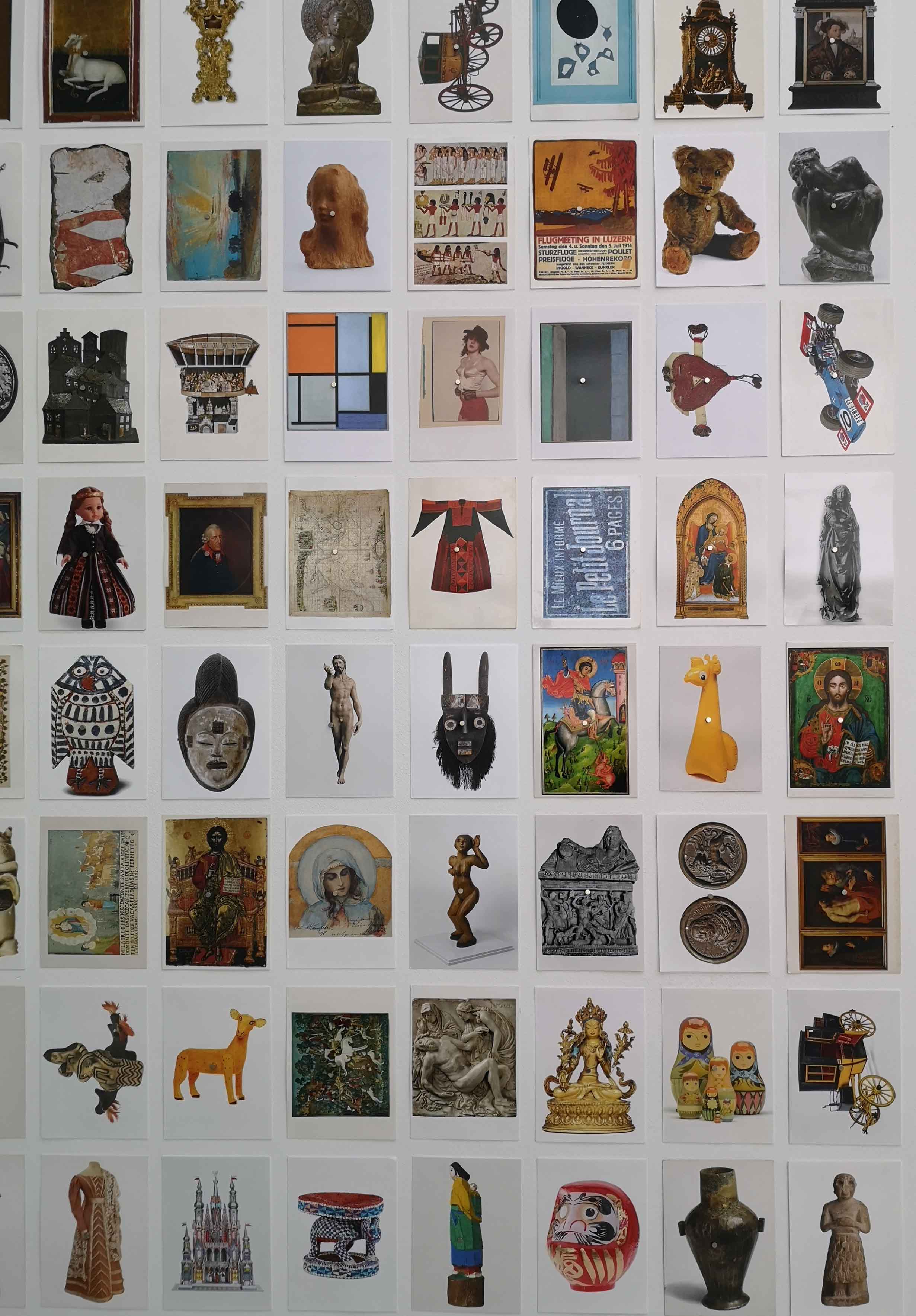
For postcard collectors, the Spanish Pavilion in the Giardini is a paradise. Oriol Vilanova has covered all the walls from top to bottom with these. The pictures of landscapes and sights are mostly sorted by colour and subject, without any hierarchy. There are sections featuring orange to red sunrises and sunsets, city skylines with lots of blue, white-background museum pieces, church portals and various animal species. One can’t get enough of looking at them and keep discovering familiar sights or even postcards once sent or received.
Though, Oriol Vilanova didn’t content himself in showing the fruits of twenty years of collecting from flea markets and second-hand shops. As the title “Los restos” (The Remains) indicates, these postcards are relics of a bygone era, when tourists wrote handwritten messages to those who had to stay at home. These could have been the parents, the godmother or even friends. Consequently, the motivation varied: sometimes it was a sincere greeting, other times perhaps just a matter of fulfilling a duty, or even a bit of showing off. Nowadays, handwritten communication has become almost meaningless. These days, one just takes a quick selfie and sends it with a few words via a messaging app – either to one person or straight to a whole group. Or one shares the greetings directly on social media, so that the whole world could see them. And this might not be a single photo, but also a video. Not only the form, but also the content and the motivation have changed.
Besides the attention to changed media of communication, the artist points to the physical evanescence. On closer inspection, the signs of ageing become visible on the postcards. The black-and-white photographs have yellowed, the colours have faded, and there are small dog-ears. With his monumental pseudo-museum Oriol Vilanova invites to reflect on the fragility of materials and the shifts in communication schemes.
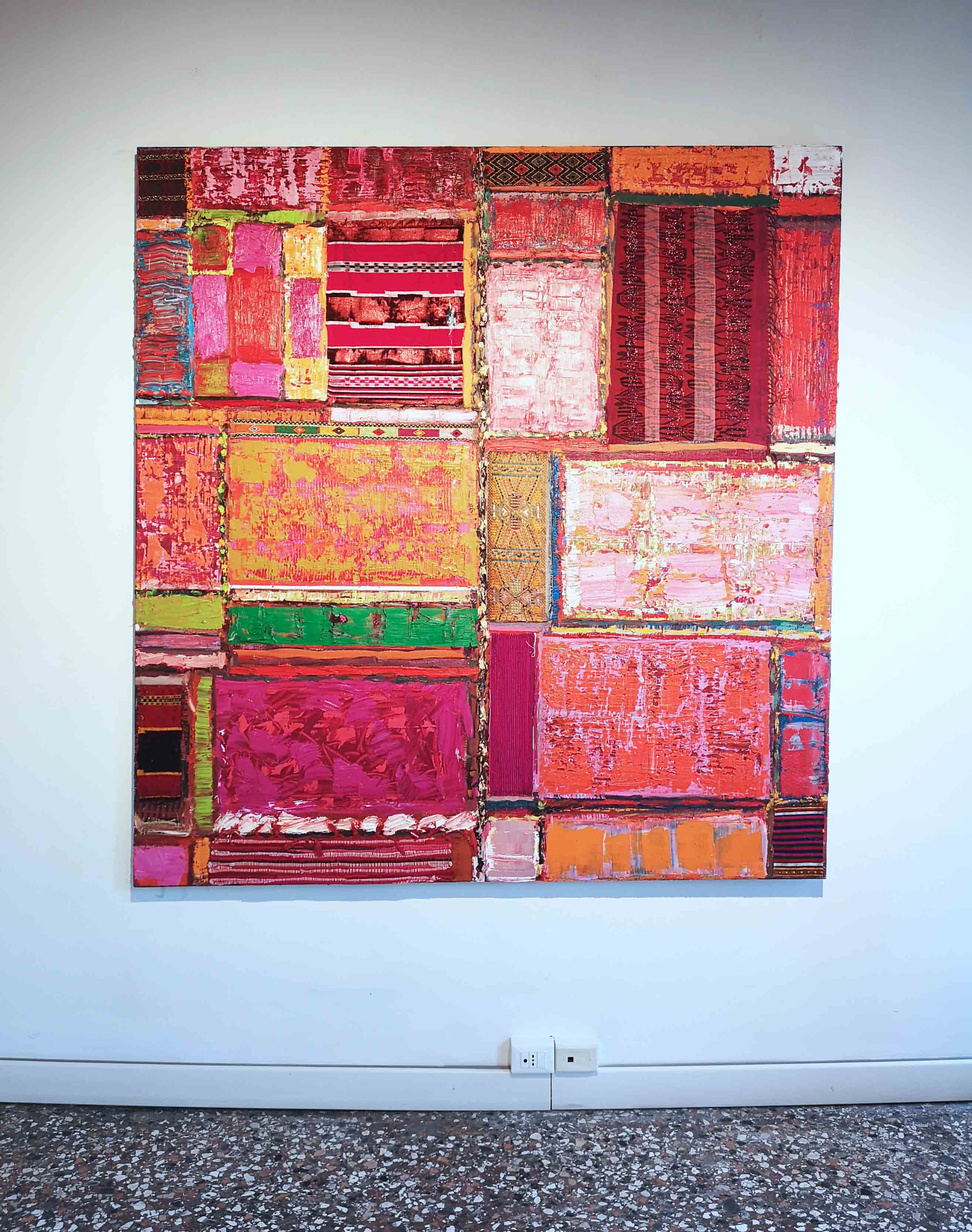
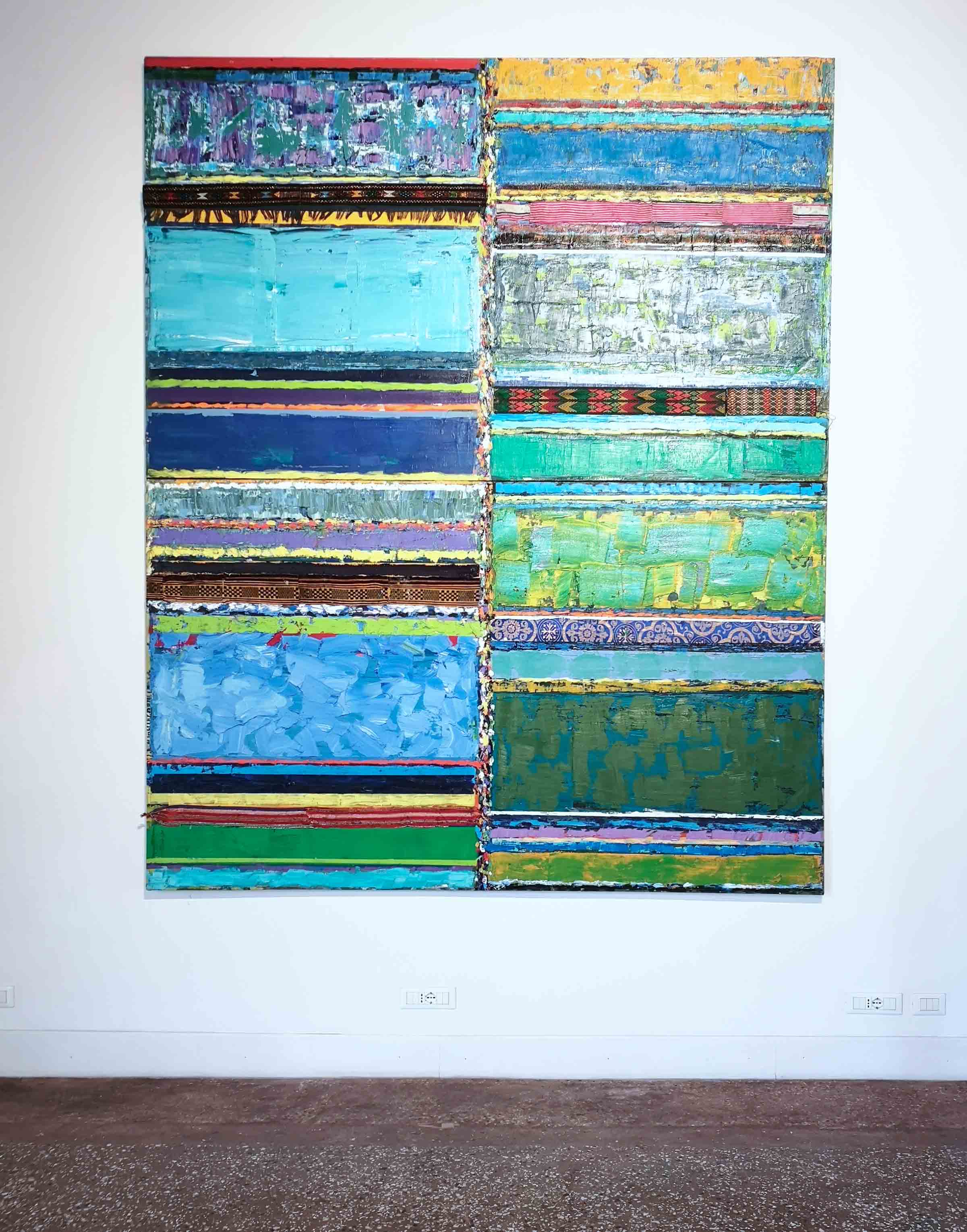
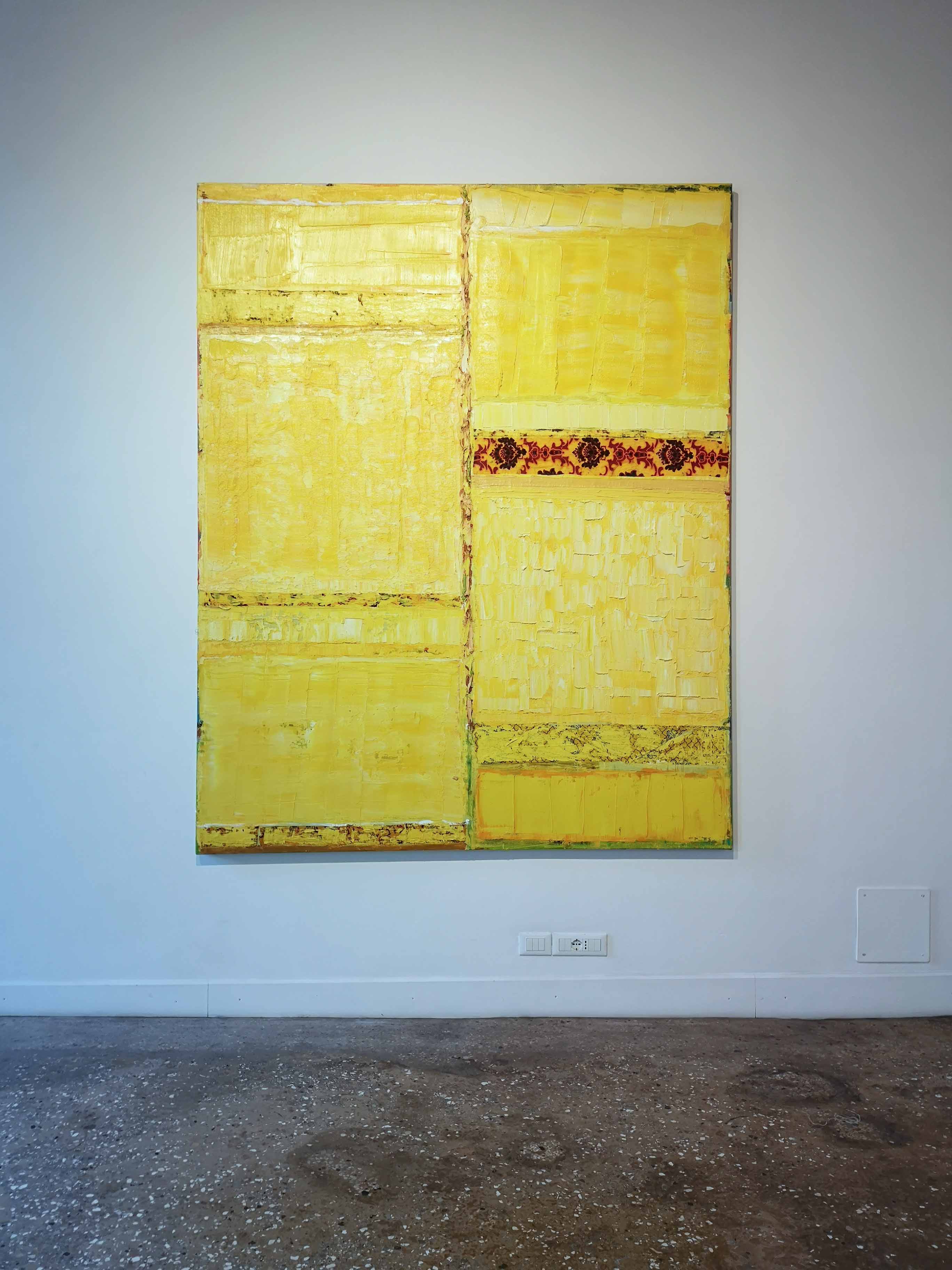
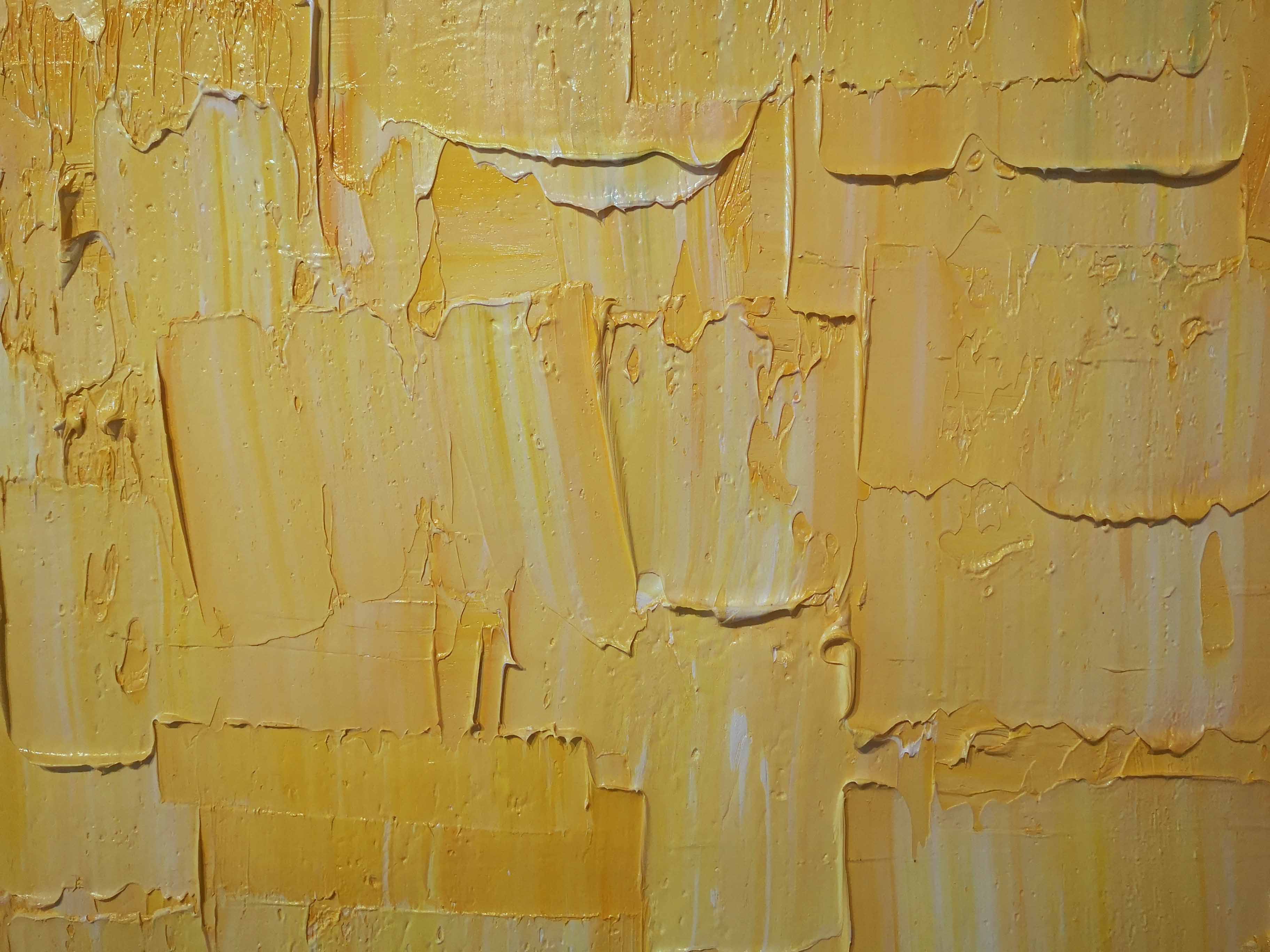
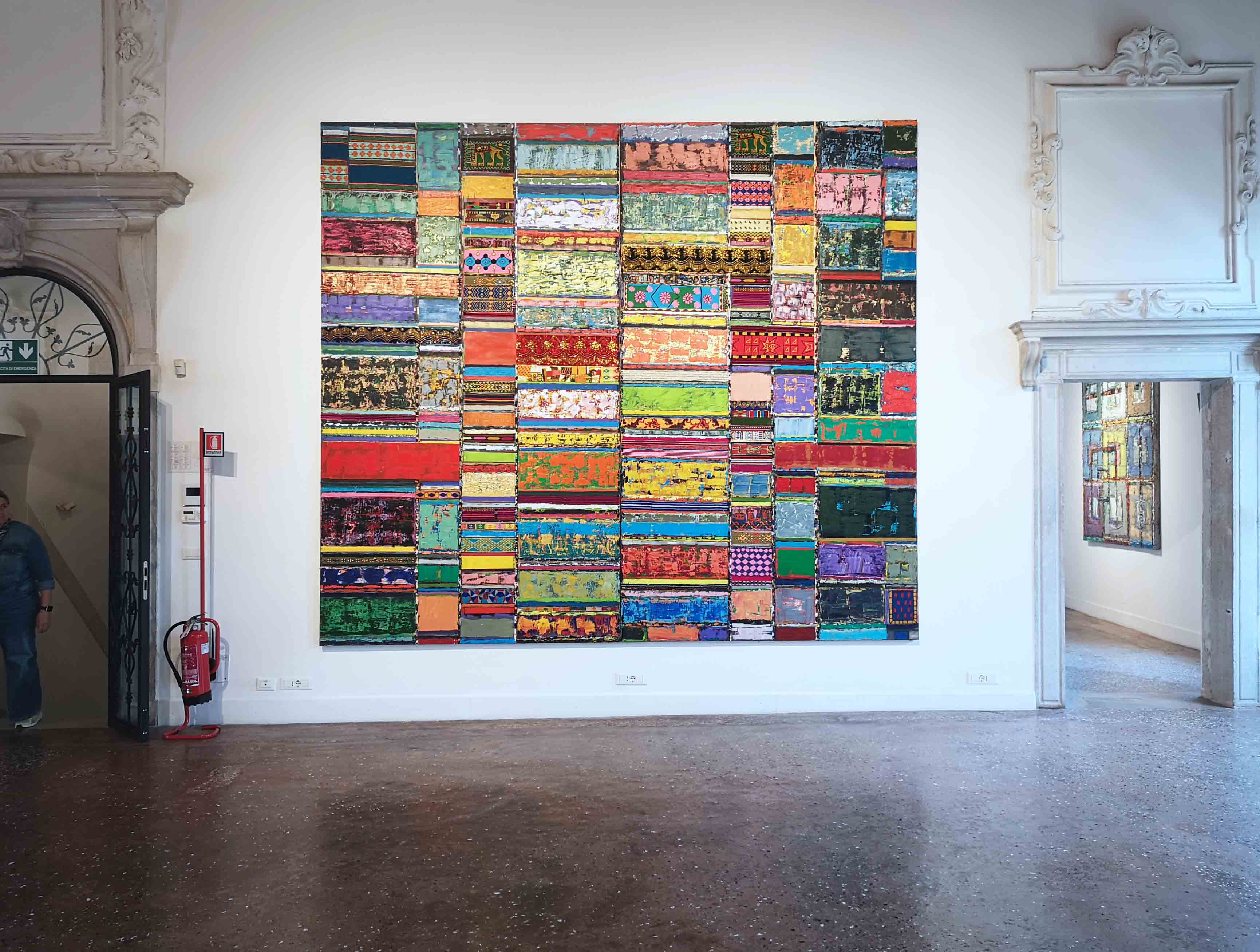
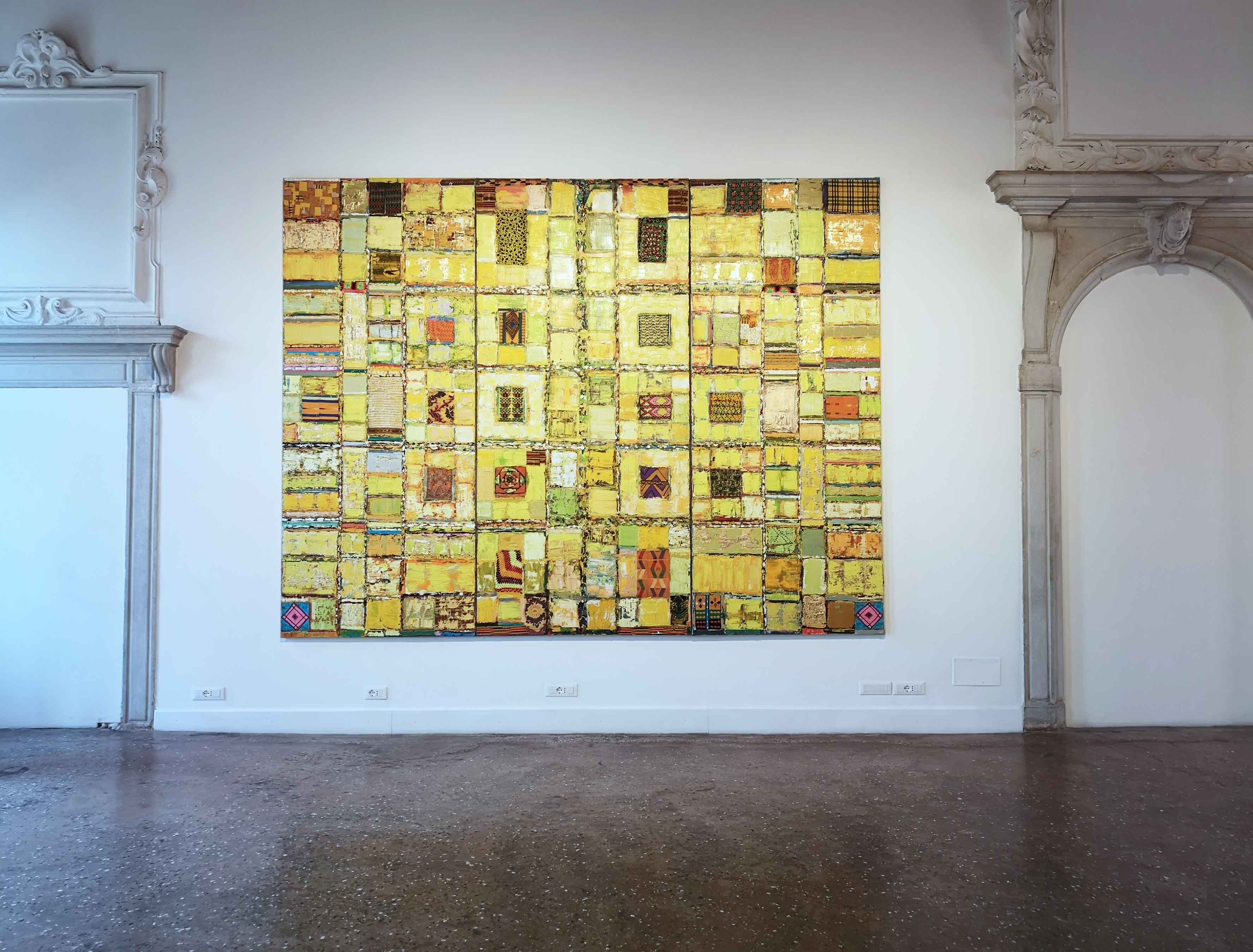
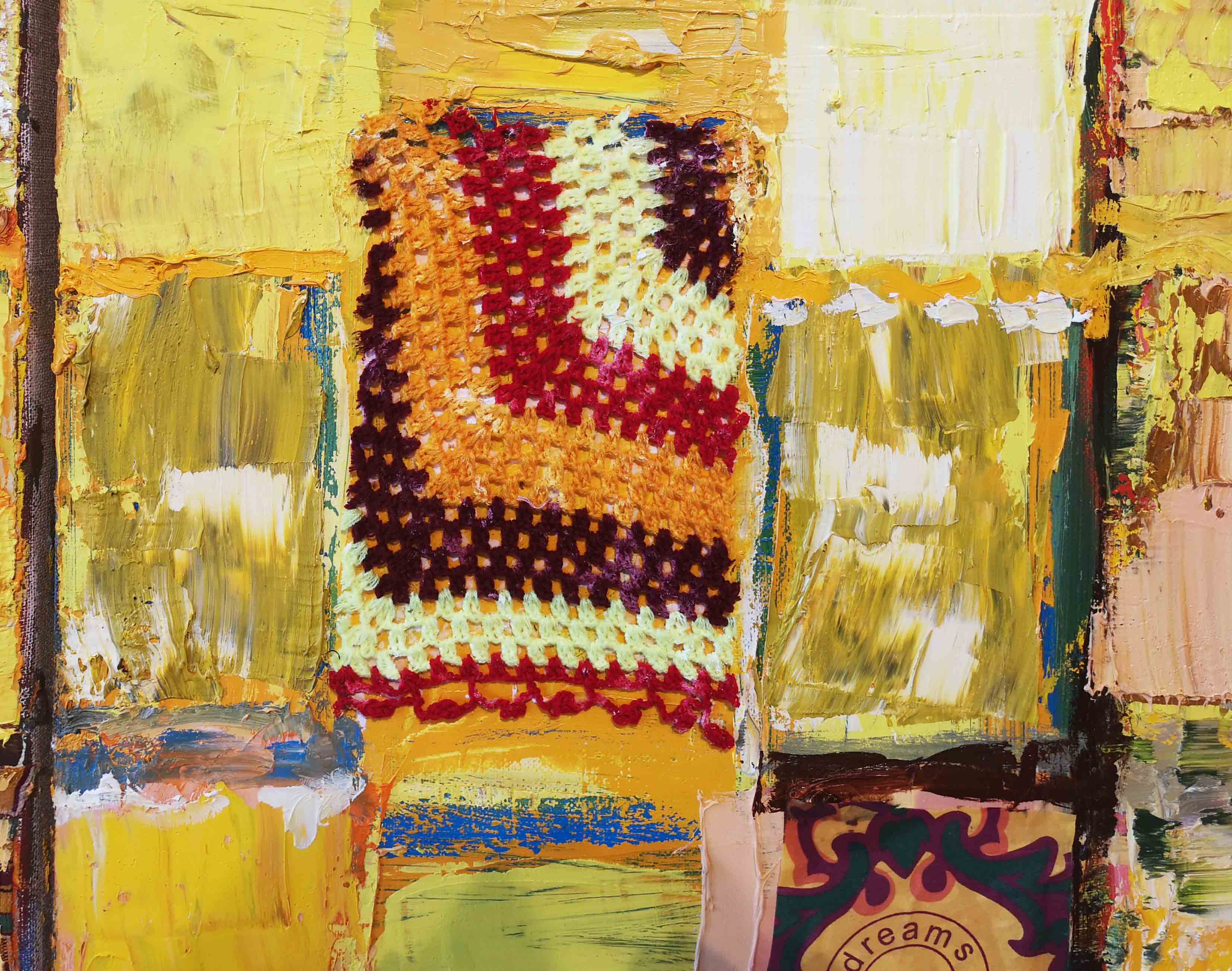
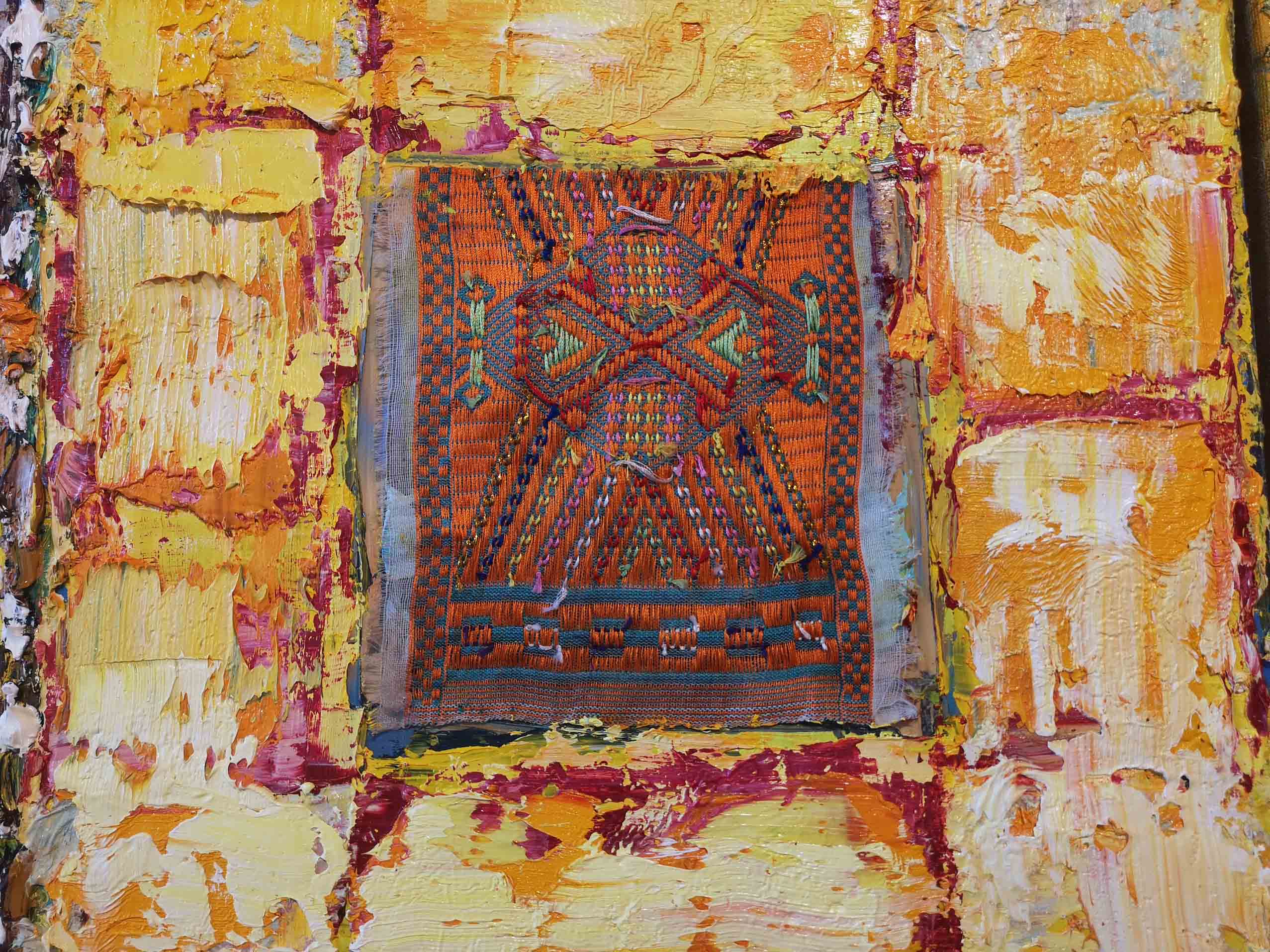
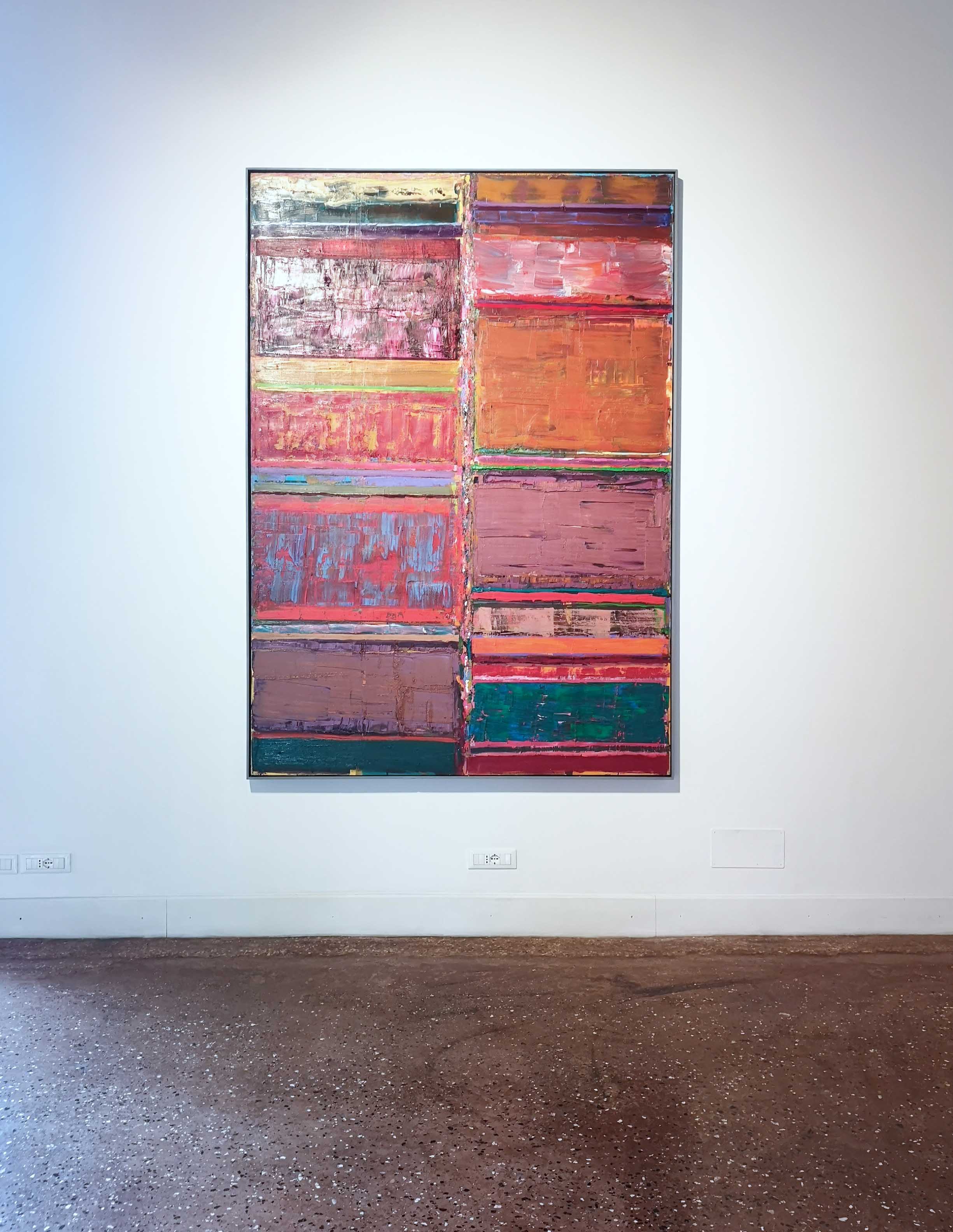
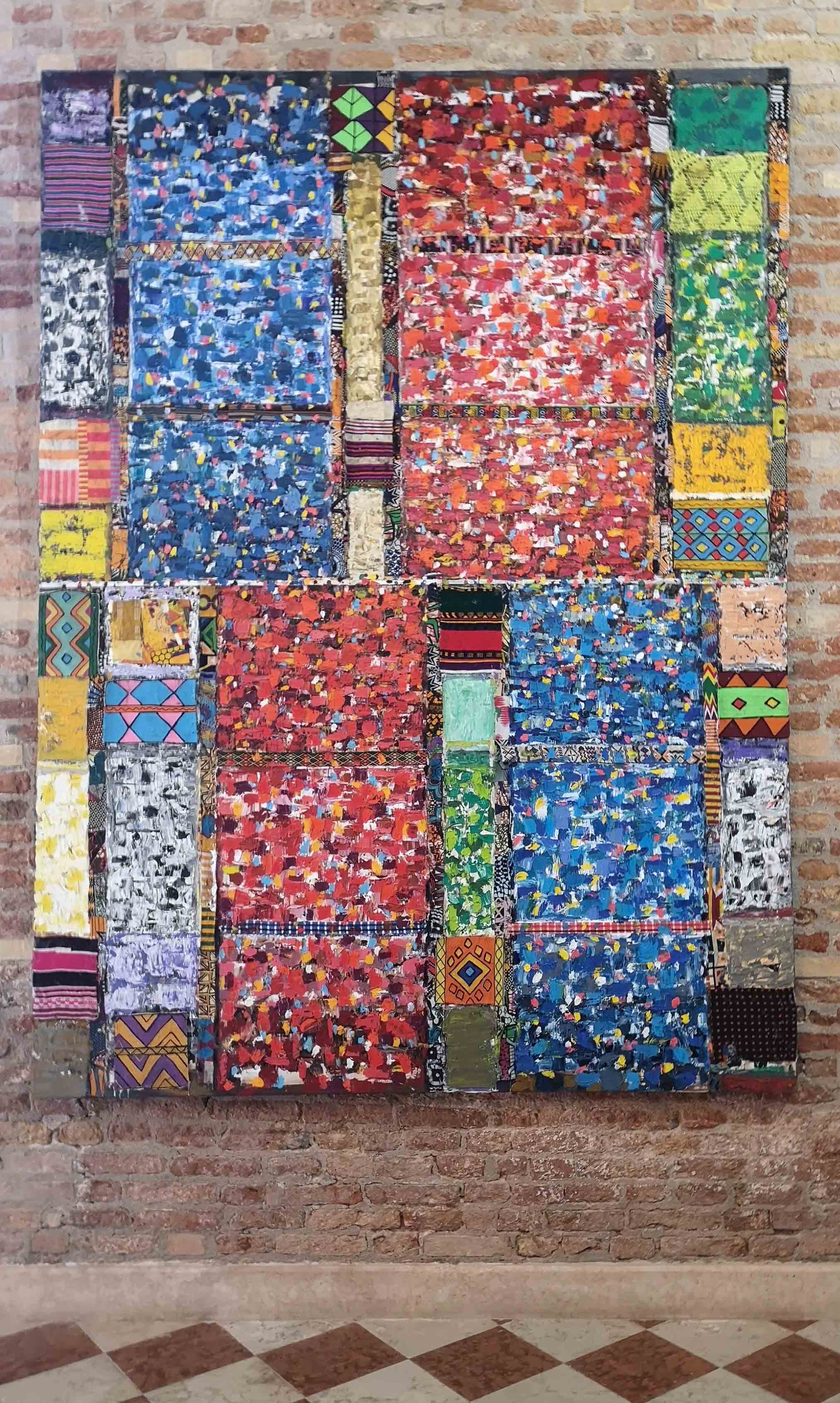
Even more colourful are Tegene Kunbi’s paintings. Located on the light-filled upper floor in a Palazzo close to the Riva degli Schiavoni, the Pavilion of Ethiopia is in the neighbourhood of New Zealand and Nauru. The often large-size canvases, shine in shades of red, blue and green, and particularly in a sunny yellow. These colours are applied in a thick, impasto-like manner. They form rectangles of various sizes. Borders separate the colour fields. Additional pieces of fabric cover whole or parts of the quadrangles. Together, these elements create the effect of an epidermis laid over the canvas.
At first glance, the exhibition title “Shapes of Silence” seems somewhat confusing, as the pictures seem to radiate bright, cheerful tones rather than silence. Nor are there any labels with the titles of the pictures that might provide any indication. Although existing, the image titles were deliberately omitted so that the language would not impose any interpretation. A suppression of visual and other expressions of the works should be avoided. They shouldn’t be silenced by language.
Therefore, we will neither give any detailed interpretation. Better to let the paintings speak for themselves. Just a few words on the materials used and their significance for the artist. Besides the oil paint, there are fabrics of opposed origine and importance: hand-knitted besides industrial produced cloths and religious destined next to utility textiles. Moreover, there are fabrics from different Ethiopian regions, reflecting their distinct histories, traditions and cultures. United side by side on the canvas, they could enter into a silent communication.
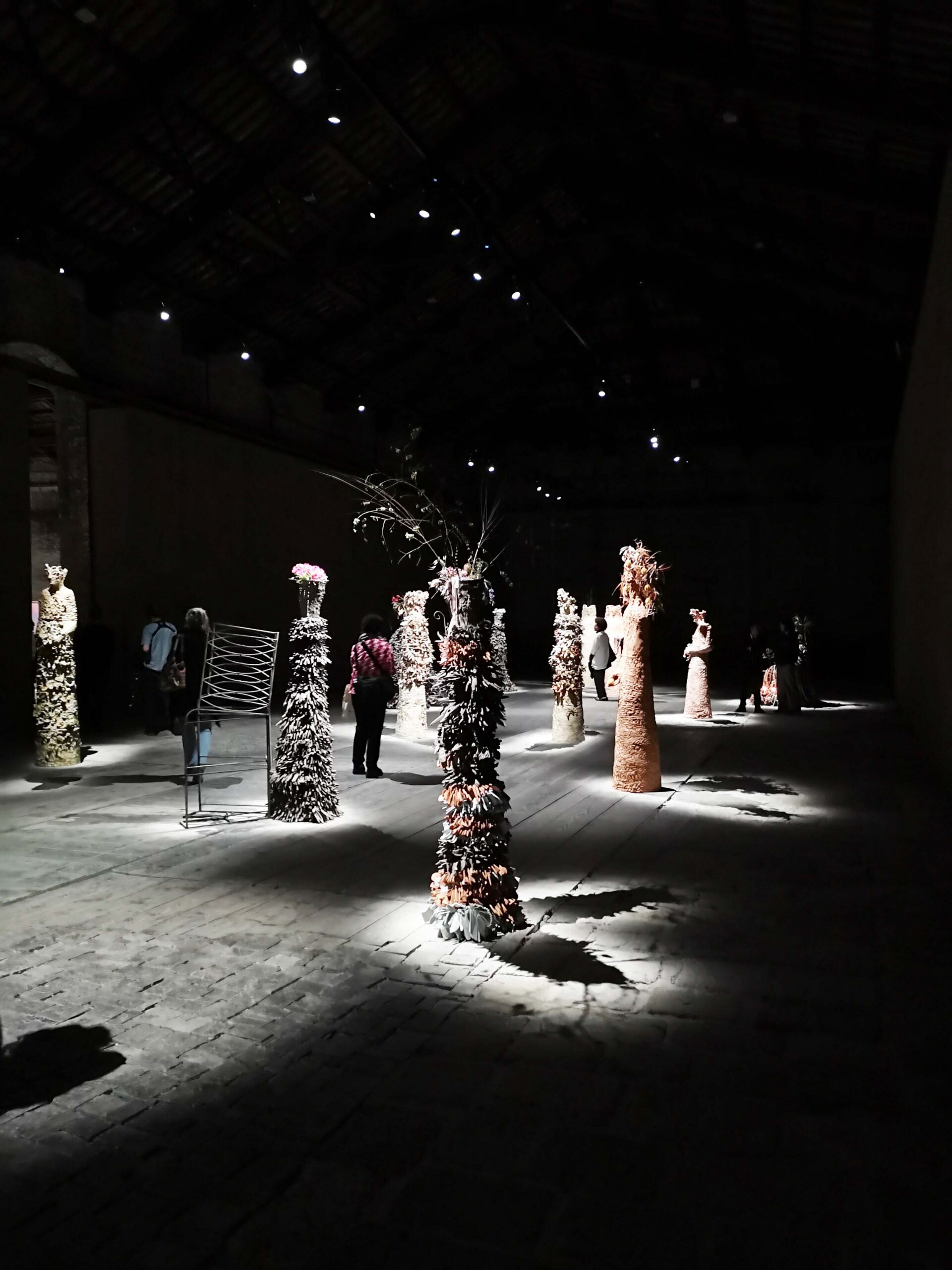 Also Chiara Camoni’s life-sized sculptures in the first hall of Italy’s Pavilion in the Arsenale are standing silently in a dim light. Made of organic and synthetic materials, these 24 guardians talk soundless to each other and to the visitor, as the title “Dialoghi” (Dialogues) indicates.
In contrast, the Japanese Pavilion is a very lively place, with a lot of activity.
The Pavillon of Japan – A great Fun
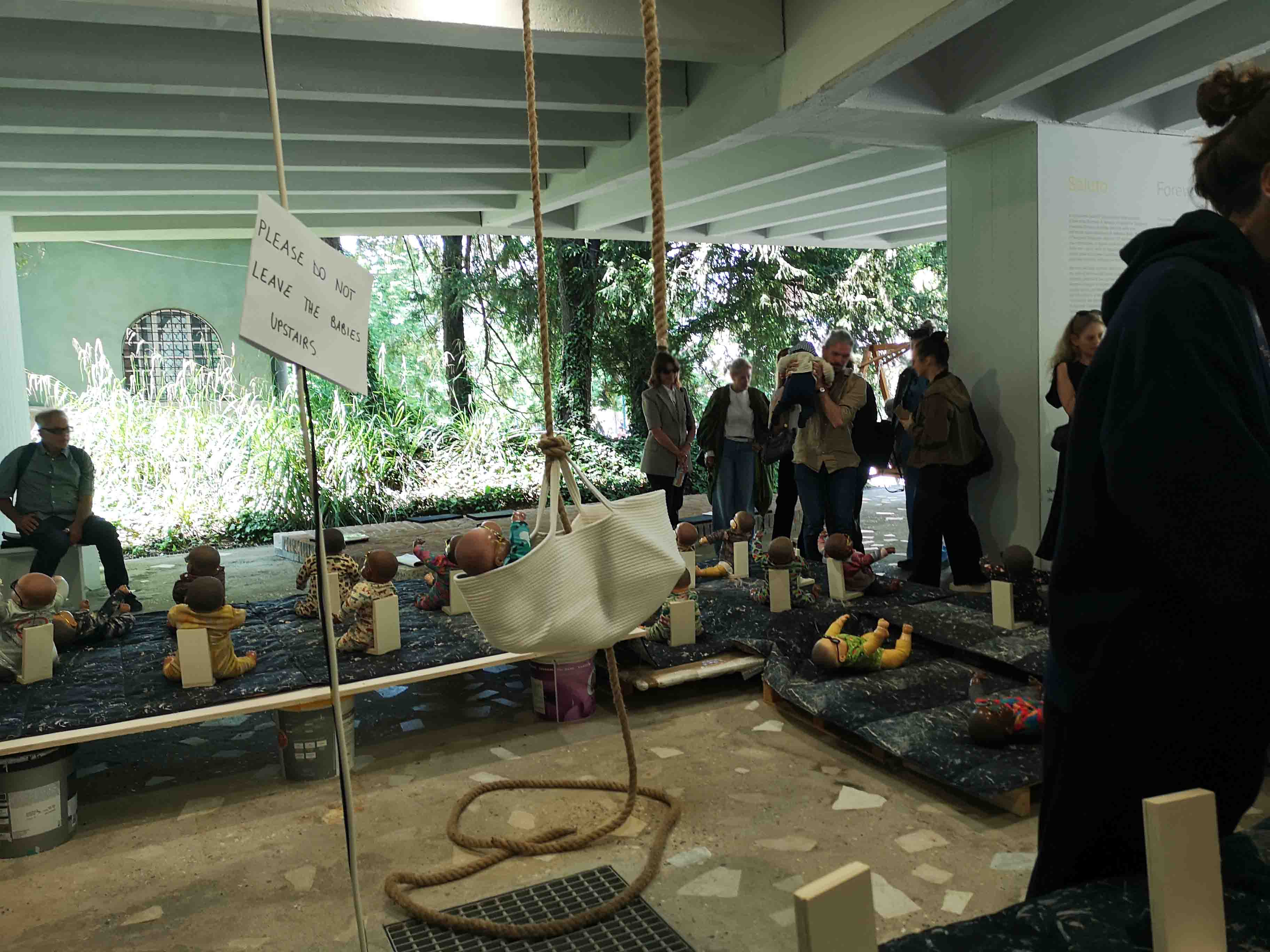
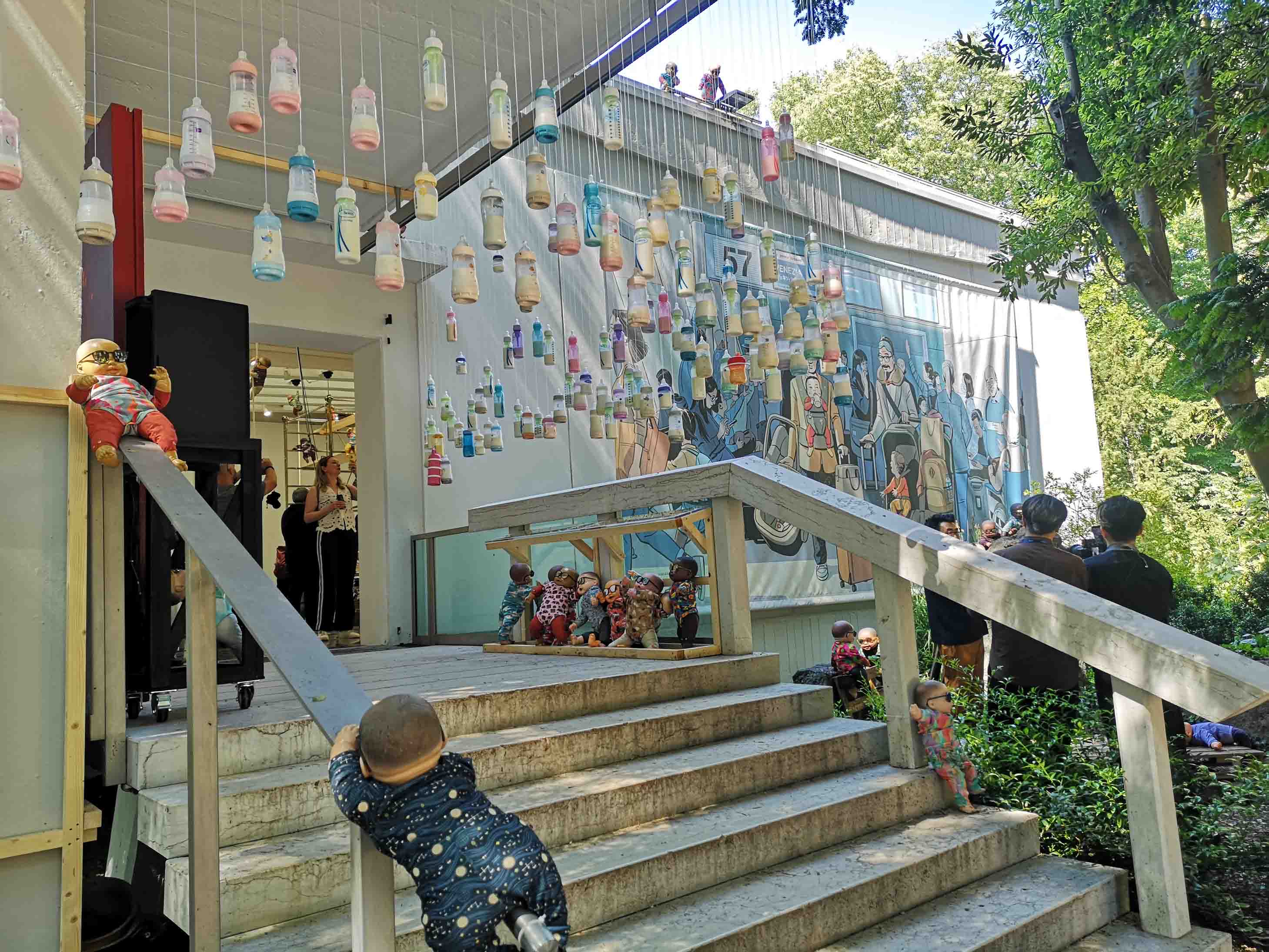
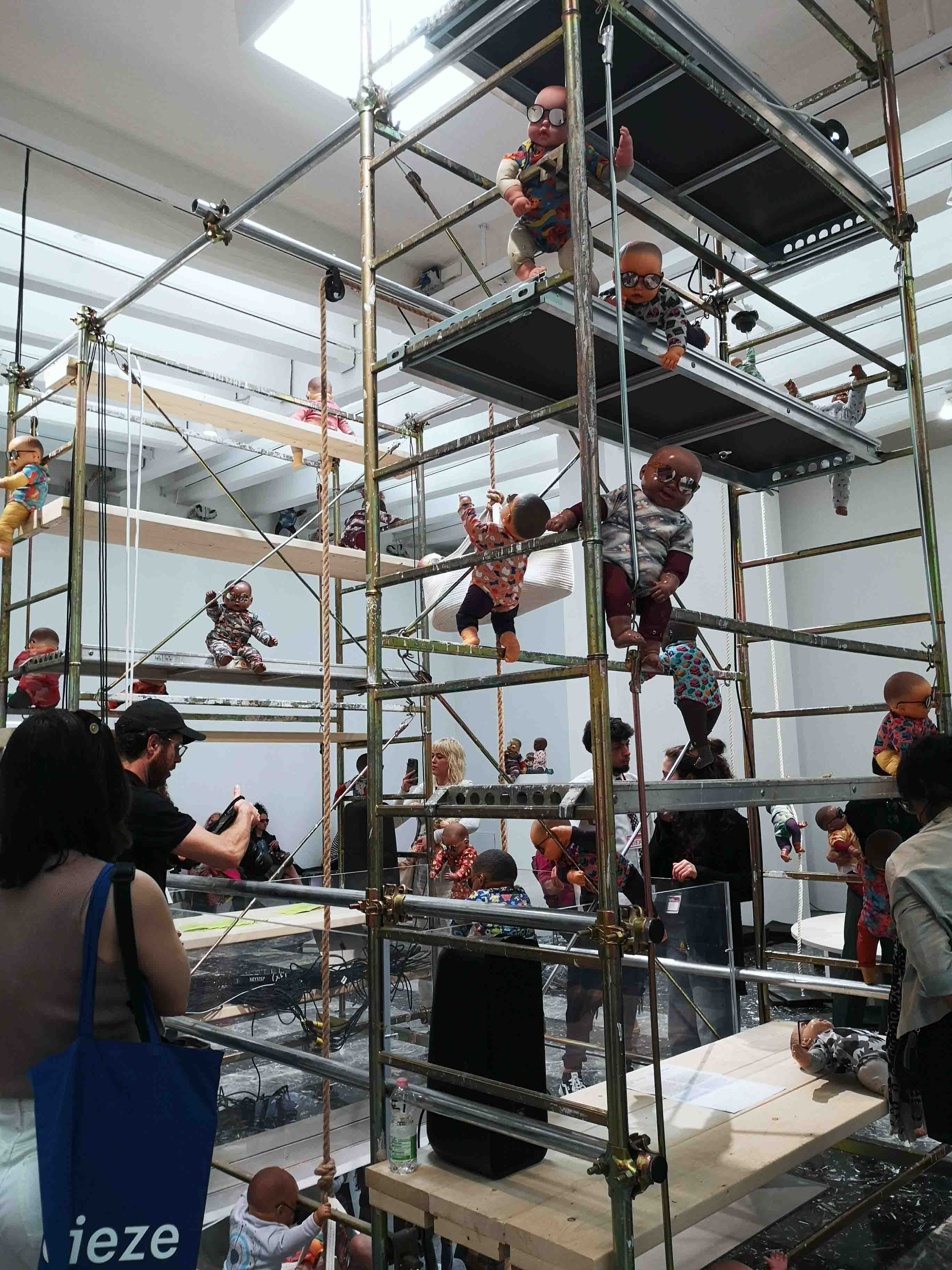
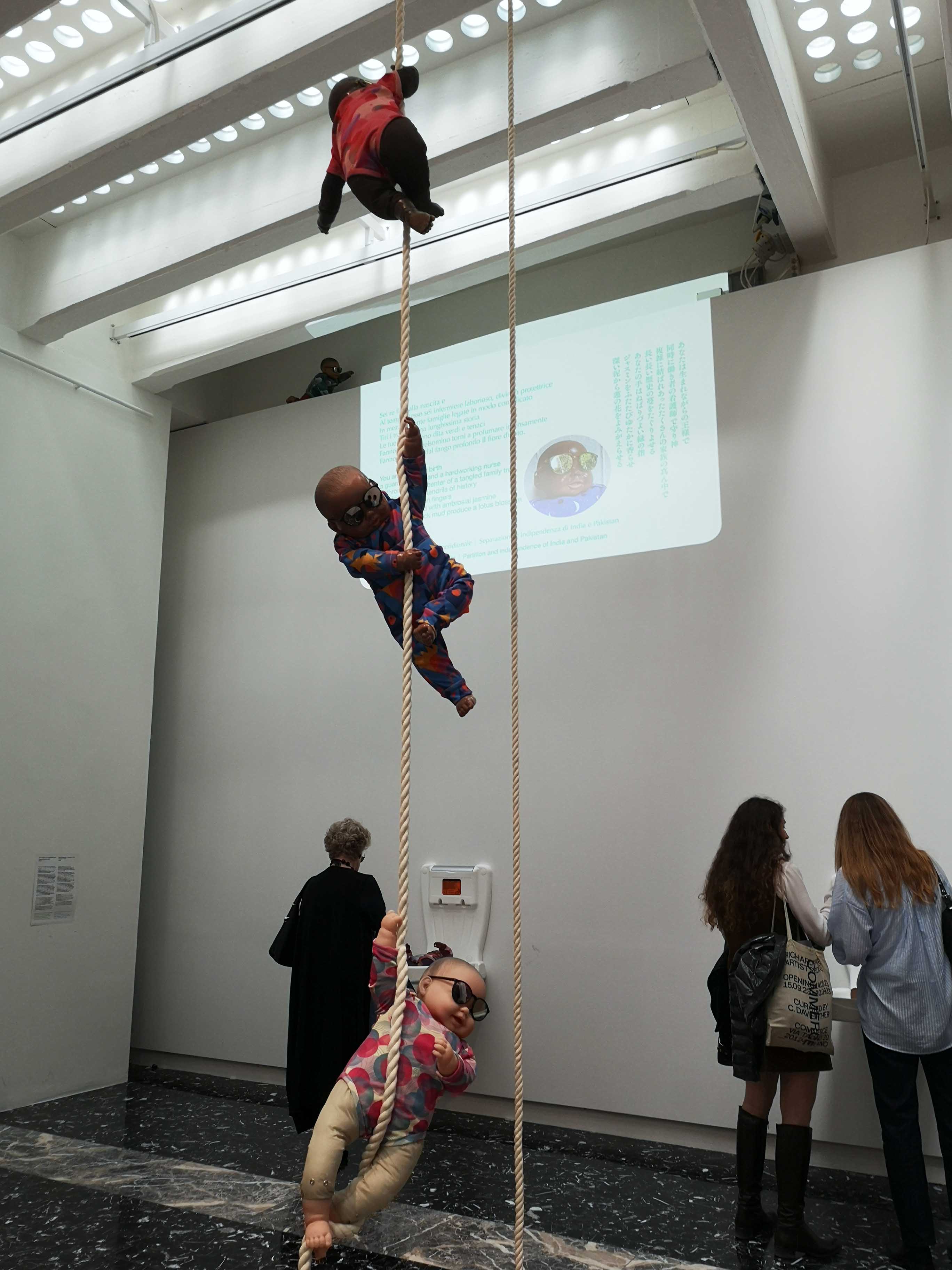
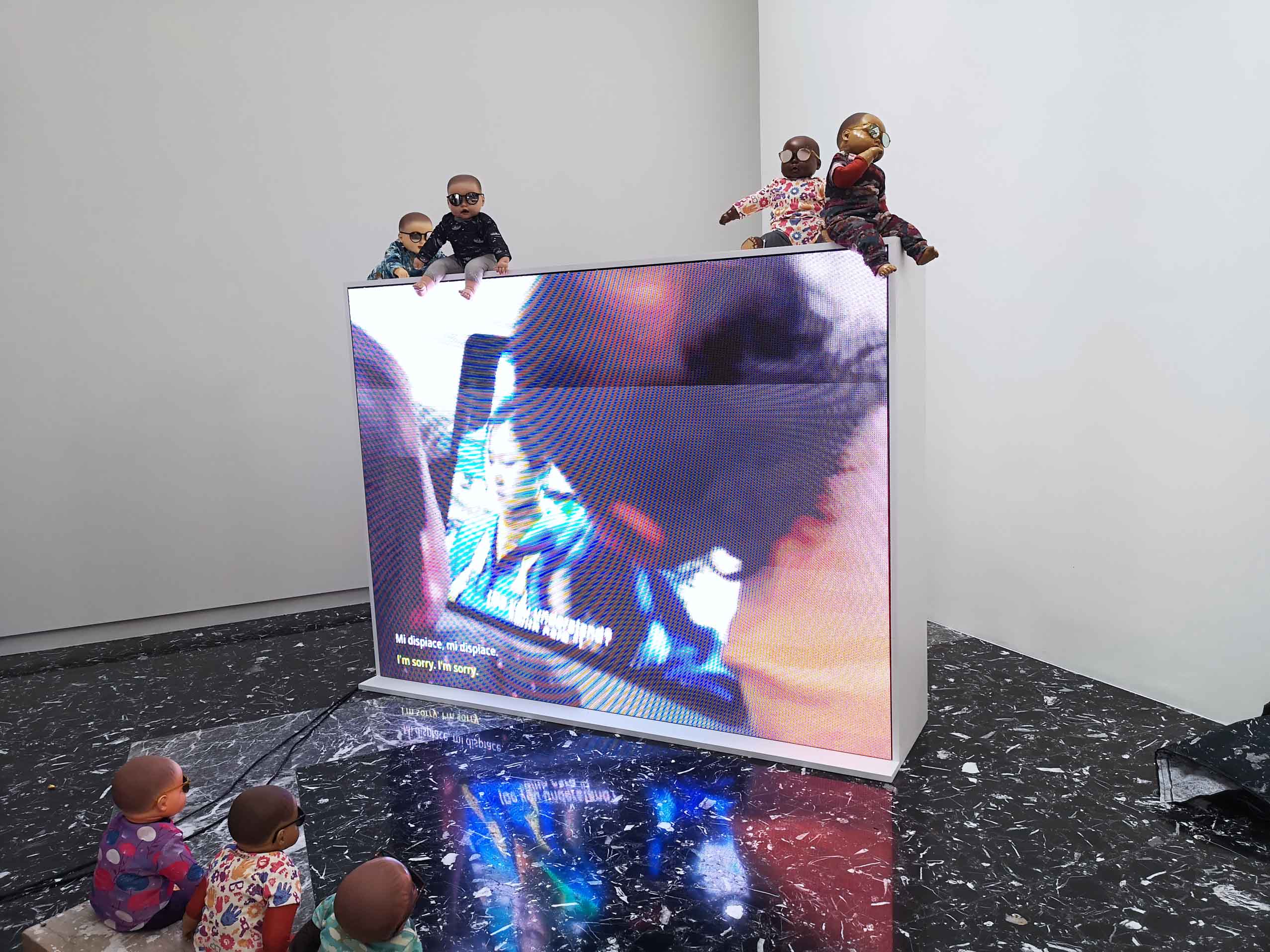
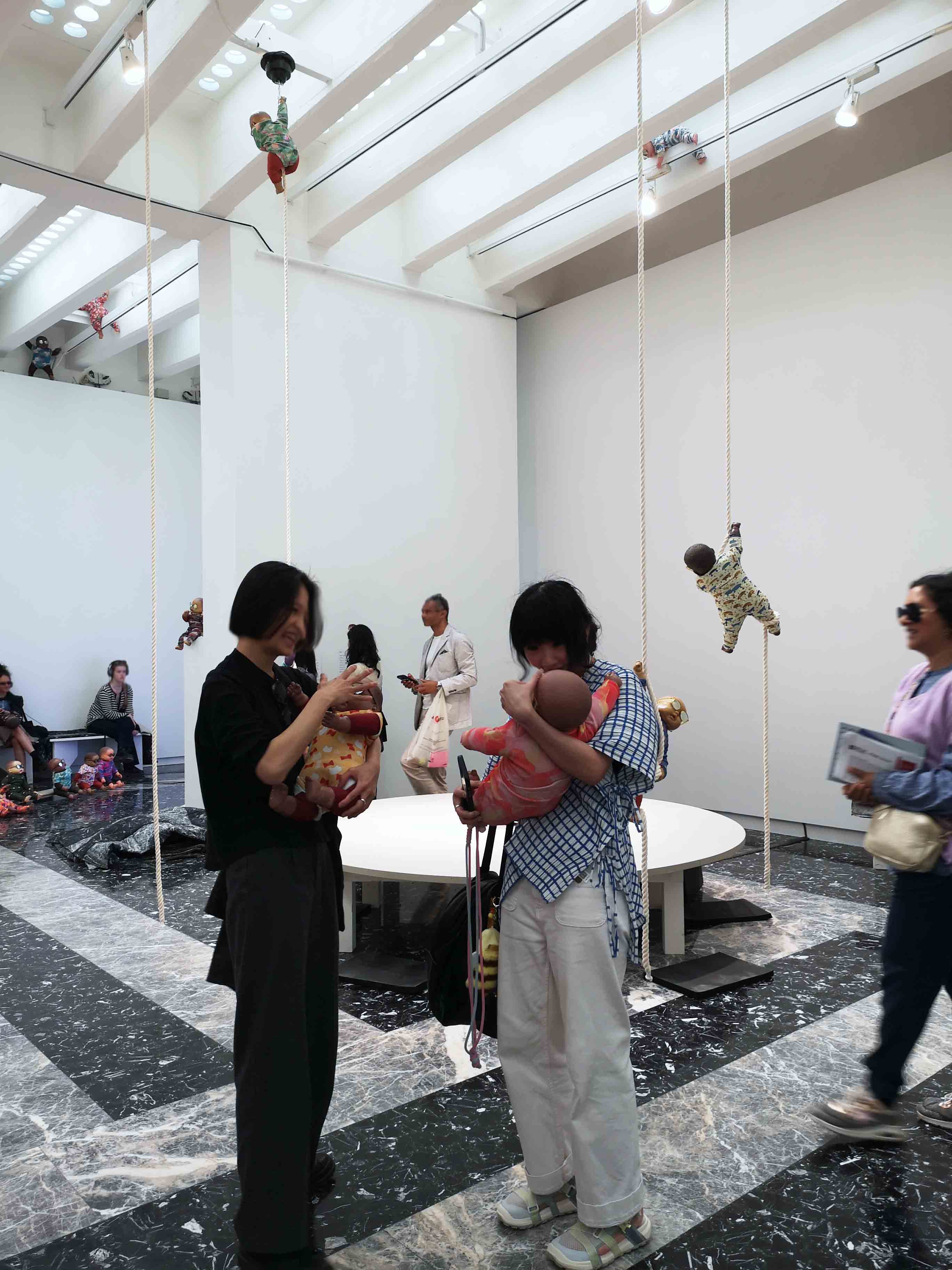
Last but not least, let’s visit the Japanese Pavilion, which is anything but quiet. The hustle and bustle begin already outside – or rather, beneath the building in the Giardini. Here people can “adopt” a baby doll and carry it with them while visiting the “exhibition”. Feeding bottles are hanging above the stairs leading to the main entrance. Infant puppets are romping about on the banister. It’s even wilder inside. Here the “children” with sunglasses watch a video, climb up a rope or occupy a scaffolding.
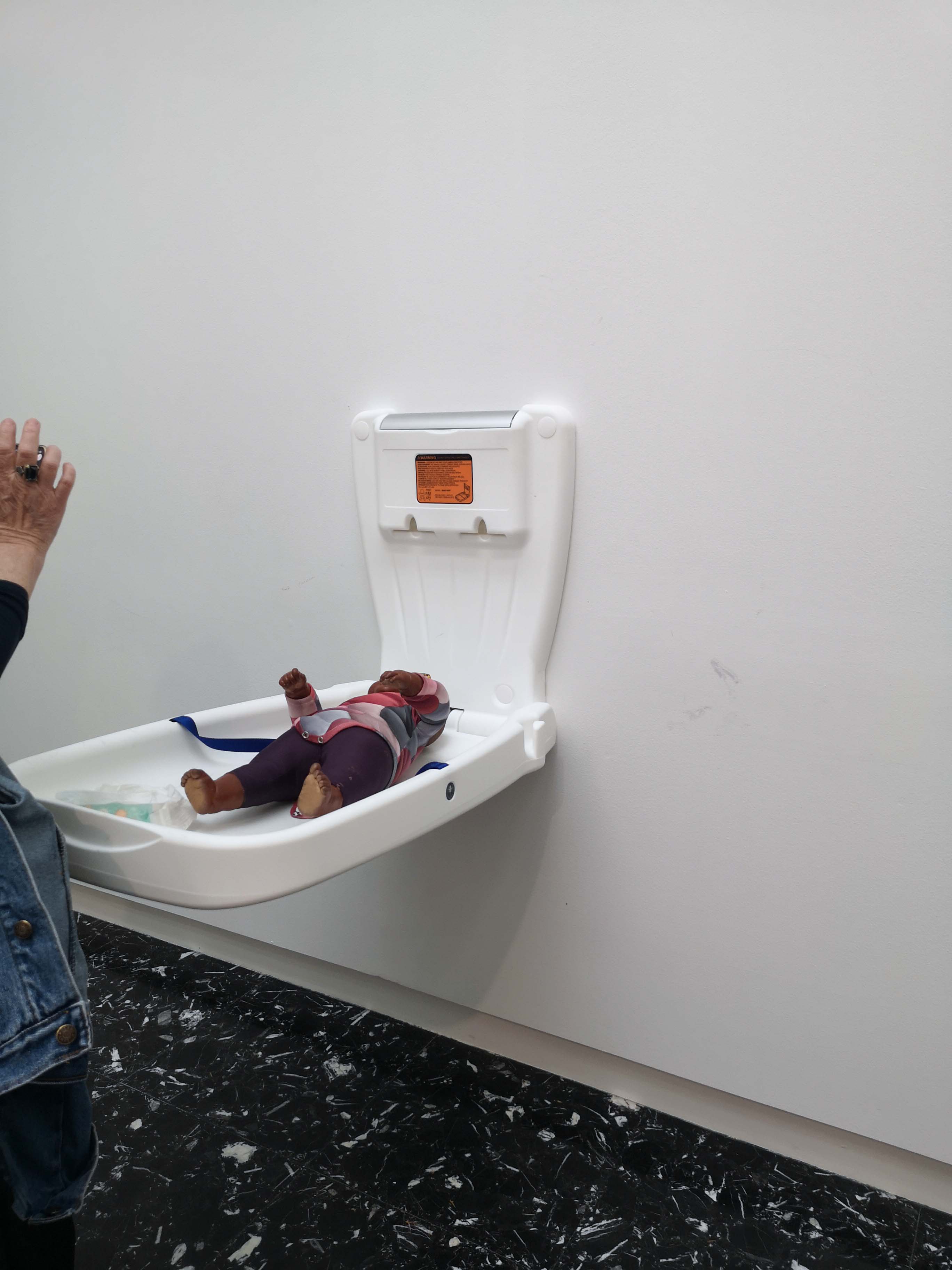
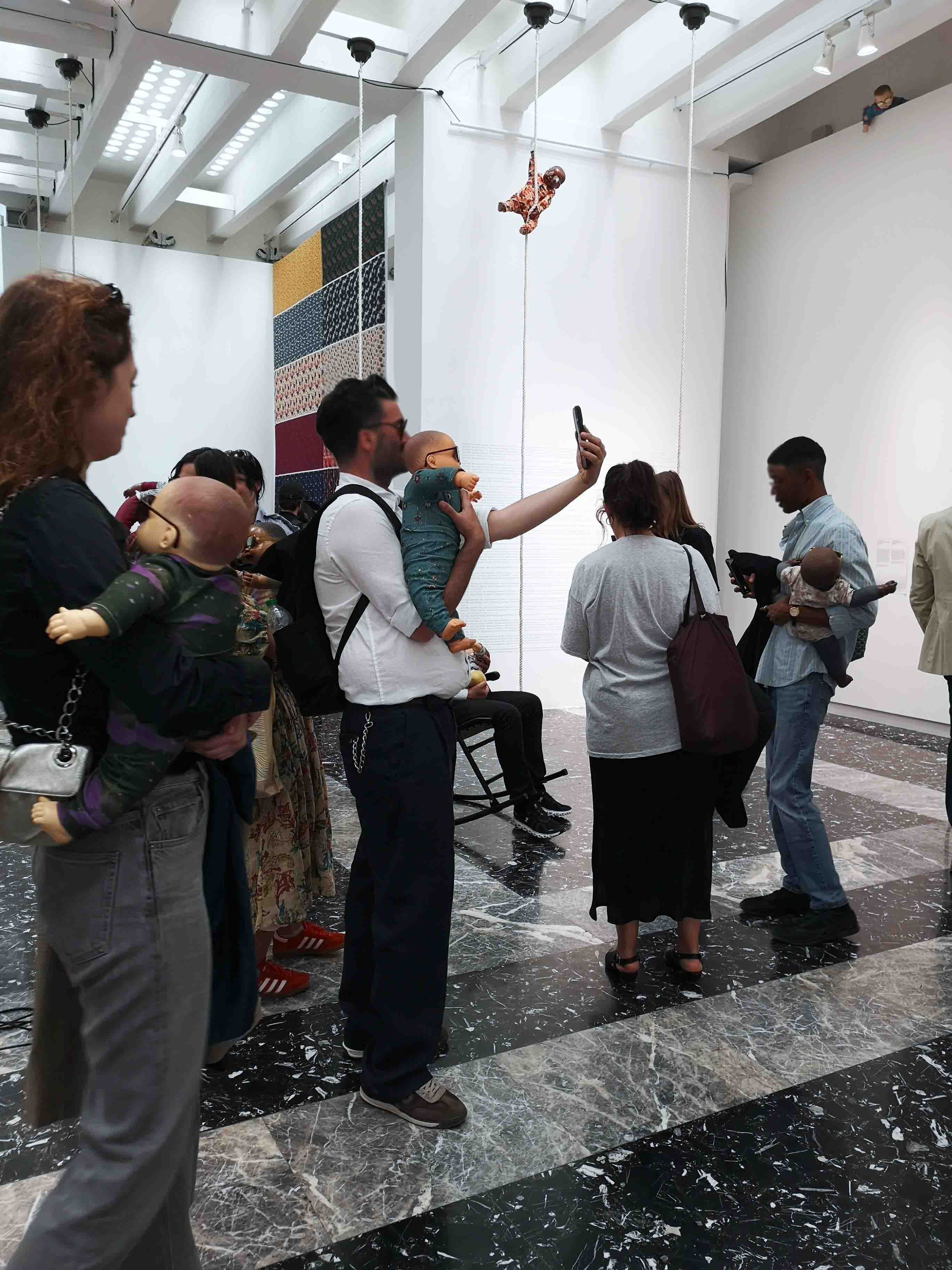
Visitors wander around, many with their temporarily adopted baby dolls in their arms. The puppets are carried around with great affection, rocked to sleep in the chairs provided, fed and changed. Some people can’t resist taking a selfie with the little rascal. Even though “only” dummies, they are treated like living. Back outside, on the way to hand the baby back, you see couples with a dreamy look in their eyes: have they just decided to have a baby? Is “Grass Babies, Moon Babies” by Ei Arakawa-Nash just a bit of fun, with a serious underlying message, or is it simply a spectacle?
Text: Astrid Gallinat
Photos © Astrid Gallinat & Stephan Goseberg
All our articles about this year’s Venice Biennale:
The 61st Venice Biennale (Part 2): Places of Tranquillity and political Observations