
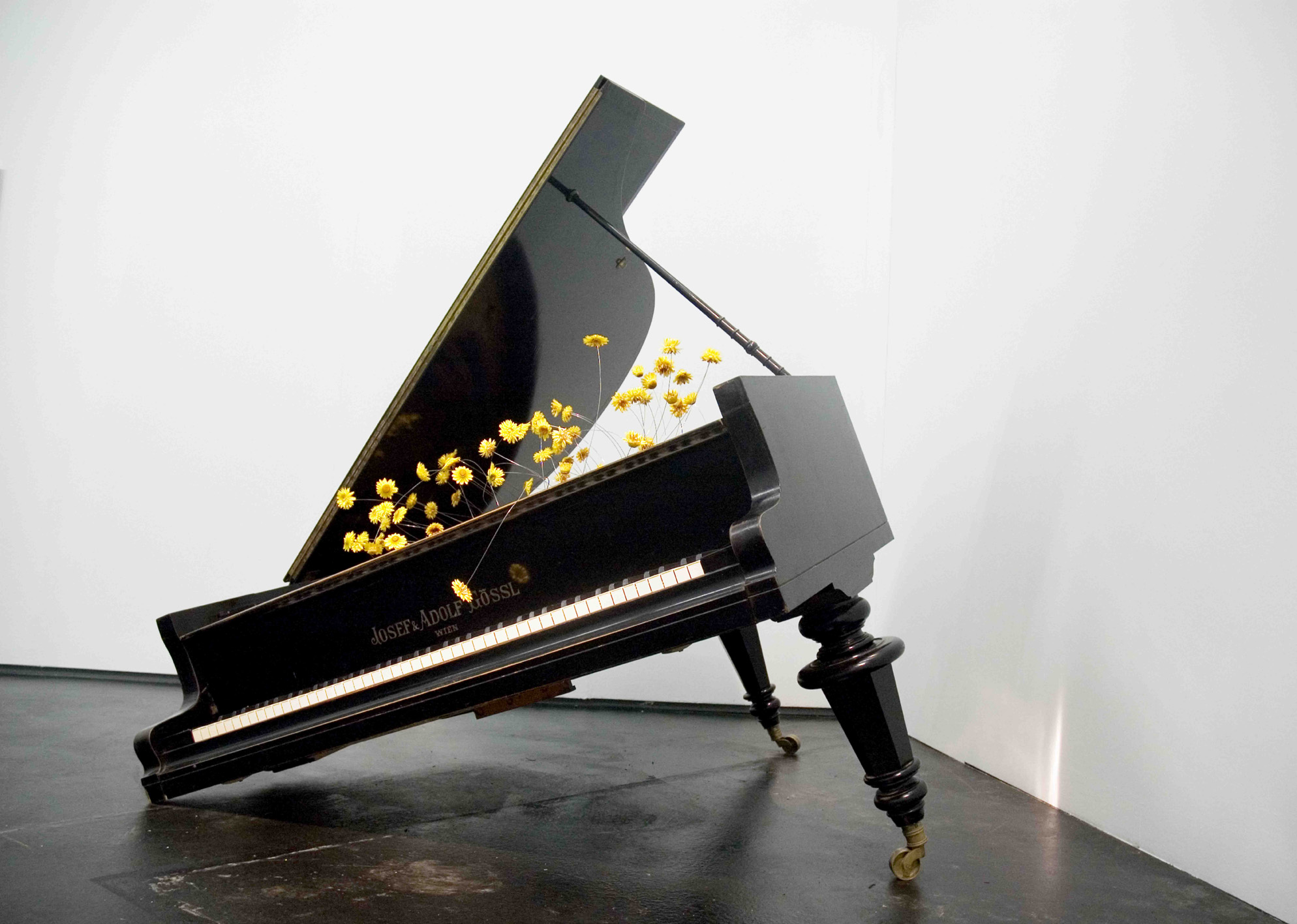
Objeto mágico encontrado n.5
(Magical Found Object n.5)
Glenda León
2005-2012
Grand piano by Josef & Adolf Gössl, Vienna, artificial flowers
175 cm x 173 cm x 175 cm (69 in x 68.5 in x 69 in)
Glenda León’s “Magical Found Object No. 5” consists of an open black grand piano with two legs. Due to the missing left front leg, the instrument stands at an angle. It leans to the left, touching the ground. This inclination of the keyboard and the lack of pedals would make it difficult to play. Despite its poor condition, the roughly hundred-year-old grand has been polished to a shine. Yellow flowers “growing” out of the case highlight this impression. Although the blossoms appear to be pinned onto the cut strings, they give the broken instrument a sense of lightness. Their bright yellow contrasts with the dark black of the piano. They form a sunny spotlight in the dark frame. On their thin stems, they seem to be swaying in the wind, as if in a field of flowers. Hence, the declined instrument has a new life. This recalls a phoenix which has risen from the ashes.
“Magical Found Object No. 5” is part of Glenda’s series featuring ‘”objets trouvés“. In these works, she transformed everyday objects such as a pair of glasses, paintbrushes and a typewriter. By adding dried blossoms – or, as in our case, paper flowers – the objects were rendered unusable for their original purposes. For exhibitions, she added a little story to each object, to describe the new function. The glasses allow the wearers to see the world in a new light, thereby bringing them happiness; the brushes dispel negative feelings such as hatred and the typewriter converts alphabetic characters into flowers, to write love letters. These new purposes, bestow a poetic magic upon the objects that can transform everyday life.
However, our object no. 5 lacks a story. Additionally, the grand piano had probably been almost unusable before Glenda’s intervention, in contrast to the other objects, which she transformed. Therefore, the artistic engagement has given a new poetic and optimistic life to it, with the flowers standing for renewal or rebirth. Instead of dried flowers, Glenda used paper flowers here. This paper had previously existed in another form – for example, as a plant from which the cellulose was extracted. That plant had once been a seed that lay dormant in the dark earth until it came to life again. In this sense, “Magical Found Object No. 5” can be seen as encouragement, offering hope even in the darkest night and in the depths of despair.
Moreover, the choice of a musical instrument refers to music. Much like observing nature or art, music can be a balm for the soul. This is even more true, because music plays an important role in Glenda’s oeuvre. Even though the grand piano does not produce any sound here, it can symbolise the magical effects of music. With this in mind, one might recall the artist’s solo exhibition “Listening to Silence” at the Magnan Metz Gallery in New York in early 2012. The show was grouped around “Magical Found Object No. 5” as central piece. It was a new version of the work with a grand piano by Wm. Knabe & Co. Perhaps it is interesting, that the company’s founder, Wilhelm Knabe, initially repaired and sold used pianos in Baltimore before going into production with a partner.* So he, too, breathed new life into the instruments, albeit in a more mechanical way. Glenda, on the other hand, uses her artistic language to strike a chord with the viewer.
At first, “Magical Found Object No. 5” was part of the exhibition “Reflexiones Intimas” at the KATT, Kunsthalle Attersee in Attersee, Austria in 2005. In 2010 it travelled for Glenda’s solo show “Un Ruido Azul” (A Blue Noise) at the Galería Habana to Havana, Cuba. One year later, it was in “Obras de tres Continentes y más…” (Works from three continents and beyond…) at the Centro de Arte Contemporáneo Wifredo Lam also in Havana on view. Lastly the flowering grand piano participated in the group exhibition “Hot Spot. Caring for a burning world” at the Galleria Nazionale d’Arte Moderna in Rome, Italy from October 2022 to February 2023. The version, which was first on view at the Magnan Metz Gallery in New York with the grand by Wm. Knabe & Co entered the collection of the Perez Art Museum in Miami. Moreover, the artwork has an additional life as large-sized (70 cm x 120 cm) lambda print photograph from 2005.
* https://en.wikipedia.org/wiki/Wm._Knabe_%26_Co., visited 20 September 2026
Glenda León
Born in 1976 in Havana, Cuba, Glenda León had at the early age of 12 a first artistic education at the School of Visual Arts “20 de octubre” in Havana. This followed by a nine-year training in classical ballet in the Centro Prodanza. In the last years of it, she graduated also in art history at the University of Havana. In 2007, she completed her Master degree in Art at the Academy of Media Arts in Cologne, Germany. A research scholarship from the MAEC took her to Madrid. Since then, she was numerous times artist in residence in Canada, France, Spain, Panama, Philippines and the United States and was honoured by Cuban and international awards, including the Premio LARA 2017 by the Asiaciti Trust Foundation, the Pollock Krasner Foundation Grant and the UNESCO prize for the Arts at the VII Biennale of Havana.
The oeuvre of Glenda is very wide-ranging. She creates objects, sculptures, installations, drawings, photos, videos and performances. In her multidisciplinary practice, Glenda explores apparent contradictions like the visible and the invisible, sound and silence and ephemeral and eternal.* Hereby, she often focuses on personal states of mind and conditions of societies. Besides in exhibitions, her works might reappear in interventions in public space. Additionally, she published several artist books for example a series called “Fragmented Reading”, where a triangle part of the book is cut out and presented as piece of cake on a white plate.
Several times, Glenda has taken up the subject of money and its conventions. The video “Inversion II” from 2011, our Artwork of the Month / June 2019, bears witness to this interest, as does the later version from 2016 (Inversion III). “Inversion II” was inter alia screened 2017 in the group exhibition “Art x Cuba: Contemporary Perspectives since 1989”, Ludwig Forum für Internationale Kunst in Aachen, Germany and in 2019 in Glenda’s solo show “Listening to stars” in Turin, Italy at Recontemporary. Also in 2016, reappeared 50 One-US-Dollar-notes in her pocket version of the Holy Bible, where they were added to the binding.
Recurrently are also ancient typewriters, which represent the importance of the written word. In 2018, she created the series “Intervened typewriters”. Depending on her additions to the machines, the objects are aiming at language and its passionate use (Incendiary discourse), at the fragility of elements added to the body for aesthetic purposes (Noli me tangere – or the impossible writing) or at the selfish hunger for taking and not giving (The insatiable writer).
Another very important subject is music. Besides other instruments like guitars, harps and drums, the piano and particularly the grand piano appears repeatedly. Since 2005, “Magical found object n. 5”, a “flowering” grand made its appearance in various exhibitions. Hereby, the main composition is always the same, but sometimes the instrument, which represents the magical power of music, itself changed. Presented first in a group show at the Kunsthalle Attersee in Attersee, Austria, the model came from Vienna. Seven years later, in Glenda’s solo exhibition “Listening to Silence” at the Magnan Metz Gallery in New York it was American. Here, “Magical found object n. 5”, our Artwork of the Month / October 2026, was the central piece. It was surrounded by empty sheets of music superimposed by photos and sculptures made of CD’s and vinyl records.
For her contribution to the Cuban Pavilion at the 55th Venice Biennale (2013), Glenda created “Music of the spheres” where images of the solar system served as score for a sound installation. So, the planets turned into musical notes. Moreover, she arranged and processed music instruments, like the beloved piano, a guitar or harps for her series “Concrete Music” and “Metamorphosis”. “Visual Instruments” from 2020, are sound sculptures, because they are built from components of musical instruments. Occasionally performed by musicians, they enable the public “Listening to the Sun/the Rain/the Stars and the Moon”. One of them, “Listening to the Moon” is our Artwork of the Month / November 2022. It was first presented in a solo show in November 2022 at the Juana de Aizpuru Gallery in Madrid, Spain.
Since 1999, Glenda’s creations were presented numerous solo exhibitions and countless group shows in Latin and North America and Europe, but also in Senegal (Dakar Biennale), China and Japan (Aichi Triennale 2022). Her most recent solo exhibition “Un árbol cae en el bosque” (A tree falls in the forest) ended in September 2026 at the Azkuna Zentroa in Bilbao, Spain. In October 2026 she participates to “HOMELAND 2026” at the Damer House Gallery in Roscrea, Ireland. Until November 2026 the artist’s works will be on display in Zaragoza, Spain at the museum IAACC Pablo Serrano, in Santiago de Chile at the Triennale ART CUT and in Bogotá, Colombia at the Galería La Cometa. From October 12th until December 15th 2026, Glenda contributes to the Open Sky Museum “AMERICA 250: A Hispanic Vision” in Miami-Dade, USA. Next year, 2027 the artist works will travel to Arévalo, Spain to participate to “Un mundo inagotable” (An inexhaustible world) from March to September.
Glenda’s works are part of many public and private collections in Cuba and abroad, for example Montreal Museum of Fine Arts, Centre George Pompidou, Paris, and The Hammer Museum, Los Angeles.
Glenda lives and works in Havana and Madrid.
* https://www.glenda-leon.com, visited 25 September 2026