
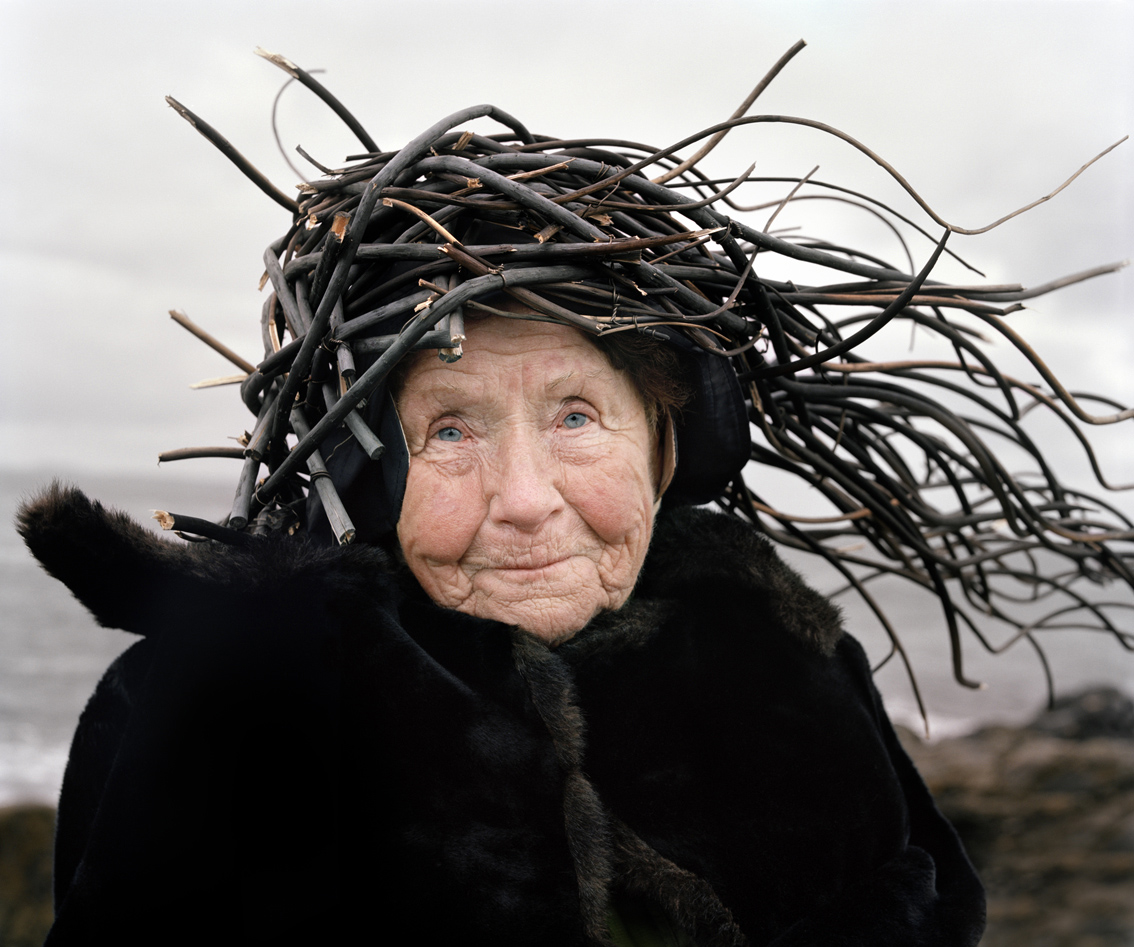
 Eyes as Big as Plates #Agnes II (Norway)
Riitta Ikonen & Karoline Hjorth
2011
Digital C- type print
120 cm x 100 cm edition of 7 + 2AP
60 cm x 50 cm edition of 10 + 2AP
The photograph “Eyes as Big as Plates #Agnes II (Norway)” by Riitta Ikonen and Karoline Hjorth is part of the artists’ ongoing collaborative project “Eyes as Big as Plates”. The presented picture features Agnes, a woman who was already over 90 years old at the time the picture was taken. She is sitting in front of the cliffs of Ølberg at the south-west coast of Norway, in the region Jæren. Her open gaze is directed straight into the camera, or rather at the viewer. Dressed in a dark fur jacket, she has an unconventional structure on her head. Woven from willow branches, the headwear conceals Agnes’ hair, which is consequently invisible. However, the headdress is not woven in a completely rounded shape. On the right-hand side of the picture, the twigs appear to be breaking out of the form and blowing wildly in the wind. Thus, the willow crown stands in contrast to the protagonist’s expression and posture: As far as can be seen, she is holding her right arm parallel to her body; her left arm is slightly bent, so that her hand disappears into her jacket. This gesture could be interpreted as pointing towards herself, albeit very discreetly.(1) Her pose seems to reflect inner calmness. In contrast, the willow headwear appears animated by the movements of the surroundings.
Due to the location of the cliffs of Ølberg, situated right on the open North Sea, there is a constant fresh to strong breeze. Probably for this, the artists and their collaborator have chosen this very spot for this photograph: Agnes represents the north wind. Originally, the Finnish-Norwegian artist duo thought the project as a play on characters from Nordic folklore. As one of the first portraits of the series, the idea of Agnes as the fabled north wind was inspired by hers, at the time relatively recent, activities. Motivated by Agnes’s grandchildren, she made her first parachute jump at the age of 85. This was repeated for her 90th birthday. After some initial concerns, Agnes really enjoyed the floating in the air. Moreover, the windy Jæren coastal region is her living environment. Therefore, the chosen role seems to be obvious. Beside these biographical matches, the willow twig cap refers to the landscape. Although willows do not grow directly on the cliffs, they can be found a little further inland.
Without this background, “Eyes as Big as Plates #Agnes II (Norway)” could recall Caravaggio’s “Medusa” from 1597, even though Agnes’s expression is much friendlier. Like the snakes encircling the head of the figure from Greek mythology in Caravaggio’s painting, the willow crown is placed upon the protagonist’s head. In particular, the branches extending out to the right reinforce this impression. Is Agnes perhaps the domesticated form of the north wind, which is in the reality of the Scandinavian peoples freezing cold with dangerous snowstorms, a destructive force like the petrifying gaze of the Medusa?
However, whether intended or not, there are other elements in the story of Medusa, which are also featured in Agnes’ portrait and her role as north wind. The mythological figure and her two sisters were the daughters of the sea deities Phorcys and Ceto. According to Ovid(2), the at that time beautiful maiden Medusa was raped by Poseidon/Neptun, in the temple of Athene/Minerva. In Roman mythology, Neptun is also a sea god like Poseidon is in the Greek. Even though in the background of Agnes’ photo, the sea is a component of the image and important for the wind.
There may be also references to Agnes’s parachute jumps in the second part of Medusa’s story. As a result of Athena’s anger, Medusa becomes a Gorgon, a monster with snake hair and wings. Therefore, Perseus who was tasked with beheading her was given sandals with gold wings. After Perseus had achieved his goal, Pegasus, a winged horse, emerged from the body of the beheaded Gorgon. It was the child of Poseidon and Medusa. So, a horse that can fly across the sea on the wind, like Agnes floating in the air during her parachute jumps.
Furthermore, Caravaggio’s Medusa has wide-open, terrified eyes: Eyes as big as plates.
(1) See Albrecht Dürer’s ‘Self-Portrait at 28’ from 1500 (now in the Alte Pinakothek, Munich). The painter’s hand is positioned centrally in the lower part of the picture and is also highlighted. Herewith he refers to himself, so that the painting is often interpreted as an “Imitatio Christi” and thus points to the artist as God’s co-creator (Divino artista). Furthermore, the marten-fur collar should be noted as a sign of wealth and high social standing. In contrast, Agnes’s gesture is very restrained.
(2) Roman poet (20 March 43 BC – AD 17/18)
The project “Eyes as Big as Plates”
In the Nordic folklore there are characters with particular large eyes, like trolls or magical dogs. Depending on the story, there might be other creatures widening their eyes, whether out of fear or amazement, like the Medusa. Inspired by this expression, the two artists named their project “Eyes as Big as Plates”. Beyond this context these wide-open eyes stand for openness and curiosity to perceive the world without preconceptions.
Due to a common interest in elderly women in Norway, the Finnish-Norwegian artist duo developed in 2011 a project departing from Norwegian folk tales and their contemporary significance to people. Assuming that aged would feel a stronger connection to these lores, they addressed members of this demographic and worked with them to create photographic scenes with the chosen person. Ever since those early days, the living environment, personal biography and connection to nature of the collaborators entered the composition. Therefore, the preliminary conversations, in which the later portrayed take the leading role, are essential and form an integral part.
Accordingly, Riitta and Karoline involve their collaborators in a communication, where the artists role is mainly to listen. Together, they find the location and the material for the wearable sculpture made from natural materials such as twigs, leaves, flowers, grasses, tree bark, moss, algae, forest fruits and much more. The resulting photograph is the conclusion to each encounter.
Although there are frequent close-ups with a portrait-like quality, the collaborators are not models. This is particularly evident in the shots that recall landscape photography, in which the people are barely visible. They merge with the surrounding natural environment. The focus is therefore more on the blurring of boundaries between humans and nature or age boundaries, or gender boundaries or even national boundaries, since the project is no longer confined to Norway. Over time, the collaborators age became less on focus. Instead, a personal link to the climate crisis became increasingly important.
Moreover, time comes into play. Firstly, the time spending on the conversation, finding a suitable location and materials, and creating the wearable sculpture. Also, the time of taking the actual photo enters, due to the use of a Mamiya 67 camera, which is a heavy and unhandy studio camera. On top of that, there is the time needed for the development of the analogue pictures. Because of the passage of time, the artists are frequently surprised by the results.
Since the first cycle of “Eyes as Big as Plates”, the works appeared in photo books. The first one was published in 2017 and was shortlisted for the Paris Photo / Aperture Foundation award that same year and won Grafill’s prize for the best cover in Norway’s Årets Vakreste Bøker. Containing not only the photos, it also includes field notes, essays and behind-the-scenes stories from the first six years of this project’s production. This now sold-out edition was followed by a second volume in 2022 and features four years in South Korea, Tasmania, Outer Hebrides, Senegal, Iceland, Greenland and Norway. A third book is scheduled for 2027 and fundraising for it will start soon on the project’s website. Beside these publications, the photos were shown in many exhibitions world-wide. In spring 2027, they will be on view in the Anthropogenic Soils exhibition in Ås, Norway and in Bornholm, Denmark. Moreover, they will take part in the Nakanojo Biennale in Japan in autumn 2027.
Karoline Hjorth
Born in 1980 in Oslo, Norway, Karoline Hjorth first tried out social sciences like geography, philosophy, and anthropology. After her first approaches to photography in Middlesbrough, England, she made her BA in photographic arts and concluded her studies with a MA International Journalism at the University of Westminster (London) in 2009. As starting point for her MA project, she took her grandmother to find out more about her “mormor” (Norwegian for grandma’) than she experienced as granddaughter. In the resulting book “Mormormonologene” (2011), Karoline documents in texts and photography the life of 24 Norwegian women over 80 years. Besides this social and anthropologic orientation, which is characteristic of her subsequent work, it guided to the long-lasting collaboration between Karoline and Riitta Ikonen in the project “Eyes as Big as Plates”. Up to now, the Finnish-Norwegian artist duo released two photo books on this venture, a third one is scheduled for 2027. Our Artwork of the Month / November 2026 “Eyes as Big as Plates #Agnes II (Norway)” is from the first cycle.
From 2014 to 2018 Karoline and Riitta interviewed and photographed people from the Barents region / East Finnmark (around Kirkenes, Norway, near the borders of Russia and Finland). Commissioned by the New Kirkenes Hospital, which was under construction at that time, the project was supported by the Norwegian art and cultures agency Kulturbyrået Mesén. For the inauguration of the hospital in October 2018, the Finnish-Norwegian artist duo created a permanent installation of written and photographic portraits of local residents. Additionally, they published a documentary book under the title “Time is a ship that never casts anchor”.
In 2019, Karoline realised her project “Algoritmeanekdotene”, where she explores the widespread use of dating platforms in Norway. Conversations with a wide variety of users inspired monologues reflecting on their experiences and descriptive portraits. Moreover, the artist photographed them in their homely environment starting with their waking up and their everyday lives. Once again, the outcomes of this work were subsequently published as a book.
Karoline’s personal oeuvre and the works from the collaboration with Riitta have participated in numerous solo and group exhibitions in Scandinavia, United Kingdom, United States and travelled also to Australia and South-Corea. In 2027, parts of the series “Eyes as Big as Plates” will be presented in the Anthropogenic Soils exhibition in Ås, Norway, in Bornholm, Denmark and at the Nakanojo Biennale in Japan.
Besides her artistic activities, Karoline was the artistic director of Fotografihuset, Oslo (now FRAKT) from 2022-2026. Currently, she is one of three artists conducting the outdoor gallery at Sukkerbiten.
Karoline lives in the Oslo region and works worldwide.
Riitta Ikonen
Born in 1981 in Kouvola, Finland, Riitta Ikonen first studied illustration and made her BA at the University of Brighton. Subsequently she attended Communication Art and Design and graduated from the Royal College of Art in London in 2008.
Already during her studies in Brighton, she started her first Mail Art project in 2003. Margaret Huber, her tutor at that time, asked her students to send her a postcard once a week to document their experiences. Even after the end of the exercise, Riitta continued to create “postcards” of various natural and artificial materials. Until today, the artist sends these small format artworks at irregular intervals. Before they are posted, they are on display at the Mail Art Gallery, which is founded by her and situated in post-box 930552 at the P.O. Box Rockaway Beach in New York during the opening hours and on Instagram (@pobox930552).
Besides her mail art, which she also imparts in workshops, Riitta has a wide spectrum of creative activities like creating wearable sculptures, performances and community-based art projects. Hereby, she often collaborates with other artists and institutions. With her wearable sculptures, the artist participated several times at the Telluride Mushroom Festival Costume Parade. Five times she was winner of the “Best Mushroom Costume Award”. Her performances are often based on experiences with nature, like “Earthworm” (2008, with Anja Schaffner) and Reishi (2023 with Annie Collinge).
Together with Karoline Hjorth, Riitta merges all her various artistic practices since 2011. For their long-term project “Eyes as Big as Plates” the Finnish-Norwegian artist duo cooperates with local residents to find their individual setting in natural environments at places around the world. Starting with communication, finding materials for wearable sculptures, their realisation and the final photograph, the collaborator is the centre of the process. Up to now, the Finnish-Norwegian artist duo released two photo books on this venture, a third one is scheduled for 2027. Our Artwork of the Month / November 2026 “Eyes as Big as Plates #Agnes II (Norway)” is from the first cycle.
In 2020, Riitta founded the “Seachanges Rockaways” , a winterly swimming meeting every Sunday at 2 p.m. In this context she also organises the “Synchronised Sea Swimming”, where people all around the world practice summer swimming at the same time. Once again, there are workshops to foster this activity.
Four years later, in 2024, the artist founded the Museotie Galleria or Museum Road Gallery in North Karelia, Finland, together with Cecilia Dean and David Selig and in collaboration with the Kelvä Village Association. It is a small hut, which was formerly a milk collection point. The freely accessible art gallery with temporary exhibitions is also an event venue and reference point to the local population and other passers-by, for example it hosts mailboxes of residents.
Besides these and many other artistic activities, Riitta lectures at schools and universities to share experiences. Hereby, she highlights ways of interdisciplinary collaboration and the potential of activism.
Riitta’s personal oeuvre and the works from collaborations with other artists were features in many solo and group exhibitions in Europe, North and Latin America, Japan, Australia and South-Corea. In 2027, parts of the series “Eyes as Big as Plates” will be presented in the Anthropogenic Soils exhibition in Ås, Norway, in Bornholm, Denmark and at the Nakanojo Biennale in Japan.
Riitta lives in the New York region and works worldwide.