
 Les Insolites
Monique Thibaudin
2023
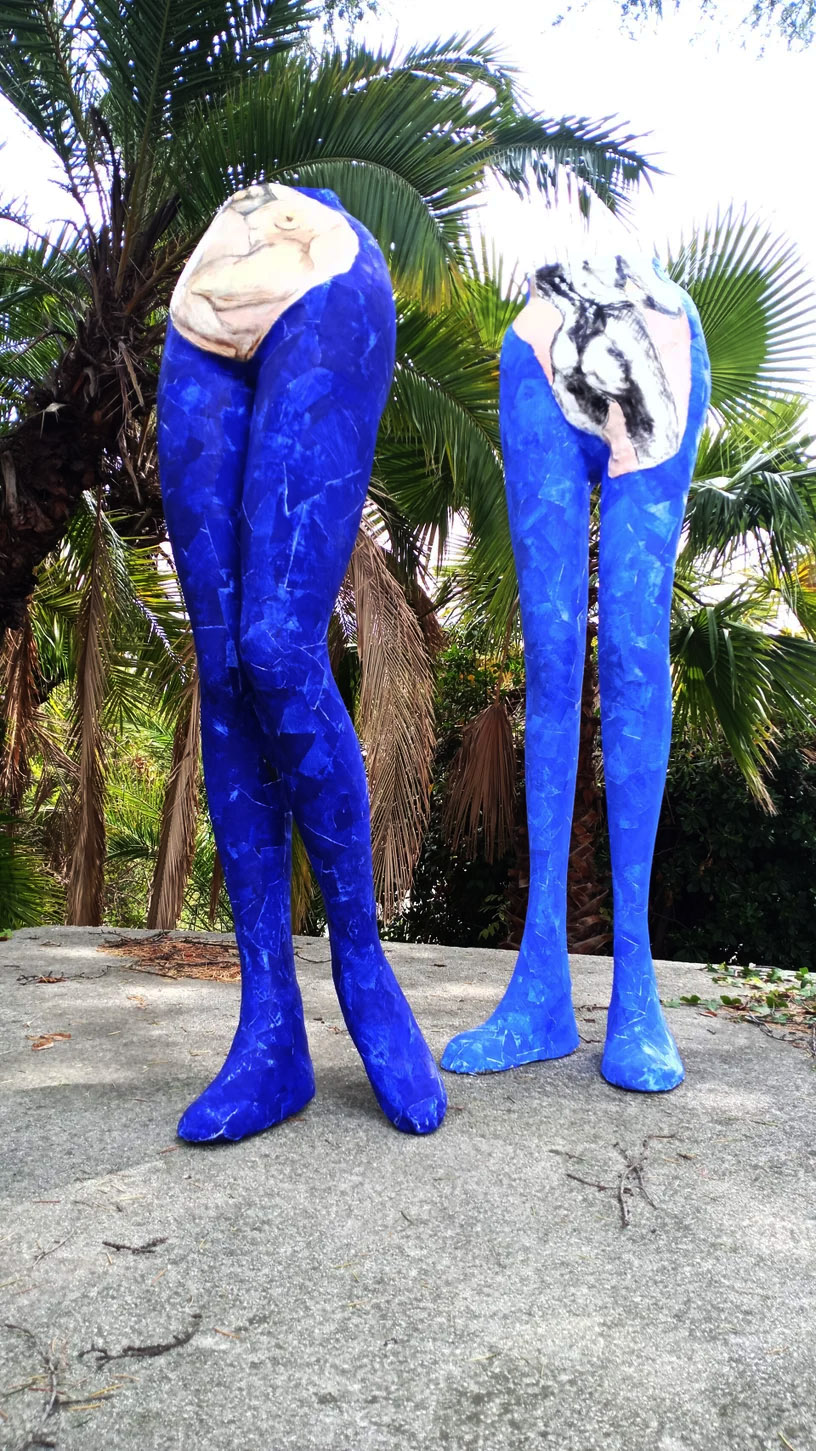
Installation under the palm trees on the Promenade des Anglais, Nice, France
Composite, ceramic, canvas coated with oil paint, pigmented paper
Approx. 170 cm x 40 cm x 30 cm
Monique Thibaudin’s installation “Les Insolites” (The Exceptionals) are two monumental sculptures of a female lower body. These anti-busts are the artist’s key motive. They were positioned ephemerally at the Promenade des Anglais in Nice in August 2023. Here, at the seaside boulevard of the French metropole at the Côte d’Azur, the artist placed her two statues in front of a vegetal environment. In front of the green palm branches, their artificial blue colour contrasts with the natural shades. Concurrently, the blue colour might be a reference to the nearby sea and with that a hint to the oeuvre of the adopted Niçois Henri Matisse, who also often alluded to it with this colour. Similarly, the vibrant blue of the sculptures recalls the Yves Klein Blue, developed by the Nice-native artist. This is all the more likely given that Monique has chosen precisely these two anti-busts for the Nice promenade. On the other hand, their huge size, may have been decisive. Due to the outdoor set-up, the oversized lower bodies could reveal their full scale. Placed in public space, the installation allowed both intentional visitors and chance passers-by to experience the sculptures’ dimensions at close distance.
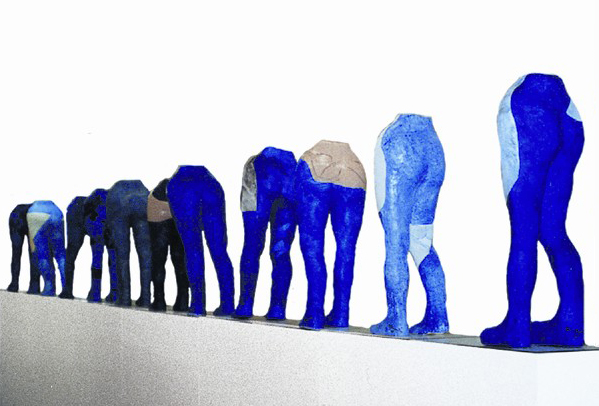
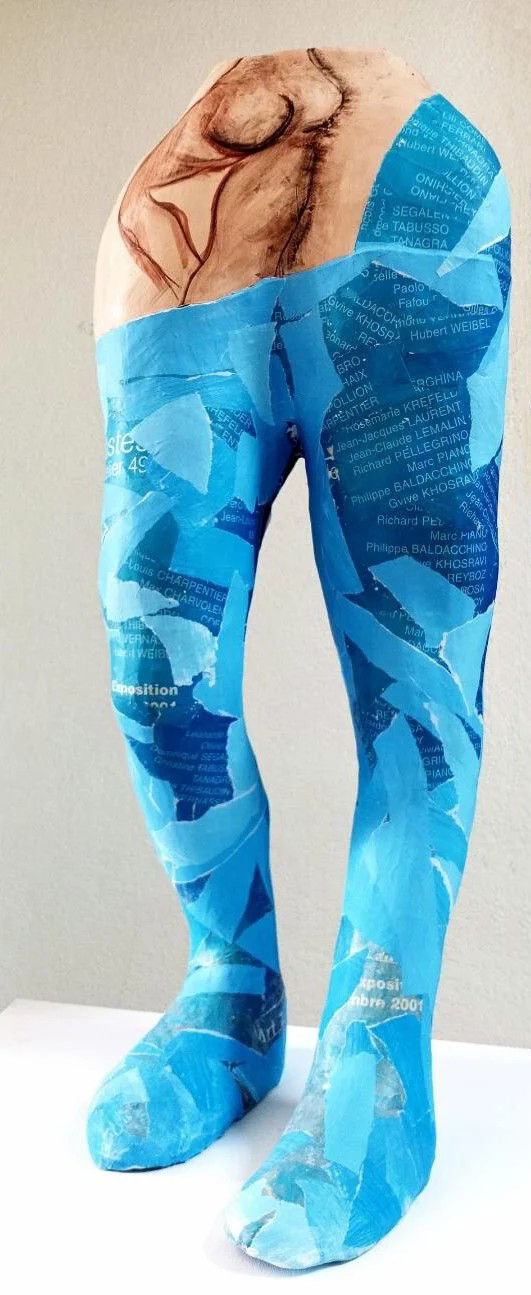 The two anti-busts of the arrangement are part of Monique’s series “Les Insolites”. Of this set, the two on display are the tallest at 1.70 m, distinguished from others which are only 1.40 m high. Moreover, there are similar sculptures measuring 70 cm and 25 cm in height with the title “OR Bleu” (Blue Gold). All these statues have the dominant blue colour in common, even though they are in different shades. In this context, particularly the few turquoise anti-busts are worth mentioning. Colour-wise, these would also have well fitted on the Promenade des Anglais, as they would have reflected the characteristic colour of the sea in the Bay of Nice. This suggests again that the pieces selected for the installation allude to Henri Matisse and Yves Klein. Is it perhaps an homage to the two artists?
Besides the for the artist’s work typical form of the anti-bust and in this series the range of blues, most of these sculptures have a kind of patchwork under the diaphanous colour. In the case of the smaller statues, this is made up of printed paper, mostly newspapers. In contrast, the two large anti-busts feature a sort of mosaic of overlapping blue pigmented paper. Here, the cut or torn edges are made visible by different shades of blue or even lighter-coloured borders.
Other common features are the nude drawings in the hip area. They recall historical nude drawings in charcoal or red chalk and are inspired by these. Herewith, Monique hints to the classical education and practice of painters since the Renaissance and also her own. For centuries, charcoal and the finer red chalk pencil were used by artists for preliminary drawings for paintings. Only later they became autonomous artworks. However, in this present series, the nudes are not independent, but an important element of the sculpture. Selected so that their shape fits to the anti-busts, they are showing parts and postures of the human body, which isn’t primary represented by the statues. In our case, each drawing show half a torso and parts of the legs. By the technique with blurred lines and hatchings, they contrast with the sculpture’s distinct silhouette. It is almost as if one is looking into the statues and beyond them.
 Furthermore, the two installation busts are connected through the drawings. The left figure holds her left leg slightly bent, like the free leg in a contrapposto pose. A similar pose is adopted by the nude on the left sculpture but is shown from the back and is mirrored. In contrast, the anti-bust on the right stands with both feet firmly on the ground. Although the counterpart in the drawing of the other statue appears somewhat more dynamic due to its bent posture, it must be sitting or lying on a solid surface. This is emphasised by the curve of the blue edge.
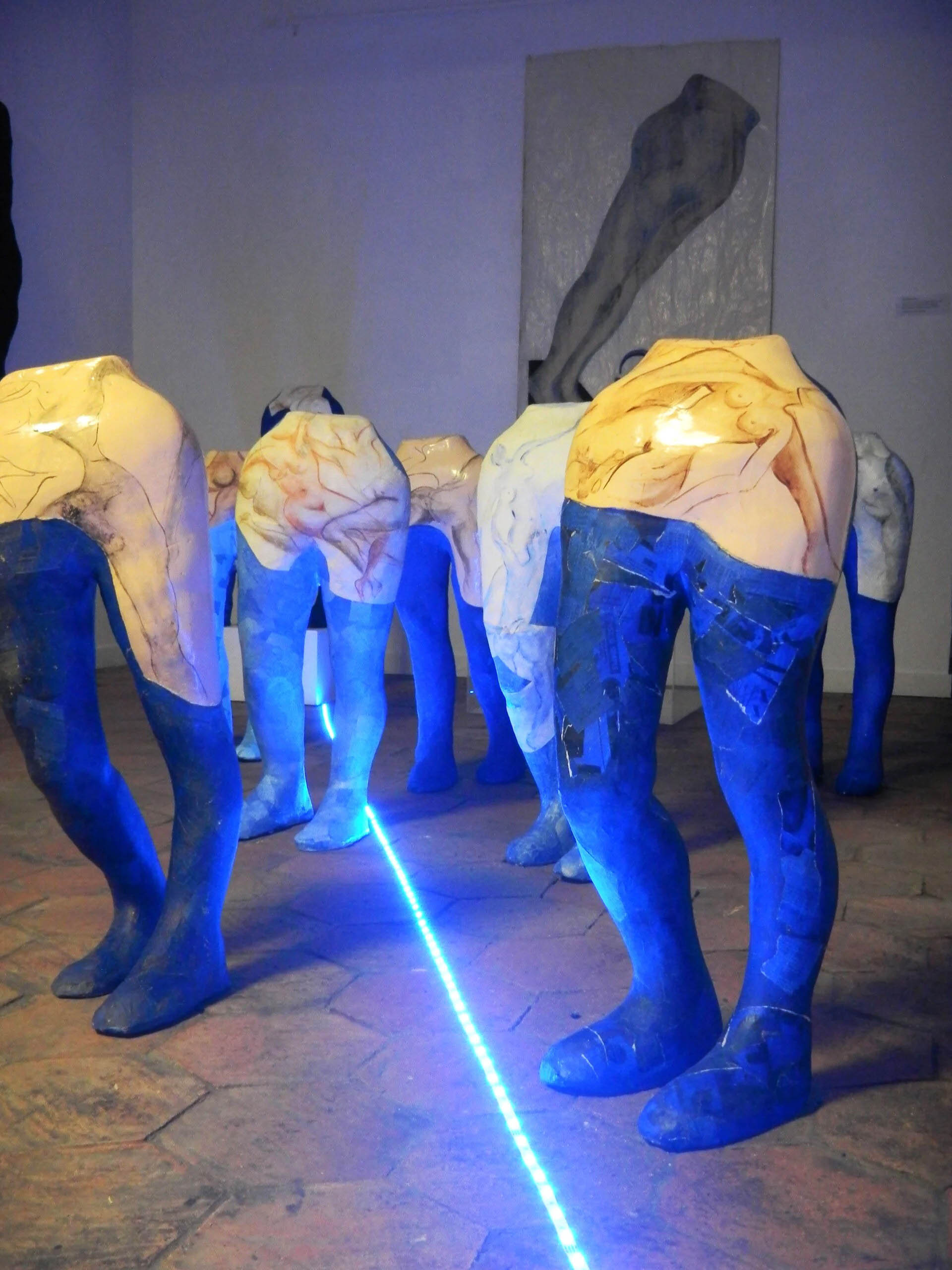 Other installations of the anti-busts of the series, have different connections. When grouped together, they can look like models on the catwalk or a group of dancers. Viewed from a certain distance, the surfaces of the nude drawings almost look marble-like, which is another linking element. Conversely, when viewed individually, the nude drawings may be perceived as complementary, or they may emphasise the posture of the respective anti-bust.
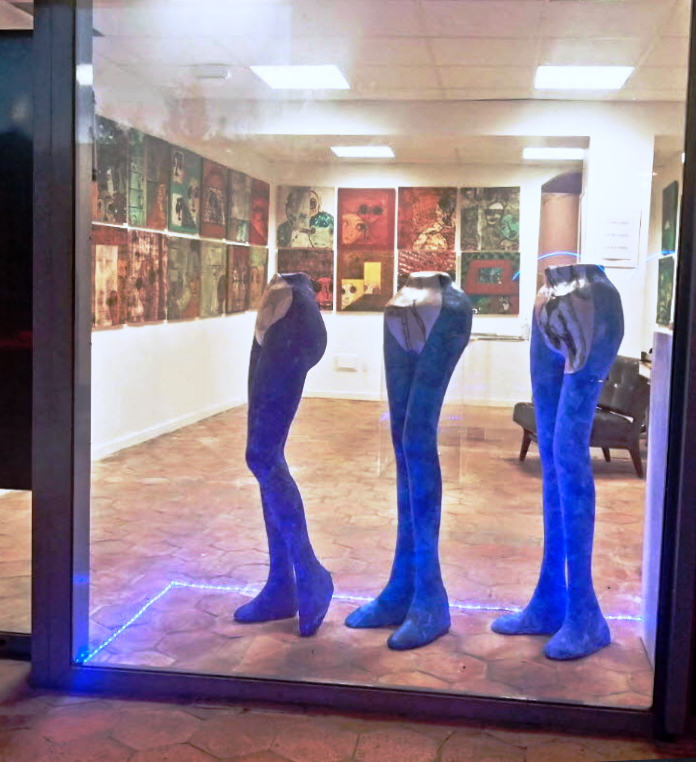 At first, Monique’s blue anti-busts were presented in summer 2022 in the double personal exhibition “Je ne suis pas Picasso” (I’m not Picasso) with the late Fluxus artist Ben in Vallauris at the Musée Magnelli and de la Céramique, vis-à-vis the Musée Picasso. Parallelly, Monique had a solo exhibition in the same ceramist city in the Galerie Itinéraire. Once more, they were on display at this gallery in 2024 as part of a joint exhibition with the painter Jean Jacques Laurant. Since then, several of the anti-busts travelled to other French towns to Italy. Finally, they returned in January 2026 to Vallauris to the Galerie Itinéraire. Some of the oeuvres entered private collections.
Monique Thibaudin
Born 1952 in Chalon-sur-Saône (France) Monique Thibaudin made a diploma at the Ecole Municipale de Dessin, Art et Technique (Municipal school of drawing, arts and techniques) in her hometown and studied painting at the Ecole Nationale des Beaux Arts de Lyon (National School of Fine Arts in Lyon). Afterwards, she entered the Ecole d’Art et d’Architecture de Marseille Luminy (School or Fine Arts and Architecture of Marseille Luminy). Here she obtained her national diploma under Claude Viallat, followed by a specialisation in the section of painting at the same school.
Her decision to use the anti-bust – an antithesis of the traditional bust – as her canvas is due to the influence of her teacher in Marseille. Claude Viallat was co-founder of the artistic group “Support-Surface”, which questioned the traditional painting support. The “deconstruction” of the painting in its constituting elements led to new artistic practices: instead of using the classical canvas on chassis, they dissociated the picture surface from the stretcher. They used different textiles, recycled found objects or worked on wood and strings. The traditional subject got less important and the materials, the creative motion and the final artwork shifted in the centre of their work.
Also Monique is working with diverse supports, but the base-subject is always the same. She created anti-busts inter alia from resin, tissues or on paper. When she settled in Vallauris in 1977, after finishing her studies, she consequently introduced ceramics into her canon of materials as well. Her sculptures, paintings or drawings are in all possible sizes. An example for her various techniques on paper is “Orchidées sur fond Bleu”, our Artwork of the month / September 2017. The sculptural anti-busts might be little statuettes or larger than life size and they might be composed of various materials. The results are sitting, standing or – like in Artwork of the Month / April 2021 “Anti-Buste en voyage dans le Sud” – walking. So she is forming a rich and varied artistic work, which was shown in numerous personal and group exhibitions in France, Monaco, Germany and Italy since 1975 till today.
Additionally, she cooperated with several different artists and institutions. Monique created with the late Fluxus artist Ben Vautier performances and joint sculptures. With him, the visual artist and architect Max Charvolen and the painter Jean Jacques Laurent she conceived exhibitions. For the filmmaker and all-round artist Giorgio Laveri she has done scenography and film decors. The writer and art critic Raphaël Monticelli contributed texts for her publications. In 2015, she founded with Jean Jacques Laurent the Galerie Itinéraire in Vallauris, which is currently directed by Enso Armando. Moreover, she is represented by several galleries in France and Italy.
Since some years Monique worked often on the concept of hybrid anti-busts. For that she uses in supplement to the basic form found or created objects. In consequence the artworks are multi personalities: half human, half zoomorphic or something else, like “Forme Hybride” our Artwork of the month / January 2016.
With her series of blue anti-busts, Monique introduces another form of hybridity. On the surface of the sculpture there are two contrasting elements: the legs are mainly covered by a kind of patchwork from newspapers or pigmented paper, overlaid by a diaphanous blue colouring; the hip areas represent charcoal or red chalk drawings of nudes. Created in various sizes, they are posed as singles, couples or groups of anti-busts in several exhibitions and were installed in private and public spaces. Two “Insolites” from this series are our Artwork of the Month / September 2026.
Monique lives and works in Vallauris (France) and in Serra Pamparato (Italy).