
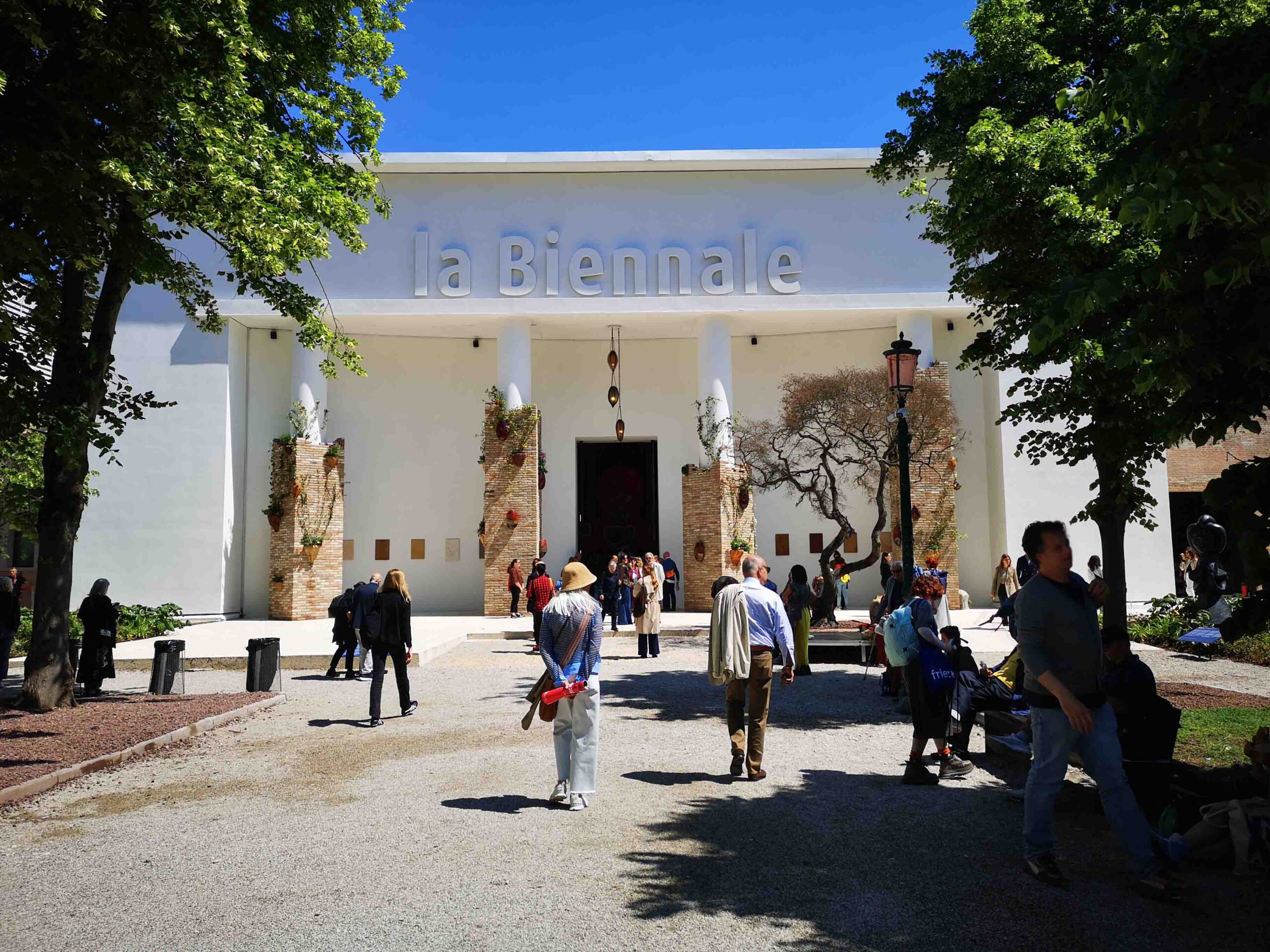
 The national pavilions of various states all around the globe are always an important part of the Venice Biennale, besides the main exhibition. This year’s title of the show in the central pavilion of the Giardini and in the Arsenale “In Minor Keys” was somehow adopted by several of the 100 national contributions, whilst others took up different topics. In the historic park of the Giardini are the 28 traditional, permanent national pavilions situated. Additionally, there is Qatar as the only newcomer to the site. A further 31 have found a space in the vast halls of the Arsenale, the former Venetian shipyard. All other countries are located in Palazzi and Art Spaces all over the city of Venice, like the numerous collateral events. In the following we review the participations of the Ukraine, Egypt, Vatican, Poland, Finland and Greece.
A political Statement at the Entry
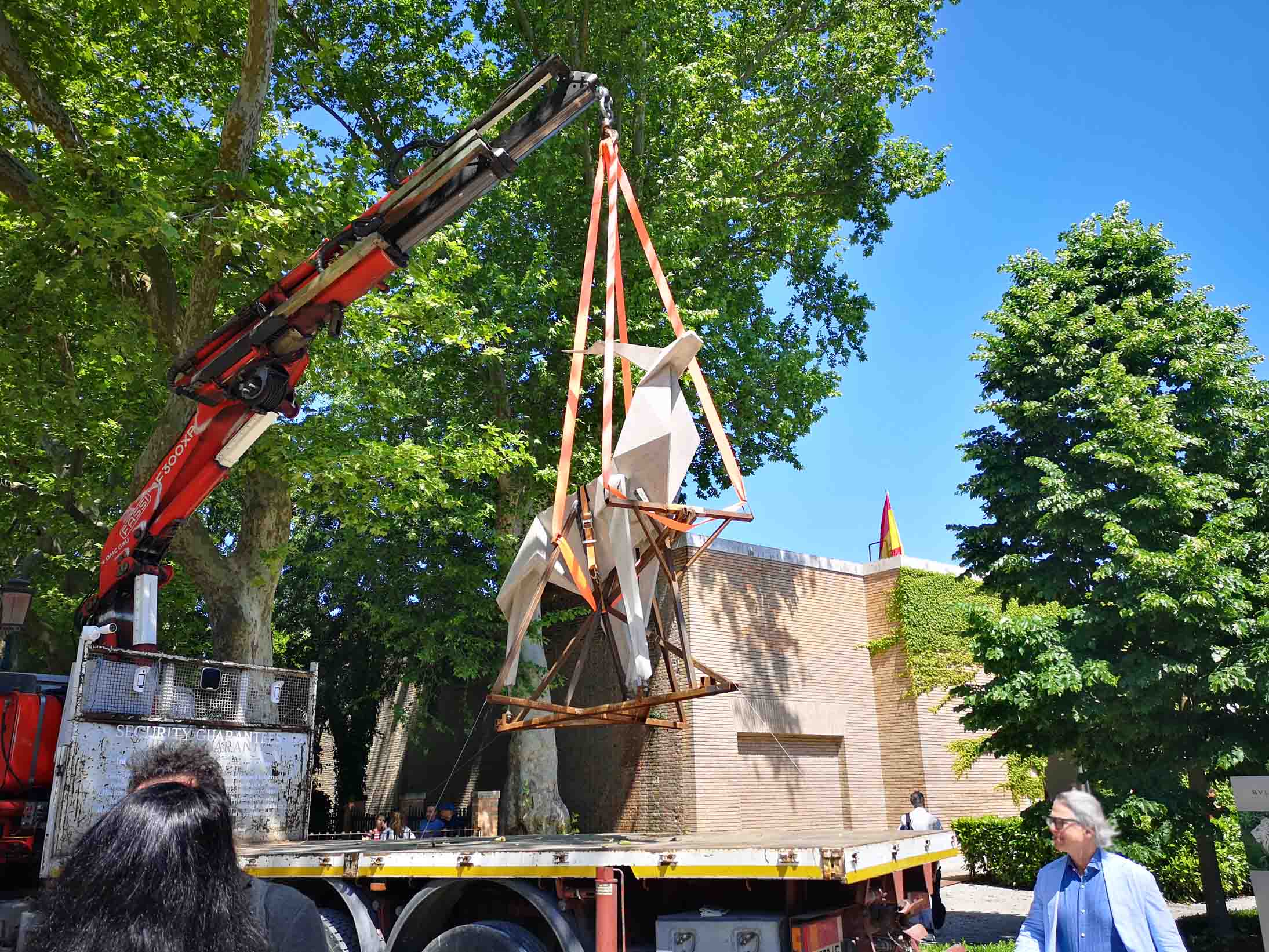 Directly at the entrance of the Giardini, the visitors are welcomed by Zhanna Kadyrova’s “The Origami Deer”. Suspended from a lorry’s crane, the 2019 created concrete sculpture travelled all the way from Ukraine to Venice. Originally set up in Pokrovsk, Donetsk Oblast, it was evacuated from the front-line city in 2024. Its journey through Europe is documented under the title “Security Guarantees” by photos and videos in the Ukrainian Pavilion in the Arsenale. This title recalls the Budapest Memorandum from 1994. Then the Russian Federation, the United Kingdom and the United States jointly provided security assurances (as opposed to guarantees) to Kazakhstan, Belarus and Ukraine in connection with their accession to the Nuclear Non-Proliferation Treaty and in return for the elimination of all nuclear weapons from their territories. Positioned a few steps from the Russian Pavilion and not far from the British and US exhibition spaces, it is silent denouncement.
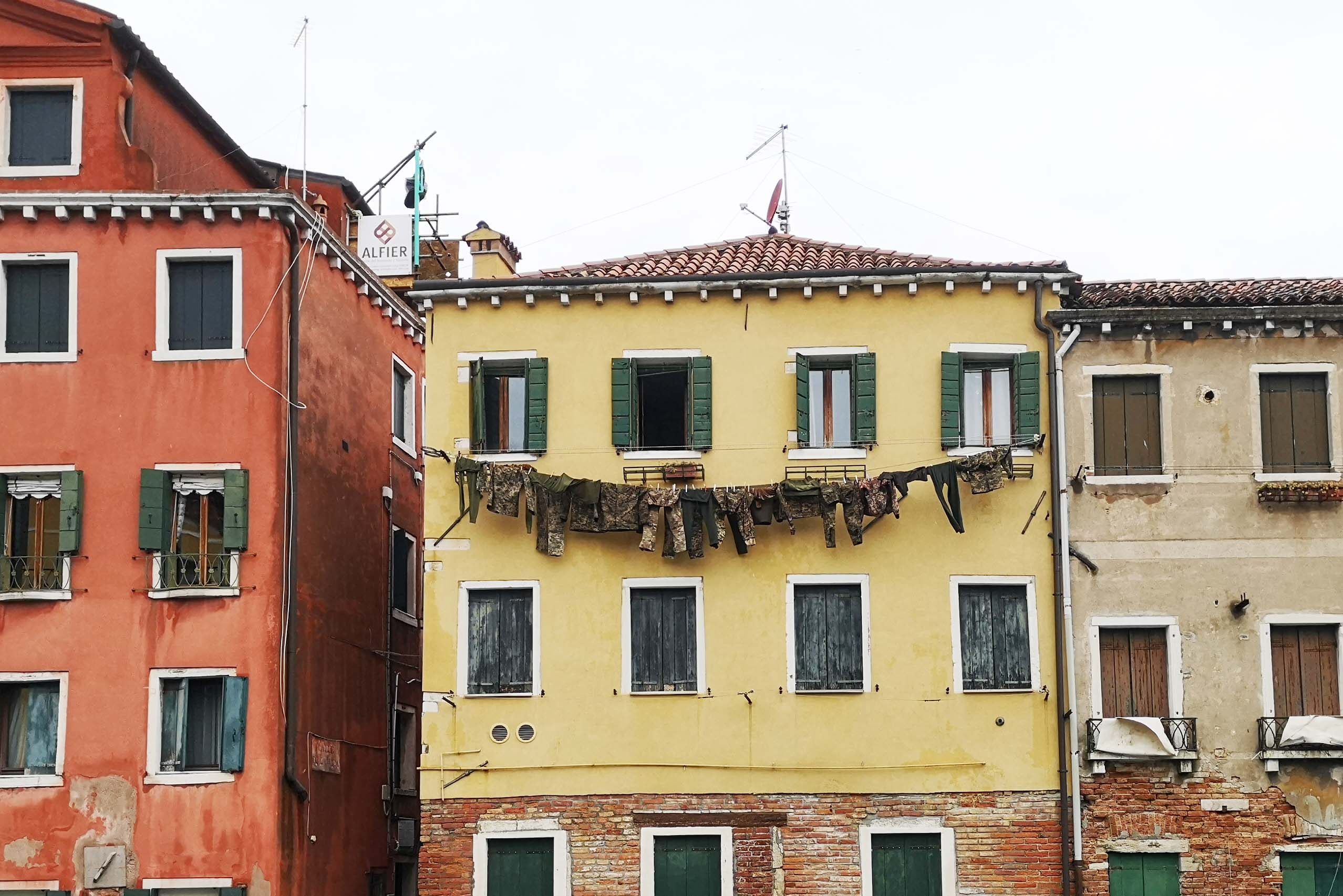 During the opening week, the Ukrainian artist Darya Koltsova also drew attention to the war in Ukraine. For “Echos” she hung Ukrainian military uniforms on the traditional Venetian clotheslines. They belong to Ukrainian artists who are currently serving as soldiers and are therefore unable to be in Venice.
Things were far from quiet in front of the Russian Pavilion on opening day, as Pussy Riot staged a noisy protest. Other demonstrations in form of marches and performances took place during the preview week. Besides opposition to the Ukrainian and Gaza war, cultural workers went on strike for better conditions, and artists withdrew their artworks from the spontaneous created audience award. Beyond these protests, art is still the main protagonist of this year’s Biennale.
Havens of Tranquillity
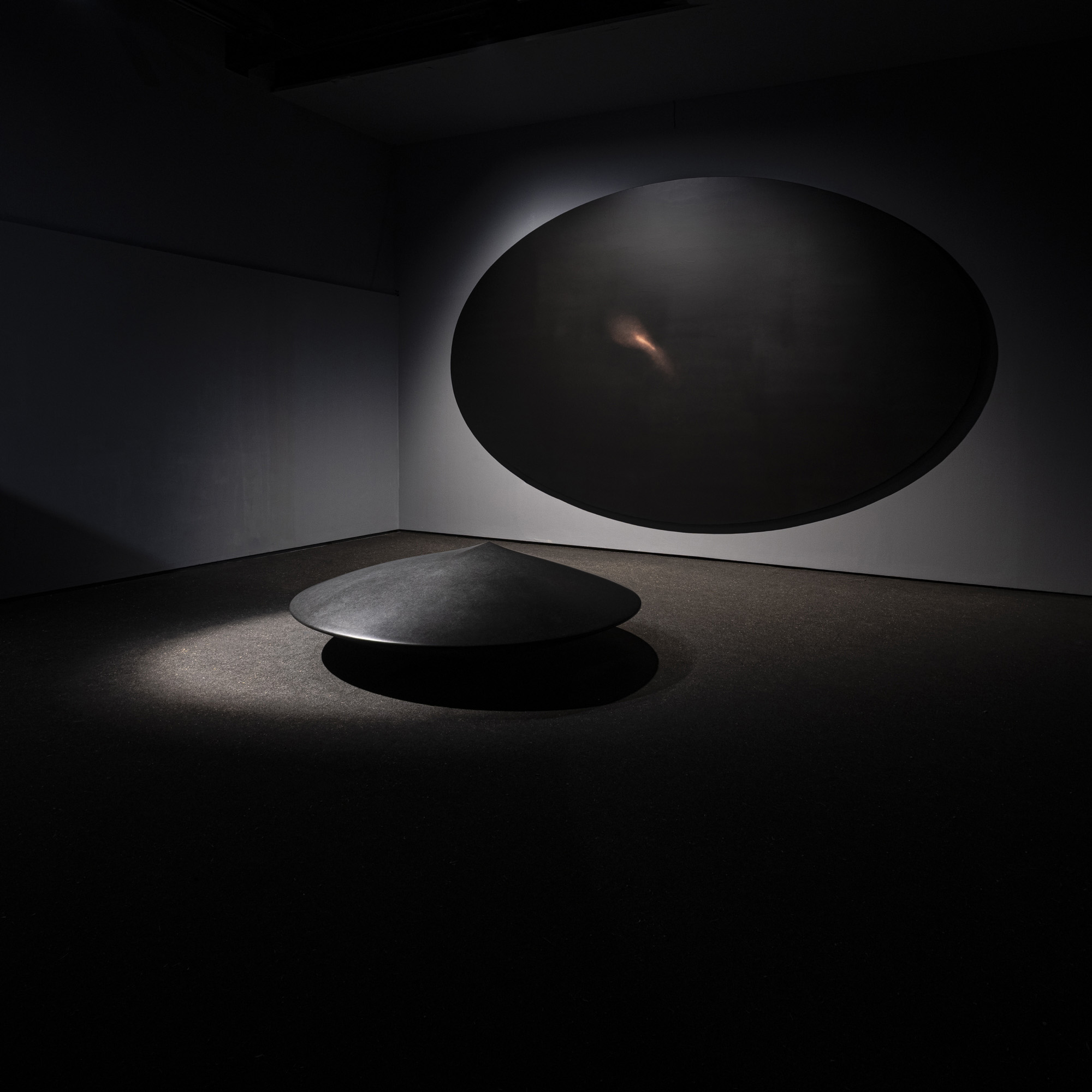 Given the long queues in front of many national pavilions, we first crossed the canal Rio dei Giardini to the other side of the park. But even there, we found another queue waiting for us outside the Austrian Pavilion, which we decided to skip in favour of visiting the Egyptian exhibition. The “Silence Pavilion” by Armen Agop is a haven of quietness. Here cell phones, loud voices and also photographs are not permitted. So, one can devote entirely to the works of art without being distracted. Already the subtitle “Between the Tangible and the Intangible” reveals that not only the eye is addressed, but also tactile perception. Moreover, in the first room one could notice the slight scent of lotus. Visitors are invited to meditate through the perception of paintings, dots which form light universes, and granite sculptures with a very smooth surface. This place is the perfect counterpart to the hustle and bustle outside.
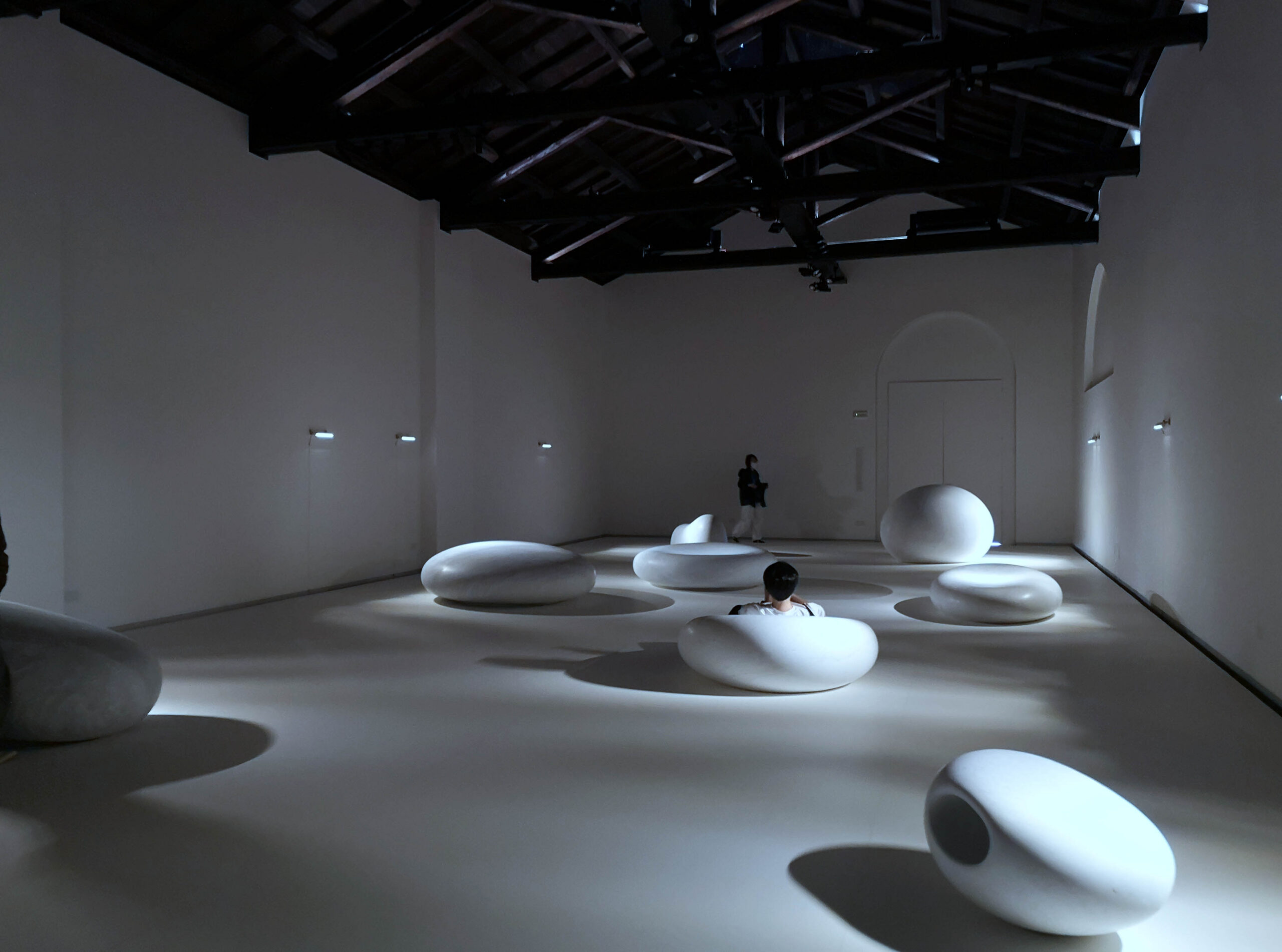 A similar experience is the exhibition “Isole del Silenzio” (Islands of Silence) by Kan Yasuda at the
Wilmotte Foundation in the quarter Cannaregio. White marble sculptures are placed throughout the hall. There are spheres, bowls and pebble-shaped structures amongst which you can promenade. Their smooth surfaces are meant to be touched. On some of them, one could even sit. A true space of tranquillity.
Also the Vatican Pavilion joined the Koyo Kouoh’s curatorial invitation to slow down. One of the two venues is the Giardino Mistico dei Carmelitani Scalzi in Cannaregio district close to the station. Inspired by the life and work of Hildegard von Bingen, “The Ear is the Eye of the Soul” is a sound installation with contributions of renown artists like Patty Smith, Brian Eno, Meredith Monk, and the Soundwalk Collective. While listening via headphones to the compositions, one could contemplate the garden with its plants and insects.
Unfortunately, we didn’t manage to visit this island of calmness during the preview, but we hope to be able to do so in a second visit. Following the high frequentation at the start of the Biennale, a reservation is now required. Admission remains free.
Also Polish, Finish and Greek Pavilion, all in the Giardini, featured sound, but each in a different way.
Calm and powerful tones
The Polish Pavilion – Whale Songs above and below the Water
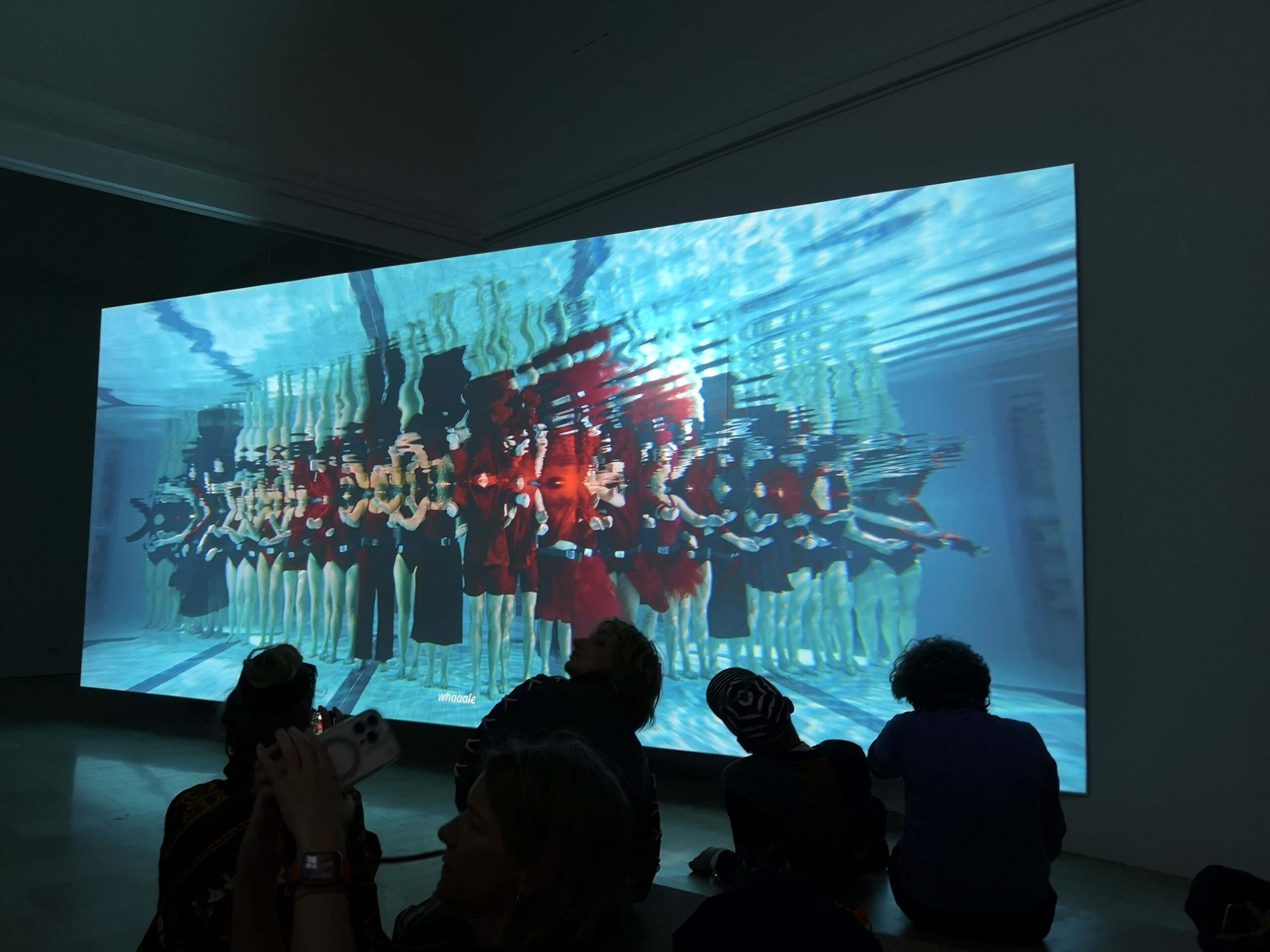 In the Polish Pavilion, it got a bit louder, though sound and music are also protagonists. The video installation “Liquid Tongues” by Bogna Burska and Daniel Kotowski with the participation of the social Choir in Motion (Chór w Ruchu). Composed of hearing and deaf people, they interpret the communication codes and songs of whales, both, in phonic English and the international sign language. Standing and swimming in a waterfilled pool or at the edge of the empty pool, the advantages and disadvantages of each linguistic culture become apparent. On land, those who can hear, or rather, those who sing phonetically, have the advantage, whereas in the pool the water literally comes up to their necks, while the deaf can express easily under water. Or, like Daniel Kotowski stated in an Interview with the Monopol magazine “Underwater, we deaf people are freer”. Of course, it is also about whales and their songs. Roger Payne recorded them in 1970, which led to bans on whaling and thus ensured the survival of the species. Herewith, “Liquid Tongues” is a story about loss, but also of retrieving marginalised cultures and their continuation.
The Finnish Pavilion – Venetian and other Winds
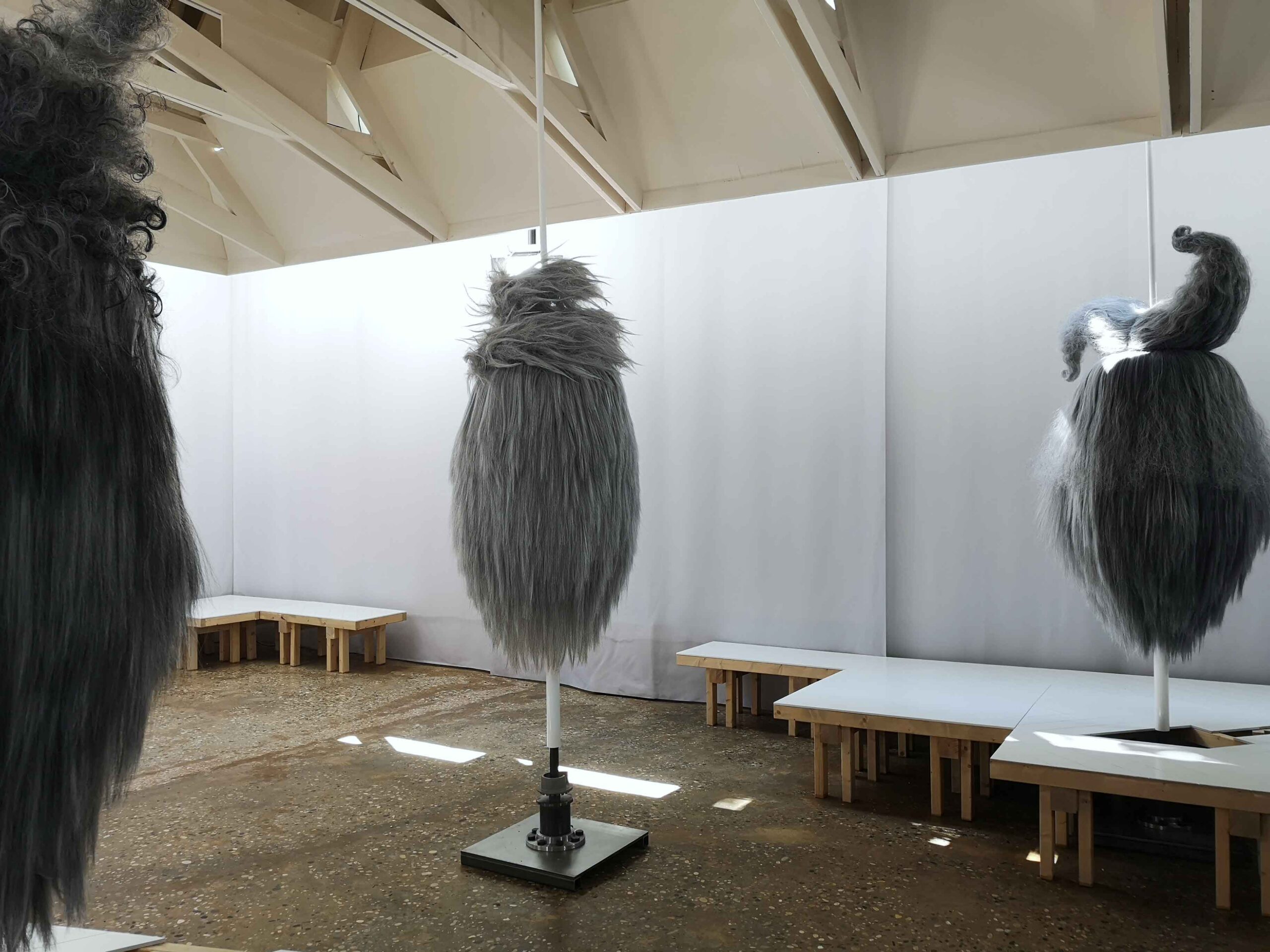 As the title “Aeolian Suite” indicates, the Finnish Pavilion focuses on wind, as its name alludes to the Greek god of the winds, Aeolus. For her installation, the artist Jenna Sutela has not only captured the five Venetian winds but has also blended them with other winds such as the one from Helsinki. Additionally, she used meteorological data, musical instruments (like clotheslines, wind machines), and a children’s woodwinds orchestra. This so composed sound collage is emitted by five grey fluffy sculptures. Recalling oversized deadCat microphones, styled with the hair artist Sara Mathiasson, they describe once more the five Venetian winds. Visitors are encouraged to practise ‘deep listening’, but also to reflect on the nature of the wind. On the one hand, it is a meteorological element that influences the climate worldwide; on the other hand, it can only be perceived indirectly when it blows against trees, buildings or bridges. Its multiple character refers to a scientific approach, but also to an intuitive. Therefore, the wind is an exemplary element, to reflect on the visible and invisible world. This might broader our understanding.
The Greek Pavilion – Looking at History in Post-Truth Times
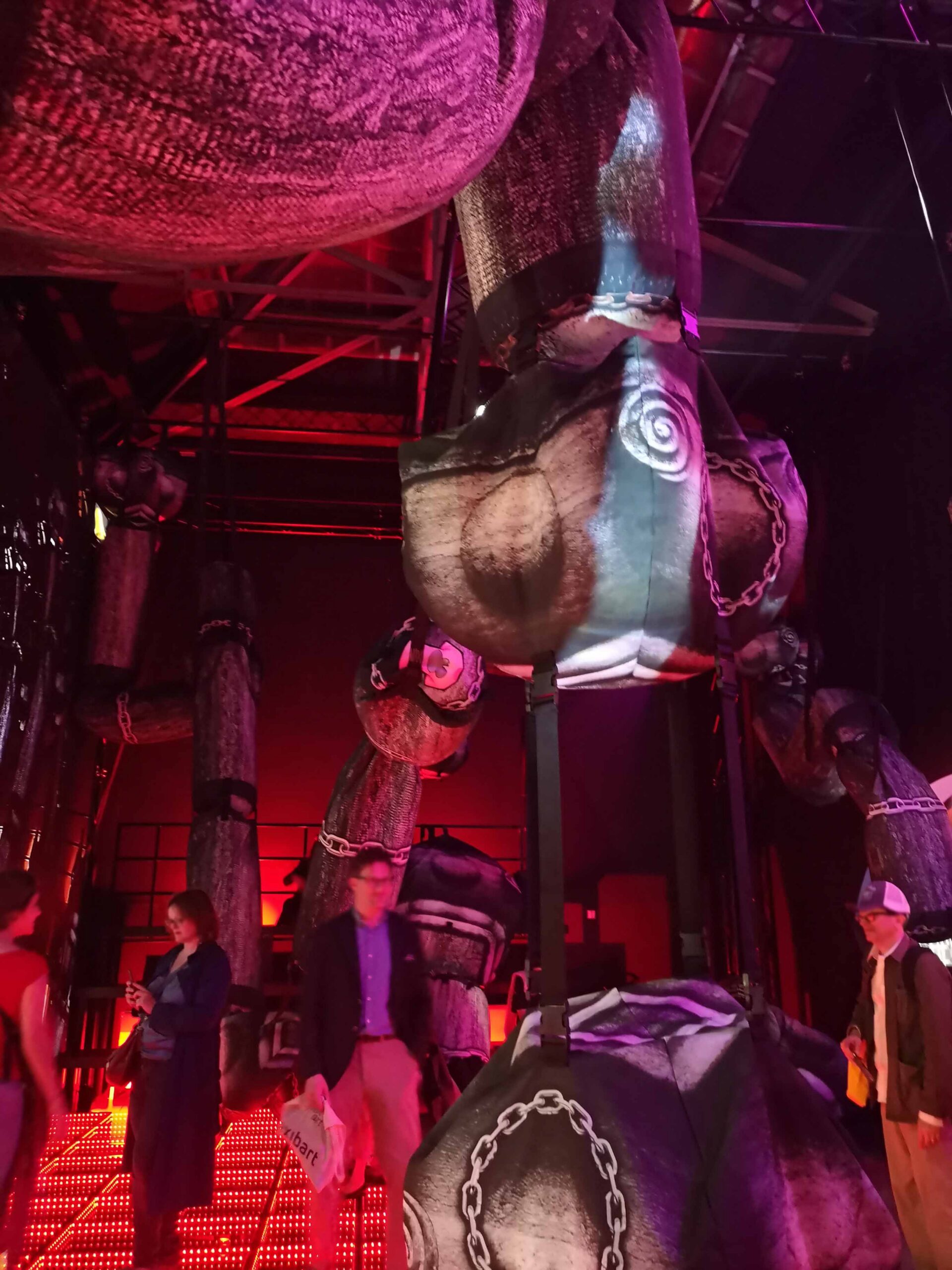 With “Escape Room” by Andreas Angelidakis the Greek Pavilion sets a strong contrast to calmer approaches. Entering the space, one is almost overwhelmed by the loud music, featuring the 1980s synth-pop track “Relax” by Frankie Goes to Hollywood. First, it is difficult to orientate in the dimly lit room with numerous light sources. After a while, one could identify the artist’s typical Poof Order Columns, spread in the room, hanging from the sealing and lying on the floor, so that they can also be used as seating. Deep within the floor, the light multiplies before being projected onto the wall via cameras, also multiplying the visitors in their movement. Almost appeasing is the part with its T-shirts hanging on the rack, recalling a cosy souvenir shop.
Andreas Angelidakis conceived his “Escape Room” as a contemporary version of the Platonic Cave. What we see reflects the age of post-truth politics and right-wing populism. The artist takes elements of the Greek and the pavilion’s history since 1934, Greek’s first participation to the Biennale. Herewith, he proposes an alternative reading of history as something not fixed but constantly open to negotiation. George Bekirakis, the curator describes the “Escape Room” as an invitation to view history not as a given, but as an open field of interpretations.” (1)
In another article, which will be published shortly, you could read how other artists reflect on the past (Serbia, Germany and Cuba).
(1) https://www.onassis.org/news/onassis-culture-at-the-61st-venice-biennale, visited 20 July 2026
Text: Astrid Gallinat
Photos © Astrid Gallinat & Stephan Goseberg, if not mentioned otherwise