
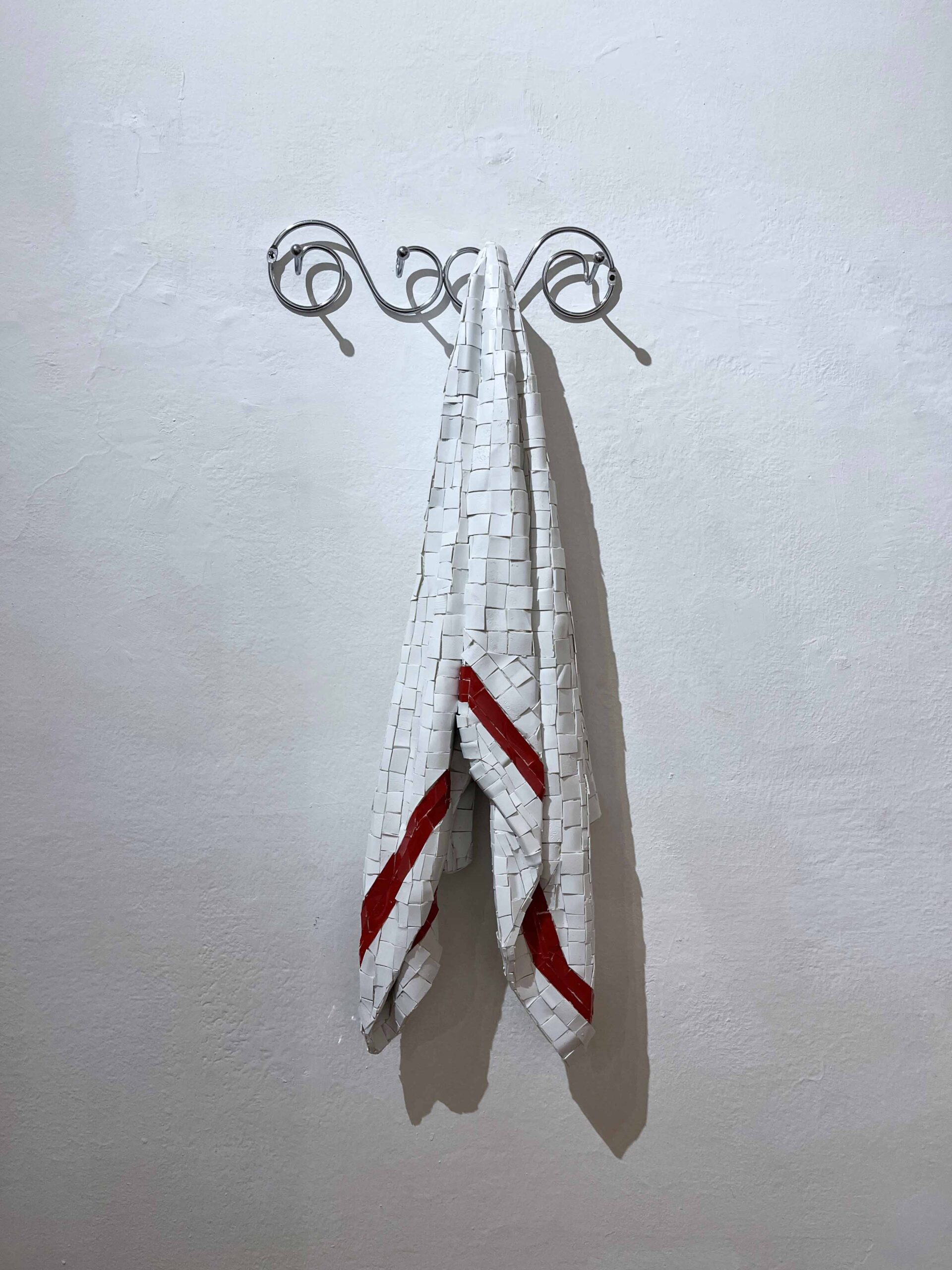
 Quotidianità (Everyday life)
Joanna Ewa Piszczek
2025
Mosaic in recycled plastic
32 cm x 70 cm
Joanna Ewa Piszczek’s three-dimensional mosaic “Quotidianità” (Everyday life) represents a white towel with a red bordure. It is hung on a curved towel rail at the wall. The execution and the staging are in a realistic manner. Not only the size and the presentation at the rail indicate this direction. Additionally, the pattern – inevitably in a mosaic by its components – could refer to a fabric in waffle pattern, even though it is a rather coarse one. By its size, the towel could be a hand towel or a kitchen towel, since we identified the waffle pattern. This weave is used for both types, in contrast to terry knitting, which is mainly for hand and bath towels and plain weave for kitchen towels, due to their specific properties. Whereas the kind of fibre remains hidden from the viewer. The surface is matt shiny because of the applied material. Typical fibres like cotton, linen bamboo or synthetic microfibres are not or rarely shiny.
This divergence from the realistic representation is due to the choice of material. Joanna didn’t use traditional mosaic materials like precious coloured stone, glass or ceramic, neither gold as extra element of divinity, but polyethylene (PET), from plastic bottles. Herewith, she wants to point to the problematic of contamination with micro plastic of our environment, animals and ourselves. Not only the oceans are polluted by these micro plastics. The widespread used PETs get from our waste through the rivers into lakes and seas and we are eating the fish from these waters. Additionally, we are wearing PETs directly on our bodies by our clothes, which are frequently made of polyester (= PET) or contain it. So, we are exposed to PETs every day. Therefore, the title refers not only to the everyday object towel. It is a remark to common contamination by this material, which creates hormone-like effects in human and animal bodies.
Besides these concerns of the artist, some additional remarks might be interesting. Regarding the ancient technique of mosaic, “Quotidianità” guides in two directions. By the application of rectangular pieces arises an abstract pattern. Even though it is mainly monochrome, it reminds ornaments like they are used as framework of figurative representations in Greek or Roman-Byzantine mosaics. Particularly noteworthy are mosaics in Islamic Art, due to their non-representational tradition.
On the other hand, Joanna has chosen a figurative subject. Herewith she is linked to the before mentioned traditions, where the abstract ornament is a decorative accessory to a figurative narration of mythological, historical or biblical themes. However, the artist probably doesn’t have one of these depictions in mind. If one doesn’t want to think that Pontius Pilatus had needed a towel after washing his hands in innocence. She has chosen a simple item of daily use, how it is to find in every household. Thus, the mosaic, traditionally connected to transcendental expression arrives in our contemporary world. With this in mind, “Quotidianità” could be a request in the sense of Christian narration to respect the biblical integrity of creation and herewith to integrate the protection of our environment into our everyday life.
“Quotidianità” was first on view to the public in the exhibition “Tre linguaggi musivi diversi” in October 2025 at the Galleria B4 in Bologna. This group exhibition was part of the official program of the IX Biennale di Mosaico di Ravenna.
Joanna Ewa Piszczek
Born in 1986 in Zakopane, Poland, Joanna Ewa Piszczek studied wood sculpture at the Art School of her hometown. Here, she consolidated her artistic language. Graduated and honoured cum laude in 2005, she worked in the handcraft production of Tiffany lamps. After her moving to Italy in 2006, she made a three-year degree course in mosaics at the Accademia di Belle Arti of Ravenna, inspired by her former practical experience.
Already during her studies in Poland, Joanna contributed to international projects and exhibitions, which brought her works also to England, Germany, Italy and France. During and after her studies in Ravenna, she continued her exhibition activities. Besides participations in group shows and art fairs in Italy, France and Poland, her works were mentioned in several magazines. Most recently, her mosaics were presented in two exhibitions in Bologna and Cesena as part of the IX Biennale di Mosaico di Ravenna. Until the 25th of January 2026, she contributes to the show “Proximite – I luoghi del costruire” in Argenta, which is also part of the IX Biennale.
In her work, Joanna is not limited to her original medias of expression wood sculpture and mosaic. For her sculptures and installations, she integrates also painting and photography. Additionally, the artist uses clay, natural materials like coal and wood. In particular, she applies plastic, often recycled. This goes hand in hand with her research questioning the natural world, the human being and our civilisation. Linked to this is a reflexion on the impact of our industrial society on nature and finally on our lives. Lately, these considerations lead to works like “Siamo quel che mangiamo” (We are what we are eating), a mosaic in recycled plastic and marble and “Quotidianità” (Everyday life). This three-dimensional mosaic made of polyethylene (PET), from plastic bottles is our Artwork of the Month in January 2026.
Joanna lives and works in Ravenna.