
 Una notte, d’estate (One Summer’s Night)
Ester Grossi
2013
Acrylic on canvas
60 cm x 50 cm
Ester Grossi’s painting “Una notte, d’estate” (One Summer’s Night), shows a woman in a green dress sitting on a chair, smoking a cigarette. She has crossed her legs and is holding her right hand to her ear. Therefore, her black hair is swinging out to the side. The room is held in warm colours (beige and brown). However, there is a white, curved area on the left of the picture. The flatness emphasises the two-dimensional nature of the image. Only the vanishing lines of the space indicate the surrounding environment. Moreover, the painting is very precise and accurately executed. Therefore, the image recalls collages or even digital productions. Contemplated on the internet it could also be a print.
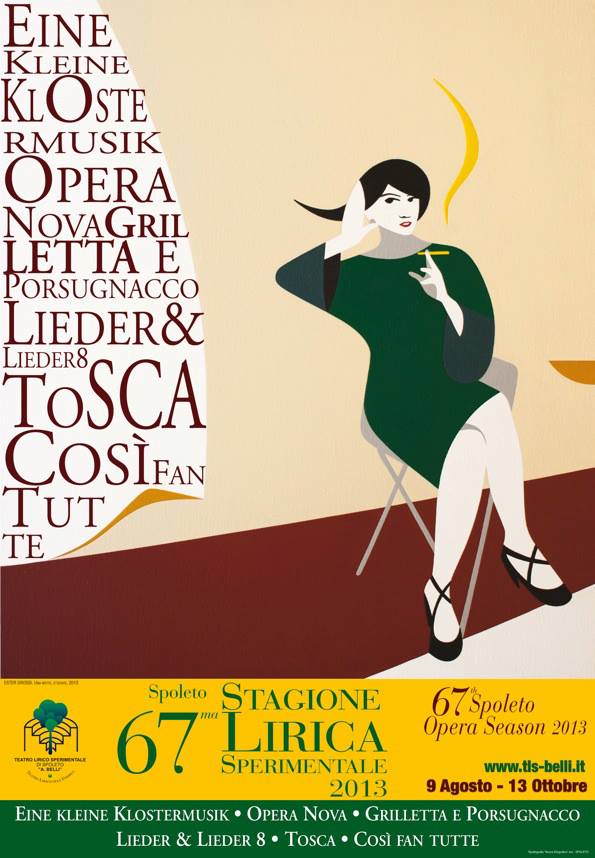 “One Summers’s Night” is part of a series Ester started in 2011. At this time, the then-present director of the Teatro Lirico Sperimentale in Spoleto (Italy), Claudio Lepore, discovered one of her paintings in a similar style. Here, a 1950s-style woman, seemingly annoyed by something, is screaming with shut eyes while covering her ears. This was the start of a long-lasting cooperation between the artist and the Teatro Lirico Sperimentale. During seven years, Ester painted the pictures that served as the basis for the annual promotional posters for each theatre season. Our current Artwork of the Month was the advertisement for 2013. This explains the white, curved area, which was on the placard filled with the titles of the announced performances. In this context, the woman could side her hair and surround her ear with her hand to hear better. This seems evident given that the Teatro Lirico is an institution dedicated to support young opera talents. After completing a two-year course, they perform during the ensuing season. These seasons are held traditionally in August and September and the shows often take place in the evening. Hence, presumably the title: “One Summers’s Night”.
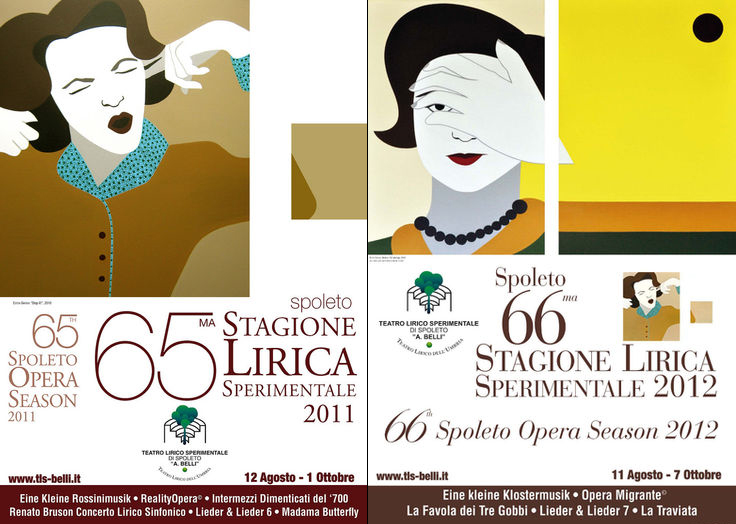 Claudio Lepore and his team had chosen the first painting for the advertisement in 2011, because he liked the idea that the seemingly bourgeois woman shows anarchic behaviours. Her gesture of closing her visual and auditory organs, could be interpreted as a refuse to listen and view an opera. For him, this “alluded to the idea of experimentation as an ontologically ‘subversive’ act.” The second poster goes in the same direction. Although the presented woman appears slightly more friendly, she is holding her hand over her eyes. However, she blinks through her fingers with one eye. On the contrary, the woman in “One Summers’s Night” appears to listen attentive. Nevertheless, she demonstrates her revolting manner by an activity, which stands in society and art since the 19th century for resistance: smoking.
Though the significance of smoking changed several times over the centuries. In Mayan times, and perhaps already in antic Egypt the use of tobacco was spiritually inspired.1 The consumption in the Renaissance and Baroque period was rather elitist, because the access was limited to wealthy people. Representations in Dutch genre painting and still-life are mainly moralising.2
Industrialisation marked the beginning of a “democratisation” of tobacco consumption. By the mid-19th century, pipes and cigars were increasingly being replaced by the more affordable cigarettes, which were soon being manufactured industrially in Europe.3 As cigarettes became widespread, they also found their way into art, particularly into painting. In parallel, the subjects depicted by painters began to change, so that the urban social life of the working classes and the world of work were also portrayed. Smoking became a motif.
In addition to portraits and self-portraits, the artists turned their attention to women. The image of a woman sitting at a table and smoking appears repeatedly. When she is not an exhausted or even a lost working woman, she is often portrayed as a role model of the “New Woman”, or sometimes both, like Van Gogh’s “Agostina Segatori Sitting in the Café du Tambourin” from 1887. Almost four decades later, Otto Dix also painted a “New Woman”. The “Portrait of the Journalist Sylvia von Harden” from 1926 shows a self-assured woman. With her short haircut, monocle and cigarette, she has adopted masculine attributes. Yet her femininity is also emphasised by the short dress. The dominating red in the image conveys energy, although Sylvia von Harden’s dark eyelids also suggest a certain fatigue. Another “New Woman” was the actress and singer Marlene Dietrich. Her career as a style icon of pop culture began around the time Dix’s painting was created. To this day, the most famous photographs show her smoking. There are still many examples in which women who smoke are portrayed as self-determined individuals. In doing so, they are defying convention.
In Ester’s painting, the protagonists’ smoking could be interpreted as an act of resistance. Accordingly, the image joins the two previous ones, even though the rebellion no longer manifests as a refusal perception.
There are many more examples, particularly from 20th-century popular culture, that highlight the rebellious nature of smoking, such as James Dean and the photographs of the Cuban revolutionaries. In the case of the latter, the intellectual appeal of smoking is also highlighted, like in images of workers from the former Eastern Bloc. These, along with critical aspects of smoking, should be discussed on another opportunity.
Ester Grossi
Born in 1981 in Avezzano, Italy, Ester Grossi is a multidisciplinary artist and works in various creative fields. This is no doubt also due to her wide-ranging education. After her High School diploma in Fashion, Design and Decoration at the art institute “Vincenzo Bellisario” in her hometown, she frequented the DAMS Bologna (Discipline delle Arti, della Musica e dello Spettacolo – Institute for Drama, Art and Music Studies). With her thesis “The Straight Story. Lynch e la pittura regionalista” she graduated with a bachelor in 2005. Subsequently, she made her master’s degree in Television, Cinema and Multimedia Production (University of Bologna) in 2008, followed by the Higher Education Diploma in Graphic Technique for Press and Printing, Salesian Institute of Bologna in 2009.
Besides her personal pictorial research, Ester created posters, magazines and album covers. Inter alia, she painted several images as basis for the annual promotional posters of the Teatro Lirico Sperimentale in Spoleto (Italy). This long-lasting cooperation with the theatre allowed her to discover the world of opera, at the time quite unknown to her. “Una notte, d’estate”, our Artwork of the Month /May 2026 was the advertisement for the season 2013.
With Sara Bonaventura, Ester conceived the visual background for the video of the album “Poseidon” by the Finnish musician Lau Nau in 2017 and designed the LP cover for 5 x 4 by the same artist in 2022. In the same year, she made the cover for the album “MORGON and KVELD” by the Norwegian performer Kristin Bolstad. In cooperation with other creatives, she designed clothing and accessories, an exhibition stand, many other promotional posters for film and music festivals.
In parallel, Ester is pursuing her artistic career as a painter with a special interest in popular culture, folklore, and mass communication. Always in a highly graphical technique, her earlier works show often stylised people (Written on the Hays, 2012); The Line below, 2012; Fucinus Lacus, 2013). These are increasingly disappearing from Ester’s pictorial spaces, giving way to fields of colour and lines (Token, 2014; Lumen 2015; Deep Down Inside the Colour, 2016). Prefaced by the series Red Hook Lines (2018), where she incorporated her impressions of the surroundings during her artist residency in Brooklyn, she began in 2020 her still ongoing series “Architecture”. Nonetheless, human beings didn’t totally vanish. Continuing since 2015, her “Personae” were in the beginning more abstract masks. A representative example is our Artwork of the month / September 2019 “Black Out 2” from 2018. Over time, the Personae began to take on a more human form again. However, they remain faceless and anonymous. Thus, the pictural work ranges between stylised figuration and analytical abstraction.
Most of Ester’s series were presented in solo shows, mostly in Italy. Moreover, her works joined numerous group exhibitions in Italy, but also in several European countries, the Ivory Coast and Cuba. Twice she was finalist for the Arteam Cup and the Premio Cairo Prize and honoured by the Italian Factory Prize in 2010. Currently, Ester’s paintings for the promotional posters of the Teatro Lirico Sperimentale are presented in the group exhibition “Lirico Sperimentale – Manifesti d’autore” in the Palazzo Collicola in Spoleto. The show in occasion of the 80th anniversary of the theatre’s activity is open until 2 June 2026. On view is a selection of original sketches and preparatory drawings, displayed alongside the posters subsequently produced.
Ester lives and works in Bologna.
1 Massimo Martelli, Vincenzo Zagà: Il fumo di tabacco nell’arte pittorica. Periodo moderno (XV-XIX sec.) – Tobacco smoking in pictorial art. Modern period (15-19th Century), https://www.tabaccologia.it/PDF/2_2011/11_022011.pdf, visited 20 April 2026
2 Joachim Rodriguez y Romero: Hast du mal Feuer? Die Ikonologie des Rauchens in der Kunstgeschichte. https://www.kunstplaza.de/kunstgeschichte/ikonologie-des-rauchens/, visited 17 April 2026
3 https://de.wikipedia.org/wiki/Zigarette, visited 21 April 2026