

5 – 8 February 2026
Various places
Since more than nine centuries, the University of Bologna has an impact on the cultural, political and civil life of the city. Reason enough for the ART CITY to focus in its Special Program on this institution, which was the first school of this kind: a community of teachers and scholars. Under the title “Il corpo della lingua” (The Body of Language) the curator Caterina Molteni invited seven national and international artists to dialogue with seven historic or present spaces of the Alma Mater. Besides the attention to the international art scene, it could be also a metaphor for the centuries-long exchange of international scholars and students in this structure. Many of the venues included video and in part performance. There was also one pure performance and a participative proposal. Noteworthy is that five from seven invited artists were female, despite the unfortunately still widespread male dominance in the presentation of art.
Rejoin by Alexandra Pirici · Flower Person, Flower Body by Ana Mendieta
To the Best of My Knowledge by Nora Turato · PITCH by Giulia Deval · Chair for the Invigilator by Augustas Serapinas
nimiia cétiï by Jenna Sutela · Day is Done by Mike Kelley
Rejoin – Metamorphoses at a Dissection Table
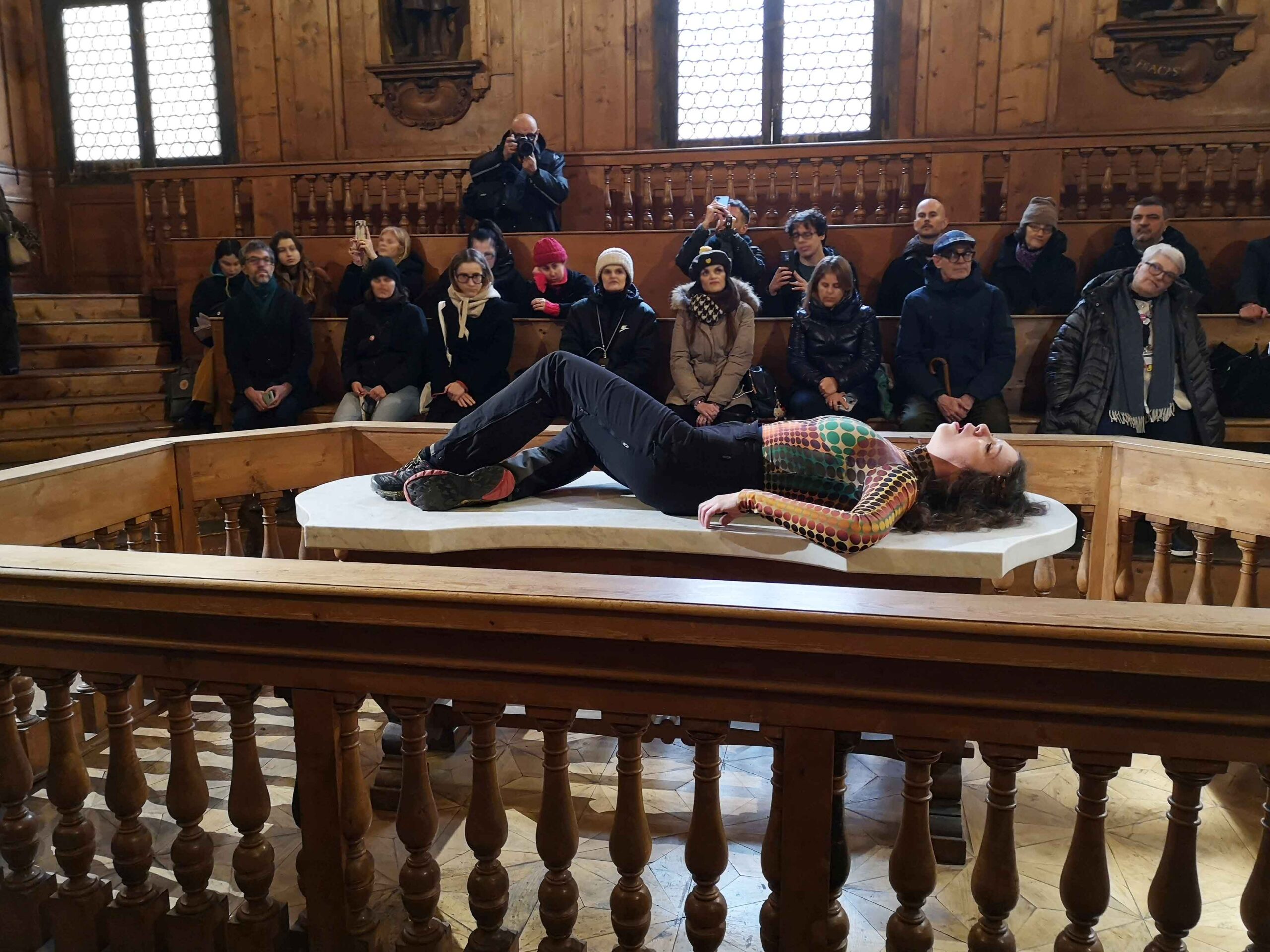 Built in 1563, the Palazzo del Archiginnasio was the first permanent main building of the Bolognese University, which was previously spread across various locations in the city. Today it houses the Municipal Library and the historic Anatomical Theatre. Here, on the cold marble dissection table the Romanian artist Alexandra Pirici (1982) and her assistant Michelle Cheung alternating performed “Rejoin”. During the presentation, the artists traverse various states of creations. In allusion to Venerina, a wax reproduction of a dying pregnant woman, still preserved in Bologna, the performers lay motionless on the table. When moving, they became animals, plants and finally an artificial intelligence, which addressed the public. However, answers to questions posed by the audience only result in confusing series of numbers. It seems a bit like a reverse autopsy. The seemingly dead body is brought back to life. Though, the movements and sounds seem to originate from memories or from a possible reality. During the performance, the actor body is in a state of constant metamorphosis.
Flower Person, Flower Body – Nature takes over
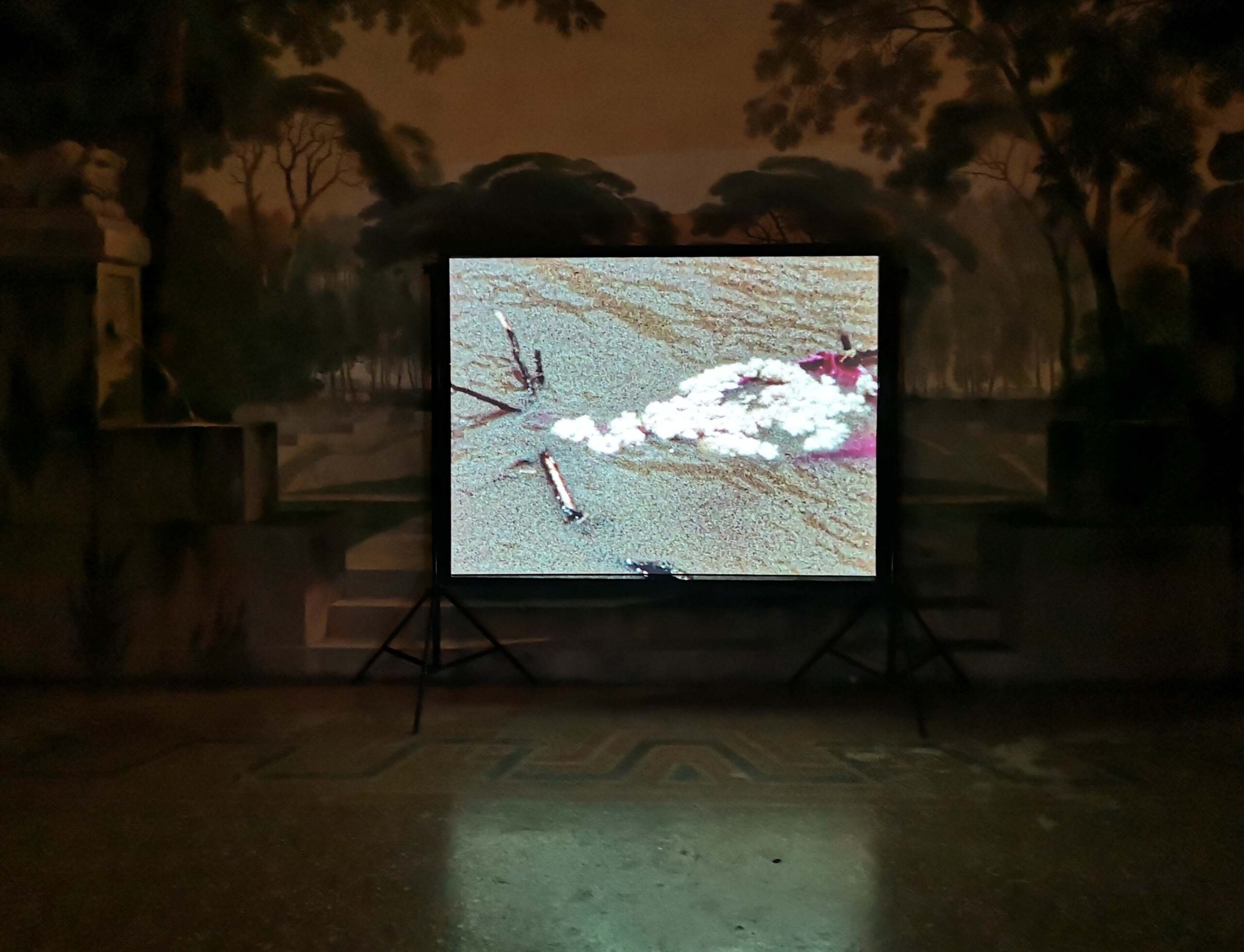 Another metamorphosis can be observed in the film “Flower Person, Flower Body” (1975) by Ana Mendieta. Here we accompany a human silhouette formed from flowers on a fabric raft, floating down a river. The scenery recalls a funeral ritual. Unlike Alexandra Pirici’s transformations, the Cuban American artist pursues with her Super-8-camera the dissolution of the flower body. During the absolutely silent six minutes and 20 seconds the flower person disintegrates by the streams drift. The film is part of a series of other works featuring flowers from the 1970s, which, with other works of the late Ana Mendieta (1948-1985), redefine the relationship between humans and nature, with a focus on nature’s central role. Exemplary, the human silhouette dissolves through the force of nature. In between, the camera pans to the trees on the riverbank. Hereby, the film and the woodland paintings by Rodolfo Fantuzzi merge. The projection took place in the Sala della Boschereccia at the Palazzo Hercolani, which currently hosts the Faculty of Political and Social Sciences.
To the Best of My Knowledge – An improvised Performance
 Less quiet was it in the Aula Magna della Biblioteca Universitaria. Especially for this hall in the Palazzo Poggi, which is filled with ancient books, the Croatian artist Nora Turato (1991) created a sound installation. Together with a durational performance it built “To the Best of My Knowledge” (2026). The basic tone for the improvised presentation is a muffled knocking, similar to a heartbeat or the bass of a distant music party. It is the registration with a geophone of the artist’s rhythmical walking on the ancient library’s wooden floor. This instrument converts ground movement into voltage, which in turn was transformed into sound. The personal interpretation of this rhythmical knocking depends on the momentary mood, which determinates the conduct of the performance.
PITCH – The Gender of Sound
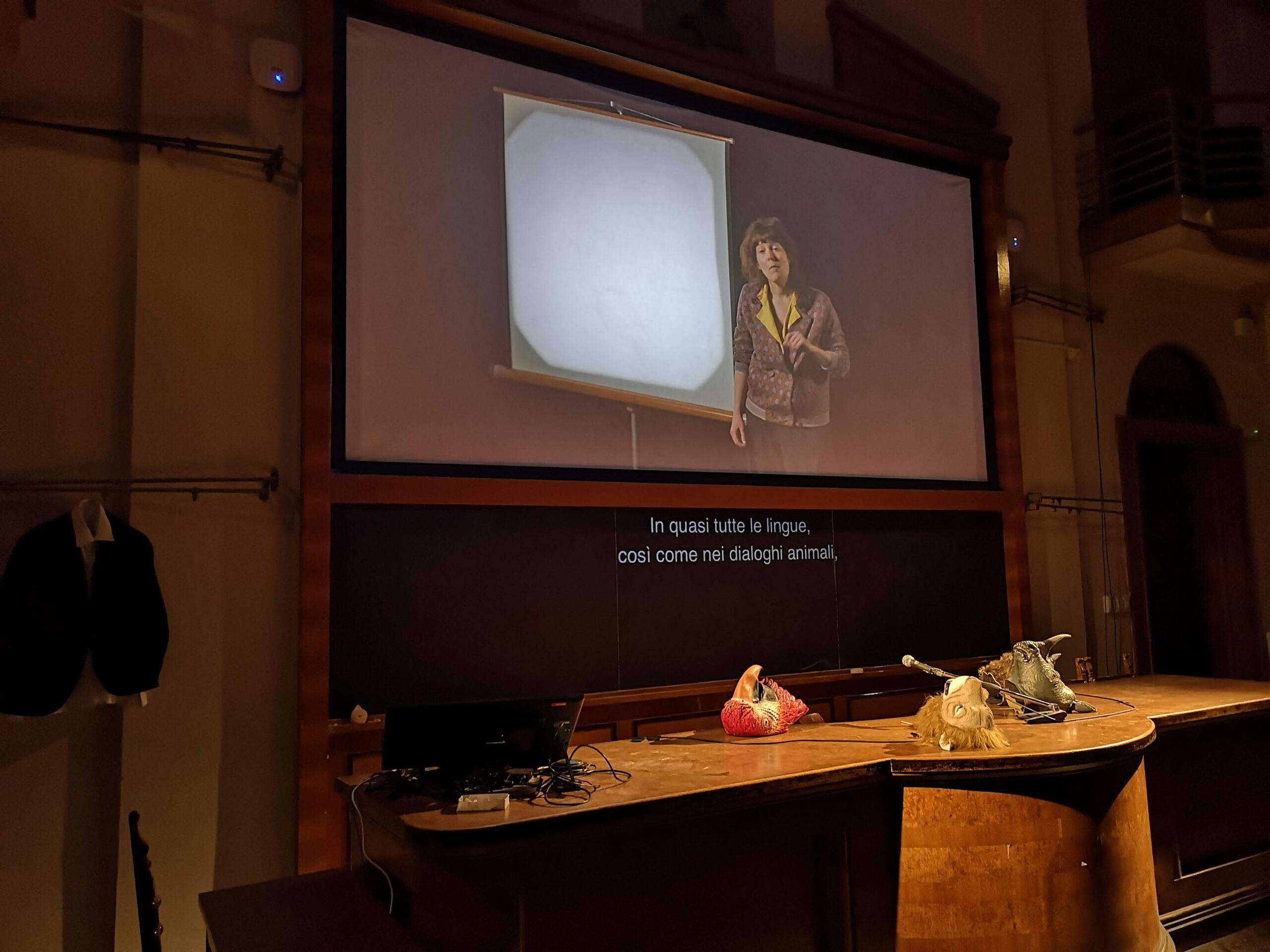 Giulia Deval (1993) also deals with sound. In the Great Hall of the former Institute of Zoology, a typical horseshoe-shaped auditorium in Art Deco style, the video “PITCH, Notes on vocal Intonation” (2025, 19 min 30 sec) was on display, suspended every day for an hour due to a live performance-lecture by the artist. Based on John Ohala “Frequency Code” connected with Anne Carson’s “The Gender of Sound” Giulia Deval explores the sociocultural effects of different vocal tones. Following Carson’s essay, she considers historical classifications, which still influence our perception of various tone pitches. An example is the unpleasant sensation of female high-pitched voices in contrast to pleasant masculine deep voices and the thereof resulting power structures.
Chair for the Invigilator – The Audience as Performer
 Another expression of power can be an elevated seating position. However, in Augustas Serapinas‘ (1990) work, they have a completely different function. Instead of watching a performance, the audience itself becomes the actor. In the library of the research and training centre of the Federico Zeri Foundation, he installed three elevated chairs, recalling high seats for hunters or lifeguards. The visitors are invited to sit down there, while reading a book. Herewith, the action of reading becomes a visible physical action. At the same time, the position changes the perception of the space. On one hand, books at the higher shelves become more visible and accessible. Perhaps one or another of the art historical volumes attracts the attention, which it would not have done from a lower position. On the other hand, the view at the other readers changes and oneself is on display. Augustas Serapinas originally created “Chair for the Invigilator” for the 58th Venice Biennale in 2019. However, here the function was slightly different. The Lithuanian artist wanted to offer a place to the guides to rest during their long working hours. Moreover, they had a greater visibility, like the elevated readers in Bologna. Though, Augustas Serapinas changed the design. While the high seats in the Biennale were painted, they were from natural wood in the Bolognese library. This allowed them to match with the wooden bookshelves there and blend with them.
nimiia cétiï – Communication of non-human Entities
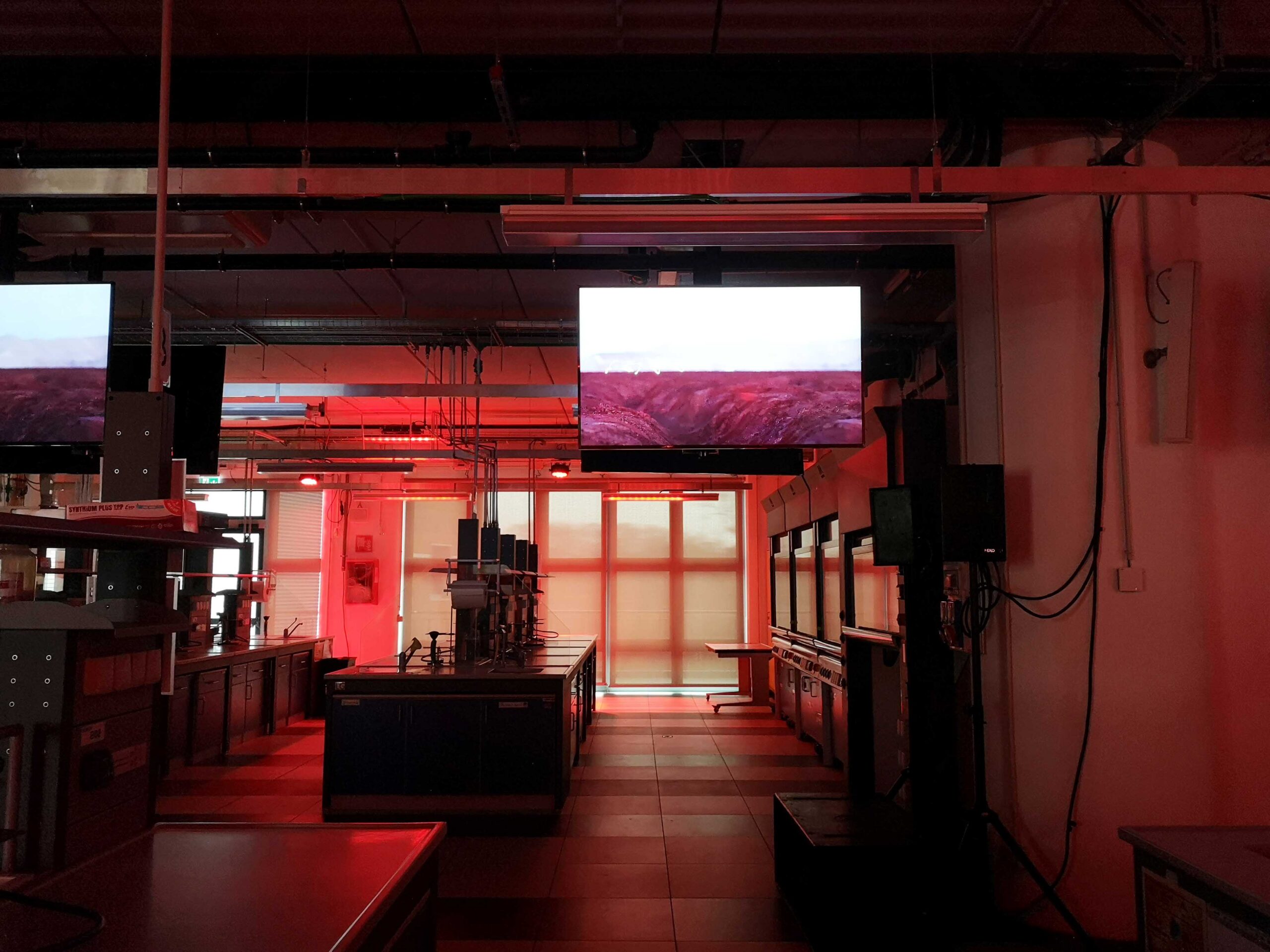 Entering the Educational Laboratory of the Centre for Chemistry Teaching in the Navile District of Bologna, there are six monitors, which facilitate the students to follow the lectures of the professors while working at the laboratory benches. Also, the first images from Jenna Sutela’s video “nimiia cétiï” (2018, 12 min 02 sec) display observations by a microscope accompanied by a seemingly electronic sound. Small grey worms transform into colourful points of light, which then form small tails that illustrate their movements. We are observing the Bacillus subtilis, an extremophilic bacteria. Next angular lines appear, complemented by vocalised sounds. Like subtitles, unknown characters occur across the line knot. Who was still supposing a science film up to this point, will be surprised to see red hilly landscapes. The accompanying sound is increasingly reminiscent of a mysterious language.
 Jenna Sutela imagined a language of Martians, inspired by Hélène Smith’s, a Swiss French medium, who claimed to communicate with aliens from the red planet in the late 19th century. Generated by computer, the scripture is based on the movements of the bacteria. With this scripture, an AI network created the sound trained with the voice of the Finish artist. Jenna Sutela has chosen the Bacillus subtilis, because recent scientific experiments suggest that this bacterium could survive on Mars. Therefore, it is particularly suitable for envisaging communication between non-human entities. The screening of the video in a university laboratory creates a fusion of pure science and artistic work.
Day is Done – Carnival in the Faculty
 Also, Mike Kelley (1954 – 2012) invited strange creatures to the university. “Day is Done” (2005-2006, 169 min) a compilation of 31 short music films was projected in the atrium of the former Engineering Faculty (today several technical institutions). The great marble hall in the Bolognese modernist building from 1935, hosts this carnivalesque opus, where vampires, demons, ghosts and other supernatural beings sing and dance in high school contexts. Based on photographs, yearbooks and local newspapers, the American artist, reconstructed extracurricular school events like costume parties and talent contest. These re-enacted activities show in short film format what happens in educational institutions beyond the actual lessons. It’s a lovely bit of fun that fits in quite well with the pre-carnival season. Moreover, it describes how the daily pressure could be compensated by socially accepted rituals, which allow free creativity.