
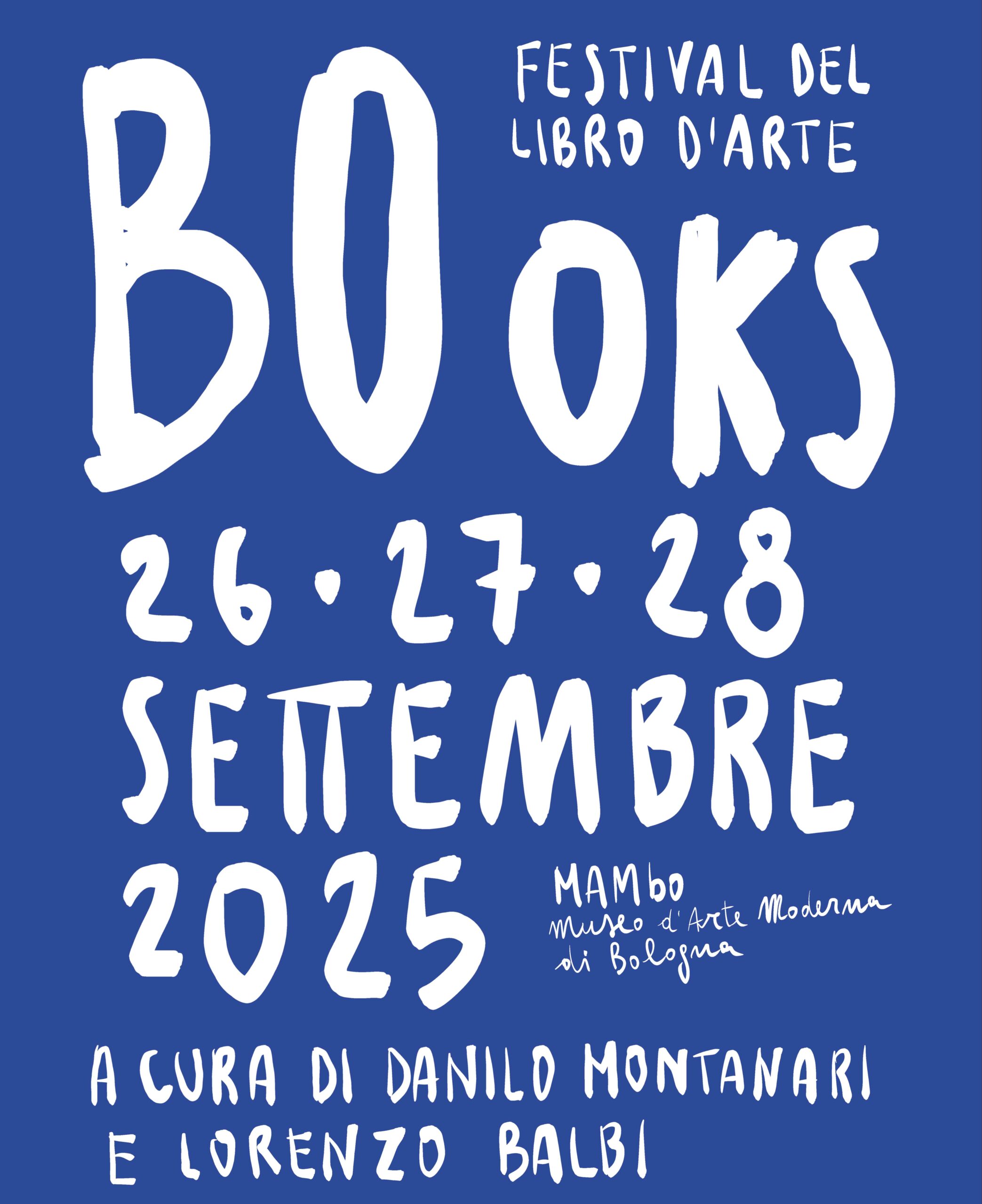
 BOoks – Bologna art books festival – Festival del libro d’arte
26 – 28 September 2025
MAMbo – Museo d’Arte Moderna di Bologna
Via Don Giovanni Minzoni 14, Bologna
www.booksfestival.it
www.museibologna.it/mambo
The third edition of BOoks took place from 26 to 28 September 2025. Curated by the editor Danilo Montanari and the director of the MAMbo Lorenzo Balbi it was hosted in the huge Sala delle Ciminiere. Attracted by the artistic form of the art book, the two curators see the event in the tradition of the Artelibro (Bologna art books festival, 2003 – 2014) and the international art book fair FLAT – Fiera Libro Arte which was carried out from 2017 to 2019 in Turin. Both events met an increasing production and demand on artists books.
Even though established in the contemporary public consciousness only in the 1960s by movements like Fluxus, Concept and Pop Art this form of artistic expression has a long tradition. It should be noted that there was a production of unique artistic books since the early medieval time with masterpieces like the Book of Kells and the Très Riches Heures du Duc de Berry. More recently, the English visionary artist and poet William Blake (1757–1827) and his wife Catherine Boucher are considered as pioneers of art books, since they wrote, illustrated, printed, coloured and bound their own editions of books. In the early 20th century, the various groups of avant-garde artists published manifestos and books. Mentioned should be the Italian Futurists, but also Dadaists and Surrealists distributed their paintings, poetry and ideas via this media.
 Over time, the outcome emancipated in parts from the traditional form and materials. Art books grew out of the two-dimensional into sculptural objects. Paper was replaced by metal or fabric. This broadened the range of subjects and changed the number of reproductions. Still, there are artist books which mainly illustrate the creative works (texts and/or images). Here, the number of copies could be relatively high, because they could be printed industrially. Others are released in smaller limited editions, since manual interventions are necessary. Moreover, there are unique pieces, as independent category in the oeuvre of the artist. All could be close to conventional books but might deviate by material and form.
 Accordingly, the offer of the 37 exhibitors varied a lot. There were examples illustrating a special project of the artist like the photobooks. Also historic and new editions of manifests, posters, illustrated volumes of poems, or performances were on view and to buy. Moreover, the various editors presented concept books, object books, collages, leporellos, scrolls, notebooks, loose-leaf collections, intermedia boxes or multiples made from a wide variety of materials. In parts, the traditional form of the book, consisting of printed pages between book covers, was interpreted broadly. Mainly unique pieces were presented at the tables of the Accademia di Belle Arti of Bologna. Even though the forms of expressions of this new generation of artists might differ from their established colleagues, they have recognised the special qualities of art books: they are communicative media, which can address a wider audience, because they are interactive, portable and easily shared.
 Beside editors, libraries and art galleries, there were some special projects. One section commemorated the Italian typographer, photographer and painter Mario Giacomelli (1925-2020). In occasion of the 100th anniversary of his birth, the exhibition “Libri ed Ephemera 1955-2025” illustrated his career from his first award in 1955 (first winner of the photography competition of Castelfranco Veneto) to the cover of Art e Dossier in 2025. There was a huge selection of books, leaflets, magazines, catalogues and covers all coming from the Archivio della Libreria of Frusaglia.
 Another segment was dedicated to Mario Diacono (*1930), who was active in Bologna from 1977 to 1979. During this time as gallerist, he brought works by many today internationally renowned artists, inter alia Jannis Kounellis, Pier Paolo Calzolari, Mario Merz, Alighiero Boetti, and Michelangelo Pistoletto to Bologna. Though at BOoks, the focus was on his relation to Italian artist Claudio Parmiggiani, with whom he shared the passion for books. In 1978, Diacono presented Parmiggiani’s art book “L’Arte è una Scienza esatta” (Art is an exact science) in Bologna.
 Also, the Modenese artist Franco Guerzoni (*1948) is connected to Claudio Parmiggiani and other artists by the same affinity. Besides his engagement with painting by a personal interpretation about the image space, he created several artist books, often in collaboration with colleagues or art-critics like Franco Vaccari, Luighi Ghirri, Emilio Mattioli and Adriano Spatola. Several of these editions are exposed during the Book Festival. Some of the volumes were published by Edizioni Ginevra Grigolo, the editor of the historic gallery Studio G 7, in Bologna. In 1973, he had his first solo exhibition here. Currently the gallery dedicates a new personal show to him, in parallel to BOoks.
In addition to the expositive part, there was a rich program of meetings. On Saturday 27th October curators and directors of Italian museums and art fairs discussed “The State of Art”. Sunday, the 28th October focused on the cultural and political context in Bologna in the 1970s with witnesses of this period and contemporary cultural actors.