
 Nains (Dwarves)
Véronique Champollion
Since 2004
Acrylic on glued newsprint paper
Single sculptures: height between 6 and 45 cm
Installation: dimensions variable
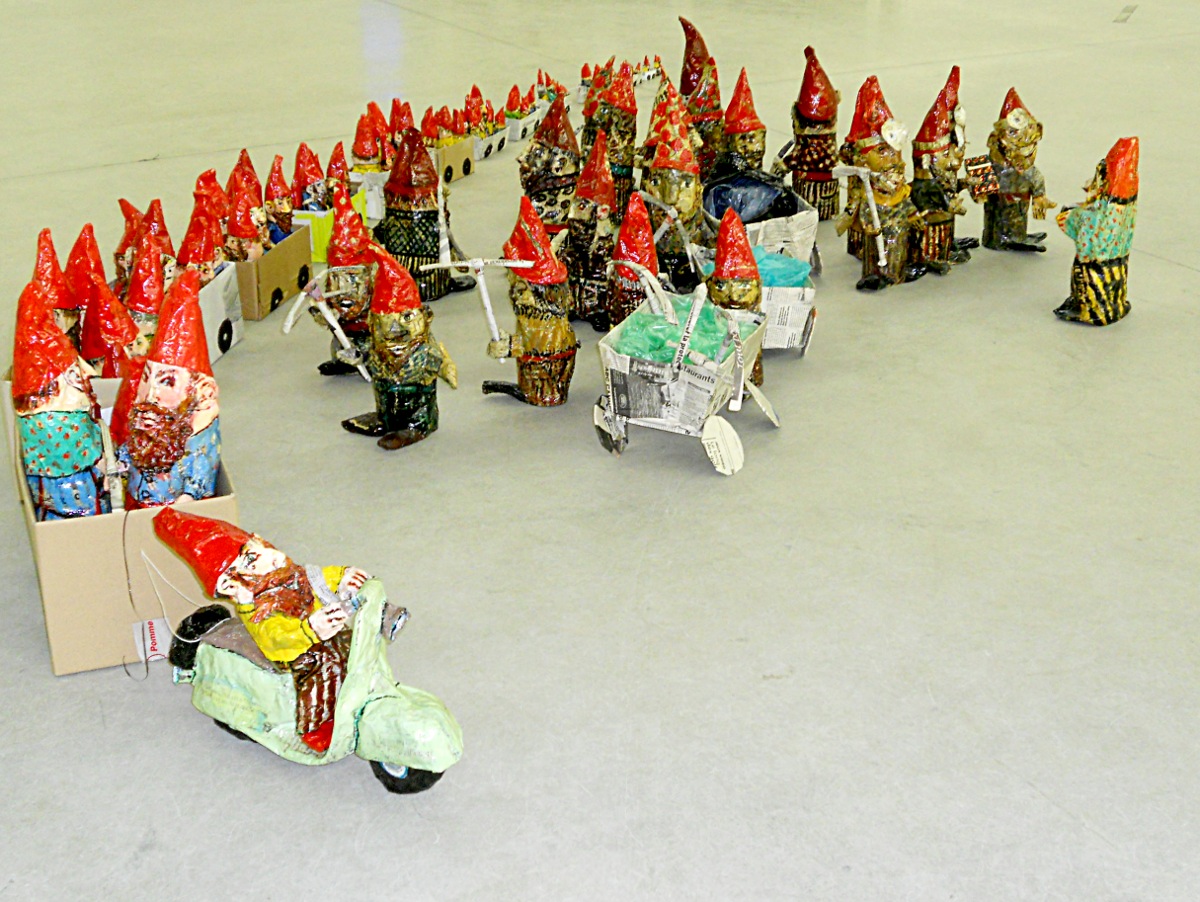
Since 2004 Véronique Champollion creates dwarves made in papier-mâché. In 2006, she presented a first installation in “the Room” – a performances space run by Carla Bertola and Alberto Vitacchio in Turin, Italy. Under the title “Bianca Neve e i 47 Nani” (Snow White and the 47 Dwarves), an allusion to the by Brothers Grimm’s written down fairy tale, they were accompanied by the additional female figure. Since then, the gnomes have been exhibited several times in various contexts. For example, in 2010, as “Train de Nains” with 90 dwarves and 25 carriages for the anniversary exhibition marking the first 20 years of the Museo Teo in Milan, where our title photo was taken.
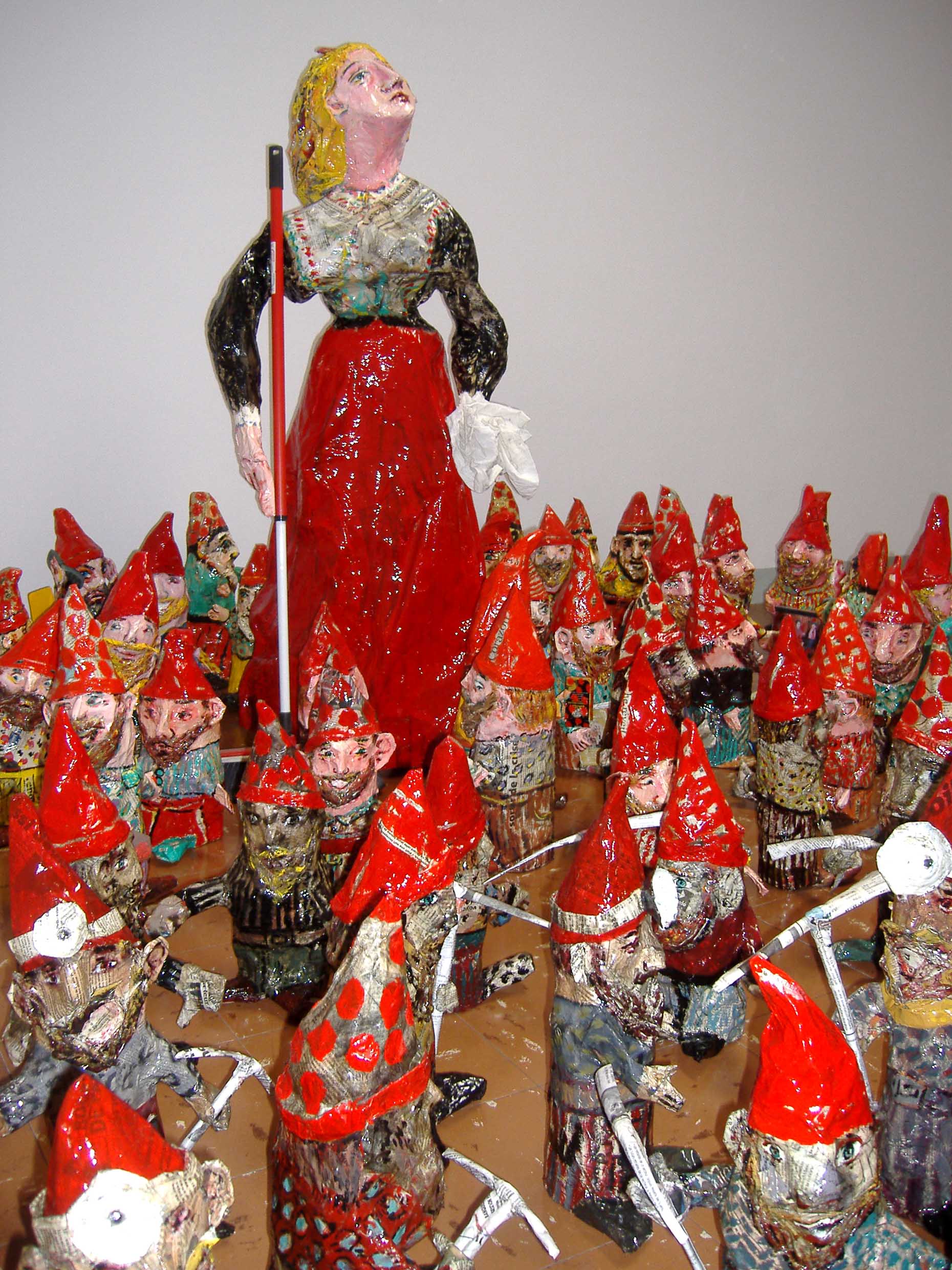 Initially, Véronique conceived the dwarves as a kind of parody of garden gnomes. Hence, the predominant red pointy hats. Additionally, they mostly have beards. However, the single sculptures can be distinguished by their physiognomy, hair and beard colour, clothes and adjuncts. Several of the small imps have nothing in their hands, some have a book, others pull or push carts, one sits on a motor scooter. There is also the duo of “Batman and Robin”. Though many are carrying pickaxe and headlamps. This is another reference to the Brothers Grimm’s fairy tale, since the dwarves there are working in an ore mine. Also, the carriages recall the entering in the mine tunnel by carts.
Having in mind Véronique’s first idea for her dwarves, one could find similar attributes in many of the classical garden gnomes. When these became popular as decorations in European gardens in the mid-19th century, their design was often based on that of gardeners. However, many were also inspired by medieval miners.
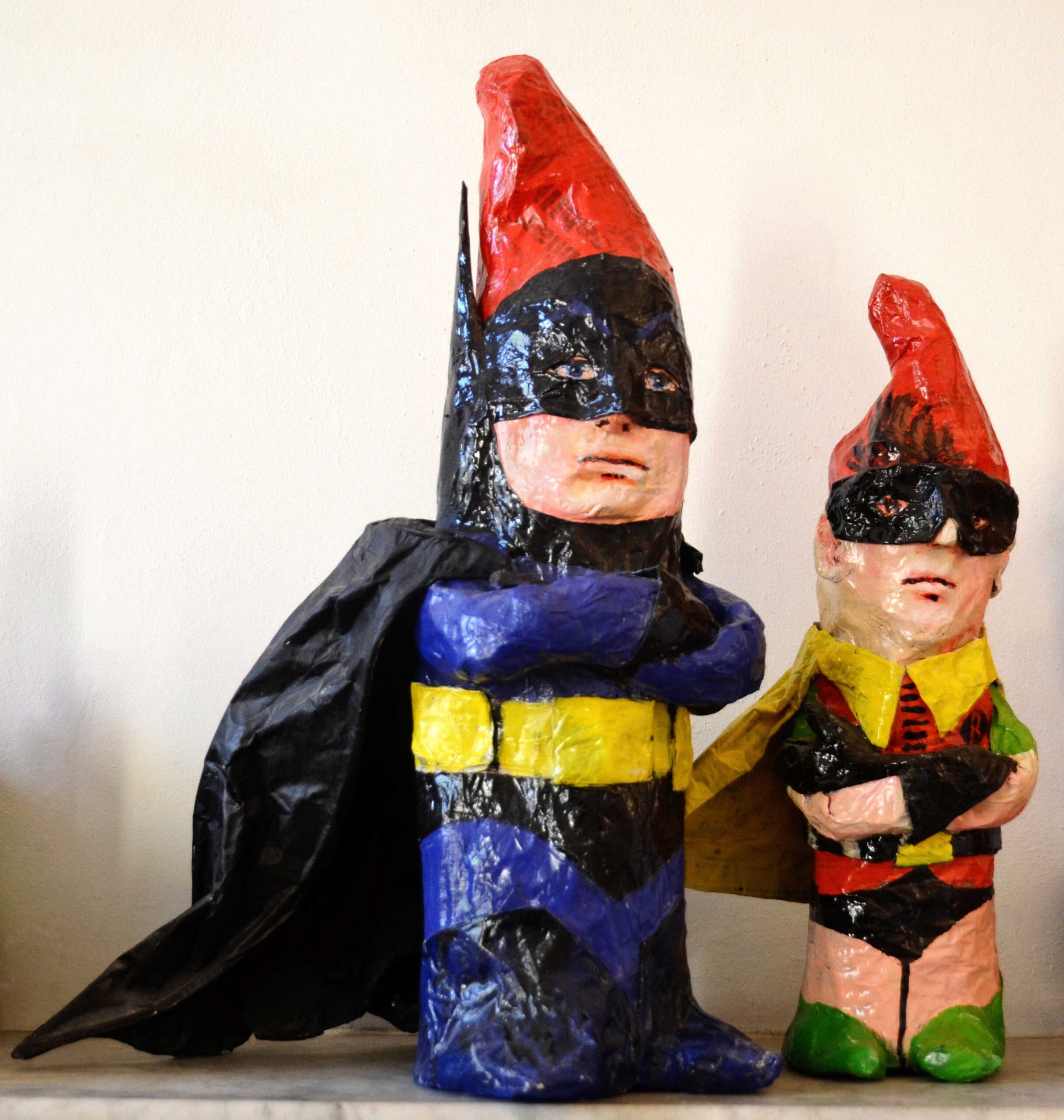 Working in the underground, miners are so closely related to the in the background operating household spirits, like the English hobgoblin, the French lutin, the Italian folletto or the German Heinzelmännchen. These little humanoid creatures do odd jobs around the house, while the inhabitants are sleeping. Even though, they are sometimes described as hilarious goblins, or even could turn to be malicious, they are mainly – and also in the artist’s interpretation – good spirits. In this sense, also the figures of Batman and Robin could be seen.
For Véronique, her small population of dwarves represent the people, who work in the background of daily live. Similar to miners and household spirits, they hardly ever appear, are almost invisible. Nevertheless, their contribution to the functioning of society is essential, often the basis. This could be the street cleaners and refuse collectors, who labour early in the morning or late in the evening to not disturb the traffic and keep the streets clean. Or think of the cleaners in offices, 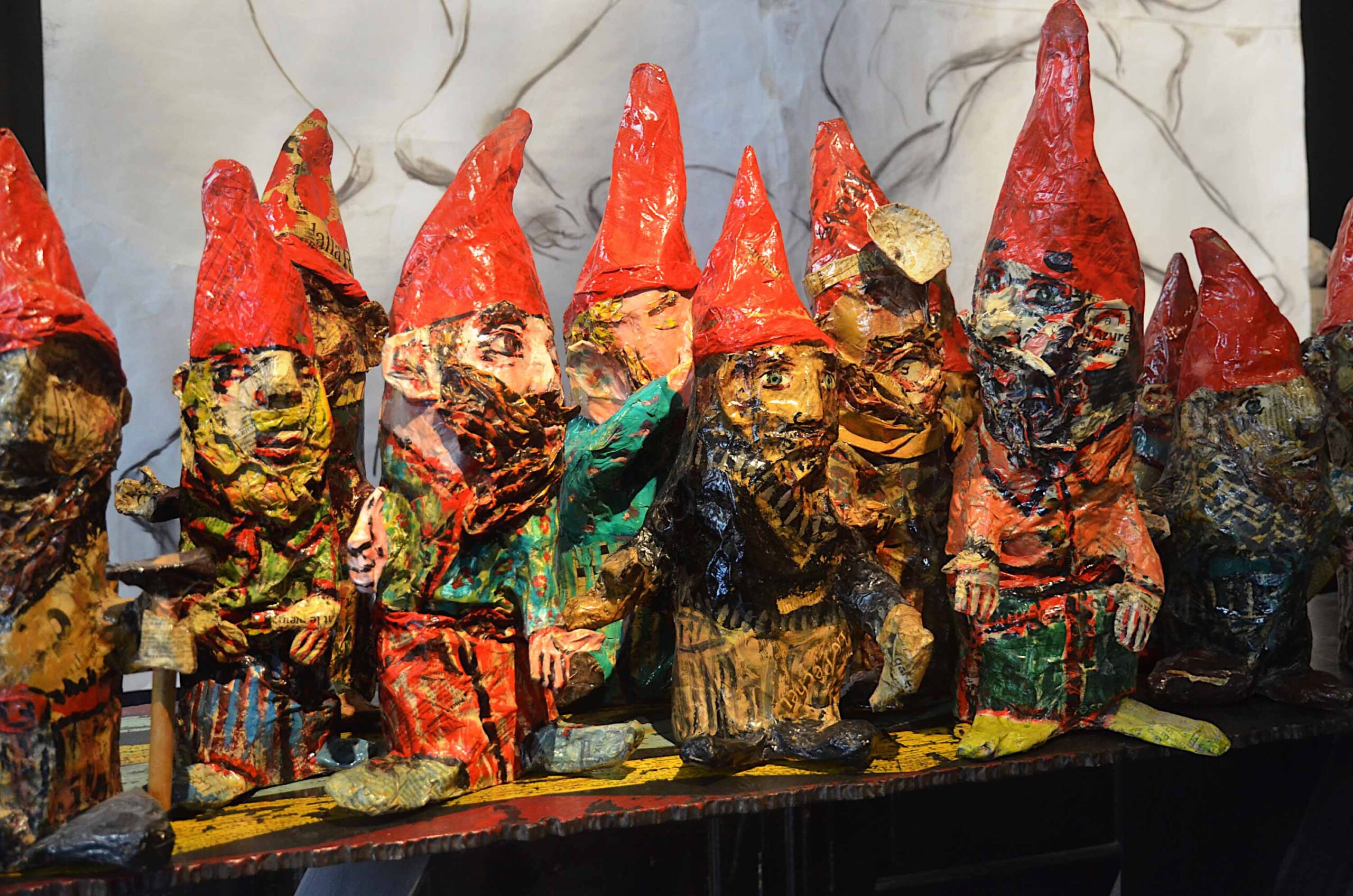 with the same schedule for the same reason. Naturally, the miners are also included. Although coal mining is declining in the Western world, metals and rare earths continue to be mined on other continents alongside coal and ores. Workers often live on the margins of society and put their health at risk for the functioning of the community at risk. The list could go on forever. Véronique’s dwarves embody all ordinary people who work day in, day out under precarious conditions for the benefit of civilisation. For the artist, they represent the suffering humanity, even if they appear cheerful and content from the outside, like the dwarf population. From December 9, 2025, until January 31, 2026, Véronique’s entire community of dwarves is installed at the Librairie Rabelais in Nice, France.
Véronique Champollion
Born in Valence, France (1957) Véronique went to the Ecole Nationale Supérieure des Arts Décoratifs (ENSAD) in Paris and obtained her diploma in 1981. Moreover, she achieved a DEA (MA) in Modern Indian Studies on Hindi films. She has been part of diverse groups of artist self-organisations like ART MOBIL with its journal, No-made, both in the region of Nice and the Museo Teo in Turin. Furthermore, she is member of the Association Internationale des Arts Plastiques (AIAP)-Unesco, based in Monaco. During her long career, she organised exhibitions, installations, videos, and performances throughout the world. Often, she focusses on the concept of “Mediterraneanness”, in which colour, musicality, humanity and playfulness play an important role.
Besides painting, the artist forms reliefs and sculptures from newspapers and posters, combined with glue, fiberglass and resin. With a glance to art history, legend and fairy tales, Véronique interprets her sources astute and humorous. Favourite inspirations she takes from classical paintings for example by Botticelli or Velasquez. Her sculpture “Botticelli’s Spring” is our Artwork of the Month / May 2015.
During her long artistic practice, she created several Madonnas in her different techniques. There are archaic ones like a Madonna of Snow, a monumental outdoor sculpture. Others are more classical works like the Madonna with Child, our Artwork of the Month / December 2017. In addition, these Madonnas might have contemporary references. Often the Madonnas are inspired by paintings inter alia by Giovanni Bellini.
A personal exhibition on fairy tales in January 2015 in Valence included an installation of a newspaper forest. Another one in March and April 2015 at the Montpellier University showed many artworks inspired by Occitan literature (Troubadours, Mistral and actual poets). In 2017, Véronique participated in a group exhibition at the Italian Cultural Institute in Paris, where she proposed a visual dialogue between Paris and Milan, with Neapolitan interferences as installation of citations coming from paintings of the three towns.
In September 2020, Véronique participated in a group exhibition about the history of engravings in the Media Library Albert Camus in Antibes. Hence, the inspiration to engage more intensively with graphic prints. Besides many other works, she made a series of prints, in particular collagraphies. One of these works, “Satyr” is our Artwork of the Month / March 2021.
Since 2004 Véronique creates dwarves made of papier-mâché. They were presented on several occasions and in various constellations, for example in 2006 in “the Room” in Turin, Italy under the title “Bianca Neve e i 47 Nani” (Snow White and the 47 Dwarves) and in 2010 as “Train de Nains” at the Museo Teo in Milan. Meanwhile, an entire population of dwarves has emerged. Our Artwork of the Month / December 2025 is dedicated to them.
Even though her sculptures are precious pearls by themselves, she sometimes brings them to life, in placing them into images for visual poetry stories, published as books in France, Italy and Belgium. Her latest publication was released in 2023 at Ichnos Editions: “Contribution à une réhabilitation du travail ménager et en particulier de la place de l’homme dans la maison” (Contribution to the rehabilitation of domestic work and, in particular, the role of men in the home), where she collaged well known historic artworks into household environments. Moreover, she contributed articles and illustrations to various journals of visual poetry.
Several Galleries in France, Italy, Monaco and the United States represent Veronique’s works. In the same countries, she had numerous personal and group exhibitions, but as well in Belgium, Germany, Switzerland and Hong Kong. Currently she contributes to the group show “Exposition Histoire d’un lieu: les 20 ans du Transartcafé” (Exhibition History of a place: 20 years of Transartcafé), inaugurated on November 28th, 2025, in Antibes.
Véronique lives and works in Antibes, France.
https://www.instagram.com/veroniquechampollion/
https://www.facebook.com/veronique.champollion/