
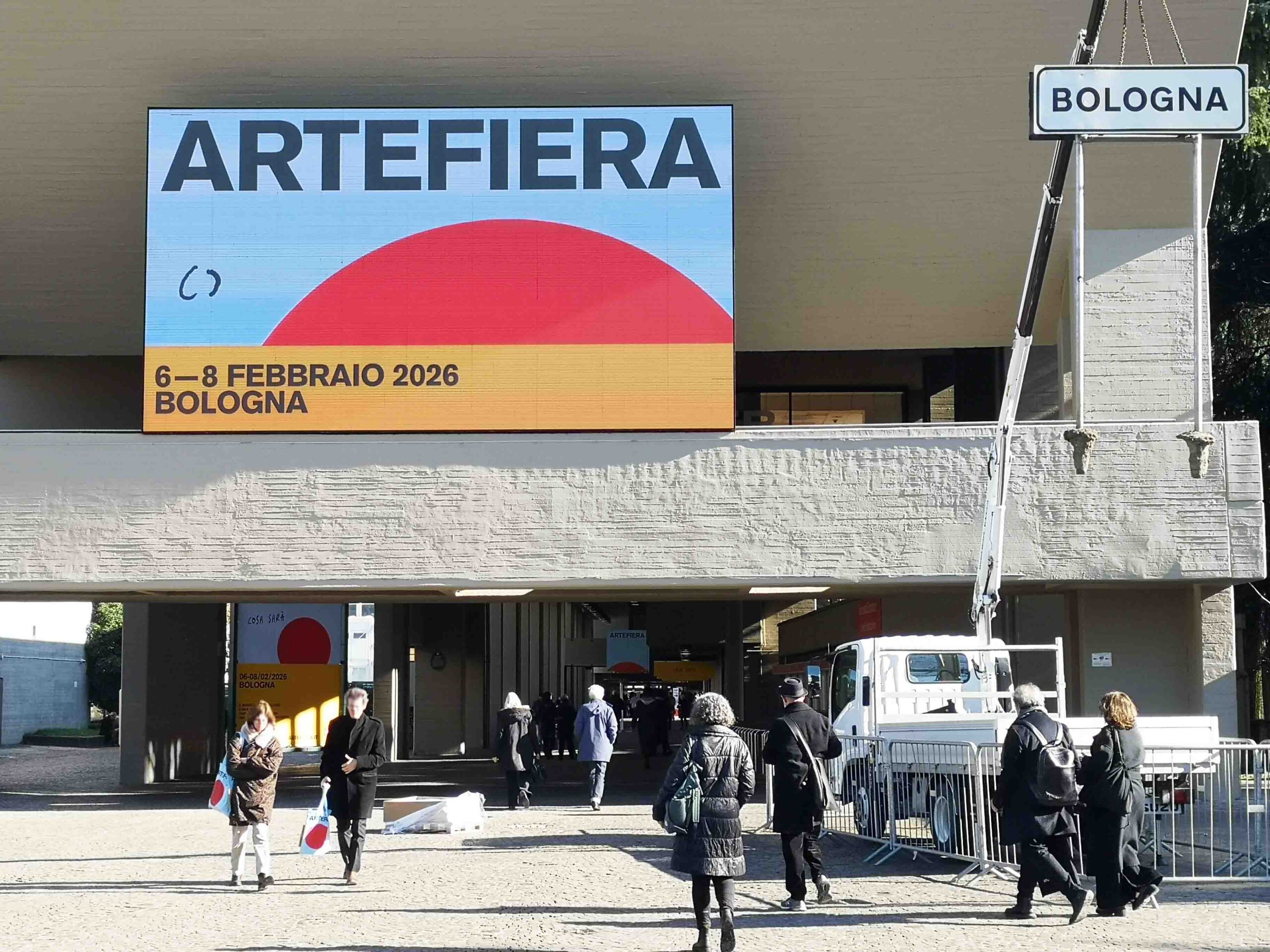
 6 – 8 February 2026
Preview 5 February 2026
Approaching its 50th edition, the oldest Italian art fair wanted to glance with this year’s 49th edition into the future. Under the title “Cosa sarà” (What will be) the new artistic director Davide Ferri (with Enea Righi as managing director) gathered 174 galleries plus 12 publishers and 15 institutions. With a total of 201 exhibitors, the fair has grown compared to last year. The number of visitors (50.000) remained stable, which were welcomed already outside the fair by Marcello Maloberti’s site-specific ephemeral installation “Kolossal”. Inside the fair buildings, the entry space was re-organised: this time the publishers were grouped here, around the obligatory bookshop.
A blurred Distinction between modern and contemporary Art
Nevertheless, continuity was evident in the choice of traditional exhibition spaces, where familiar national and international lovers of Italian art could easily orientate. As customary, Hall 26 was dedicated to post-war art and Hall 25 to contemporary. However, this general line was blurred. For example, Lorenzelli Arte from Milan brought several works by Alberto Magnelli (1888 – 1971), who was ahead of his time as the first Italian painter to create abstract images. Perhaps therefore, he was in the contemporary part on view. Then again, now in Hall 26 the Bolognese Galleria Forni presented the most recent works by the former youngster L’orMa (Premio Euromobil under 30 in 2016 and a few months later Arteamcup Prize winner over 30). Besides his very new creations in marble, L’orMa freshly constructed the brain factory called “AI”. It is a critical view on the current digital developments. As it happens, the gallery 21 Art in the next booth presented a series (2024) by Jan Fabre, which featured also our central organ of thinking. However, the Belgium artist wanted to pay tribute to his late brother.
no images were found
Not far away, the Galleria Russo from Rome displayed besides classics like Giacomo Balla and Giorgio de Chirico fresh works by Carole Feuerman. Her swimmers make you think of summer already in February. Traditionally hosted within the modern ambiance were the academies of Bologna and Florence, who naturally presented their current students. Additionally, there were several foundations, inter alia Zuccelli, Lercaro and Bevilacqua la Masa, with mostly young artists on view.no images were found
Design and Multipli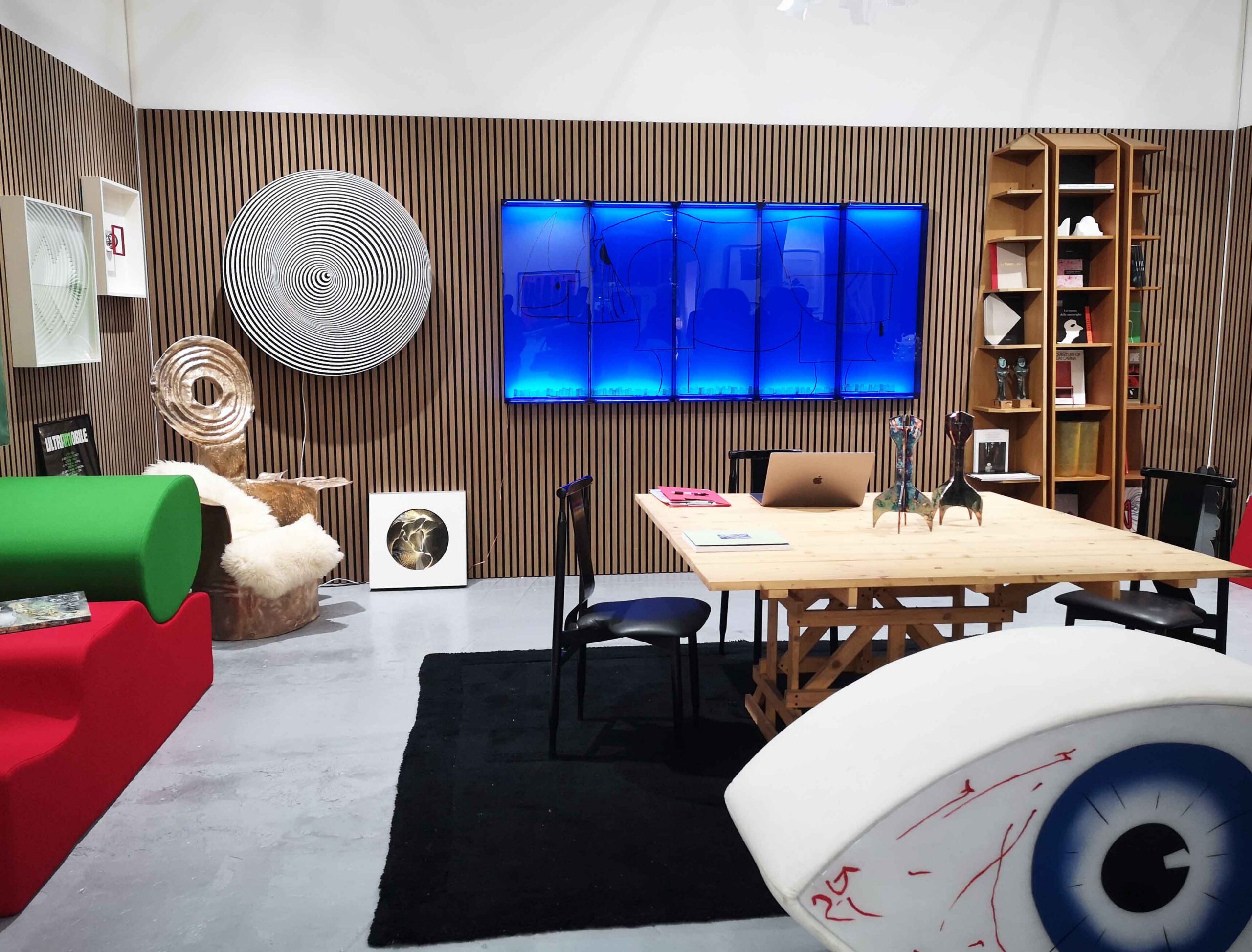 Also located in Hall 26 was the section “Ventesimo+”. Curated by Alberto Salvadori, it featured Italian and international art from the early 20th century to today. Looking back and yet visionary was the booth of Paradisoterreste, which is specialised in the reedition of historic pieces of design and the release of new editions. This year’s booth was dedicated to the founder Dino Gavina in imagining the historic office of the Bolognese entrepreneur, designer and editor. Furniture and other design elements were grouped around Gavina’s worktable. Another section “Multipli”, curated by Lorenzo Gigotti was nearby, not only in the spatial sense, but also in regard to the content: the reproducibility is inherent in design as well as in photography and print.
Newcomers, Photography and Painting
Whereas the section “Fotografia e dintorni” (Photography and surroundings) was located in Hall 25. The gallery P420 (in addition to the booth in the main section) presented the sometimes disturbing, but poetic black and white photos by Goran Trbuljak. Further interesting photographic works were provided by Tomaso Blinga (Tiziana di Caro, Naples) and Hamza Badran (Gian Marco Casini Gallery, Livorno).
no images were found
Perhaps most forward-looking was the section “Prospettiva” (Prospect), introduced last year and curated for the second time by Michele D’Aurizio. Eleven galleries with less than ten years of activity invited young creatives to present their research at monographic stands. The monumental black and white drawings by the Chinese artist Yuchu Gao (Ermes Ermes, Rome) were impressive, not only by size but also in their thematic and stylistic diversity. At first glance, Alice Amanti‘s booth (London) appears much sparser: three images and a sculpture by Ilaria Vinci. However, the Italian Zurich-based artist creates detailed pictures in pencil and watercolour. An open nutshell, inspired by nature forms the exterior of a structure. The inside reveals a view of what initially seems to be an engine room. One apparently serves the purpose of self-optimisation through wellness, the other refers to death and the possibility of Christian faith as salvation from it. A mattress tower protects against sleep disturbances.no images were found
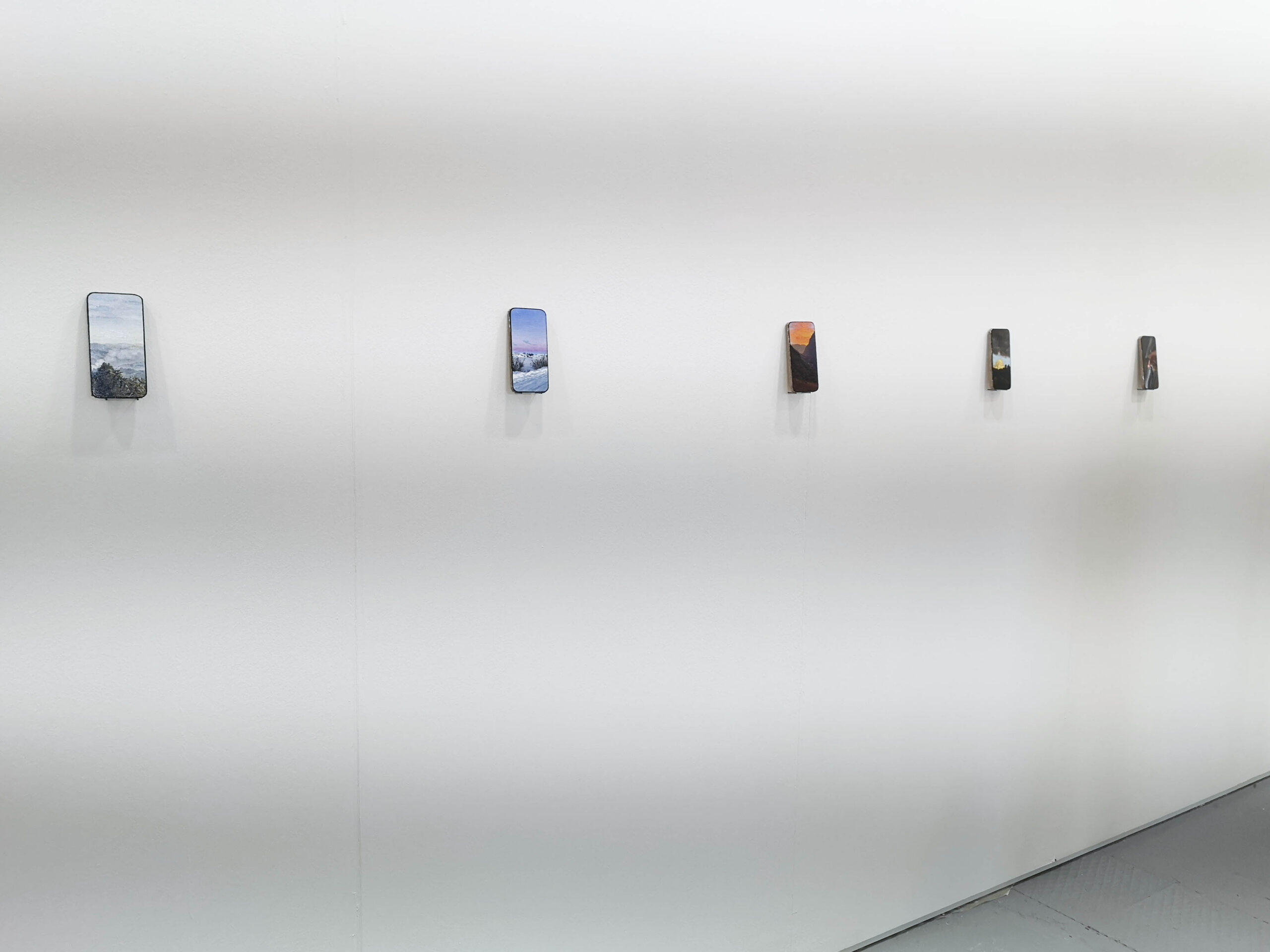 Almost next to it, separated only by a relaxation area, was the section “Pittura XXI” (Painting XXI), curated for the first time by Lorenzo Gigotti. The most impressive works here, were the small-format paintings by Xiao Zhiyu at the stand of the Galleria Fuoricampo from Siena. For his series “Things I Keep in My Pocket” (2025) he applied the format of smartphones to his paintings. This decision is more than an allusion to our contemporary everyday viewing habits. In fact, it is a reflection on the smartphone itself. For the Finland-based Chinese artist, the device “represents the highest refinement of modern technology: millions of identical copies scattered across the planet, each one the endpoint of a vast, invisible mesh of extraction and production—rare earth minerals dug from the ground, labor outsourced across continents, container ships crossing oceans, patents, treaties, tax shelters, surveillance protocols.”* At the same time, the smartphone is a very intimate, tool, since it is, through news channels, film, social media and communication for many the access to the world. Moreover, numerous people use the device as a kind of diary, often through photos taken, as Xiao Zhiyu does. So, he keeps his whole world in his pocket and takes his inspirations for the paintings from images, he captured on his iPhone.
Paintings in the Main Section: From surrealist notions to stylised Flowers and colour Fields
Naturally, the main section took up the most space of the halls of the art fair. There were interesting paintings, too, for example at the Galleria Giampaolo Abbondio, directly opposite to the section “Pittura XXI”. They brought works by Chiara Sorgato, which have surrealist and poetic notions. Many are very detailed and invite to a longer contemplation. Whereas the works by Stefania Orrù initially recall colour field painting. However, they are not homogeneous surfaces of colour, but reliefs of colour, arisen from a blend of scagliola, marble powder and pigments on canvas. With this choice, the Quam gallery from Scicli remind a little bit their first appearance in Bologna last year, when they installed the light-filled images by Federico Severino.
no images were found
Besides established artists, the gallery L’Ariete artecontemporanea from Bologna brought the tranquil paper flower paintings by the newcomer Marco Sisto, first presented last year during the Open Tour. Once again surreal, or rather magical, are the images by Evgeniya Pankratova at the gallery Mimmo Scognamiglio Artecontemporanea (Milan): Hands hover above tables on which unusual scenes are taking place, holding objects or sprinkling water. In contrast, Jenni Hiltunen‘s portraits of women at the same gallery have a very calming effect.no images were found
Photography in the Main Section: Tranquil meditative imagesOutside the photo section, there were also some remarkable photographs, for example Laveronica (Modica) presented some pictures by Moira Ricci from her series “Dove il cielo è più vicino” (Where the sky is closer), which was installed in the MAMbo in occasion of the Foto/Industria last year. Then, the images were printed on huge banners. However, even smaller they retain their poetic charisma on the threshold of abstraction. Maurizio Mercuri‘s Apollo series is even in a smaller format: an egg lies in various positions between the pages of a book, meditative photographs by the post-conceptual artist. The AF Gallery showed them besides other of their featured creatives. Silvia Camporesi‘s tranquil moments are always a joy to behold, whether they depict architecture, nature or fabulous beings. The Galleria Massimoligreggi (Catania) dedicated a solo exhibition to the Italian photographer this year. Known for his ephemeral oil installations, these works by Per Barclay get at least a more permanent character through photography. The Galleria Giorgio Persano (Torino) brought two recordings of his intervention at the “Teatro di Corte, Reggia di Caserta” in 2025.
no images were found
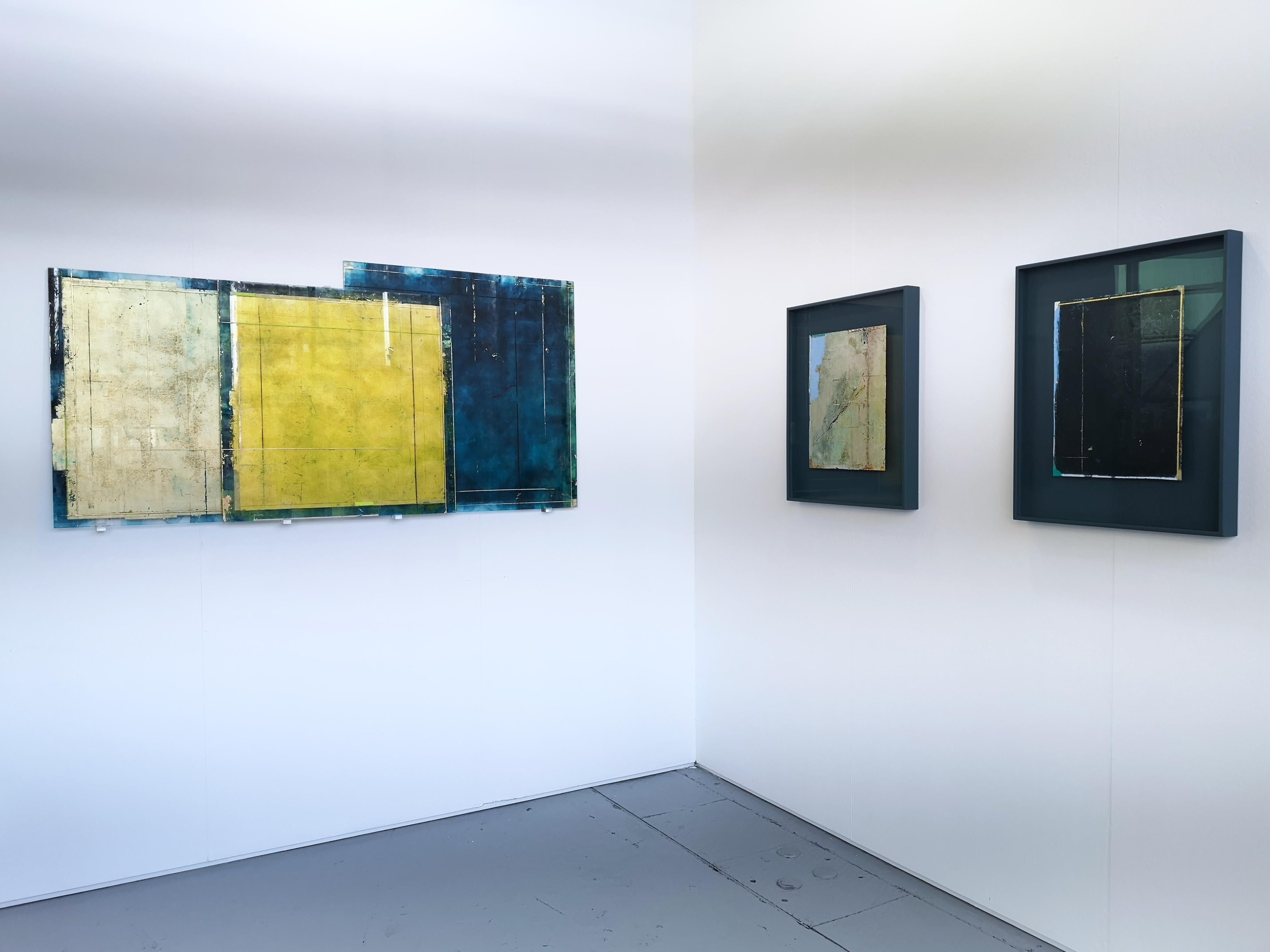
Overall, it was a balanced fair that confirmed its continuity in presenting traditionally Italian art without much fanfare. This allows a positive outlook for the future to carry on in this direction. Collectors seem to see this similar, since the galleries reported very positive sales figures.Here are some more impressions of noteworthy artists and booths, not mentioned in the text:

* Quoted after an Instagram post by his gallery Fuoricampo, 8 February 2026, https://www.instagram.com/p/DUfZgw1Dd1X/?img_index=1