
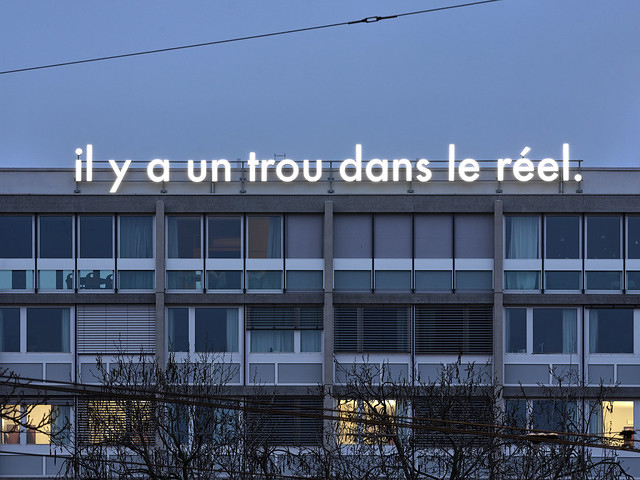
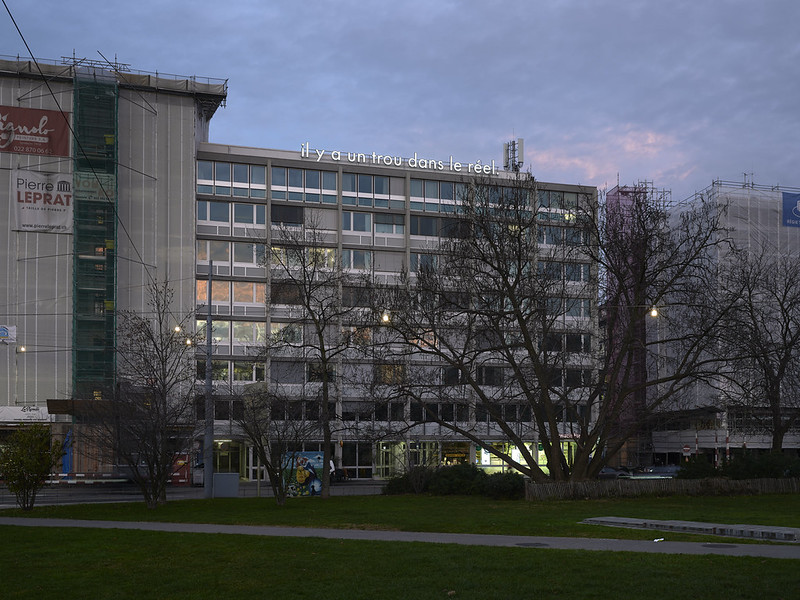
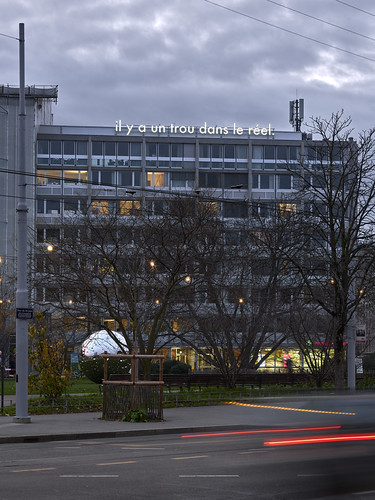
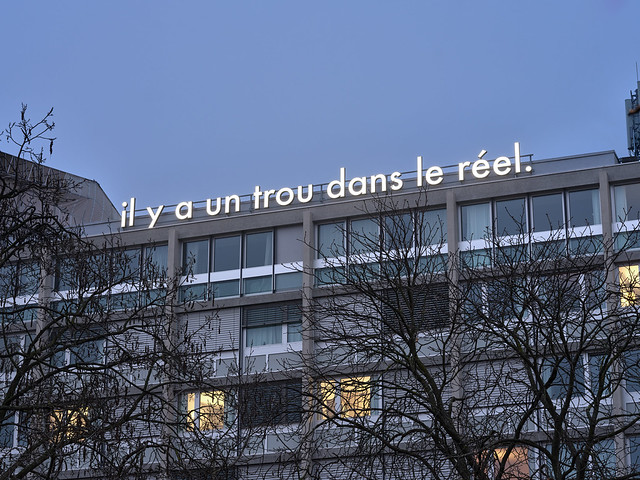
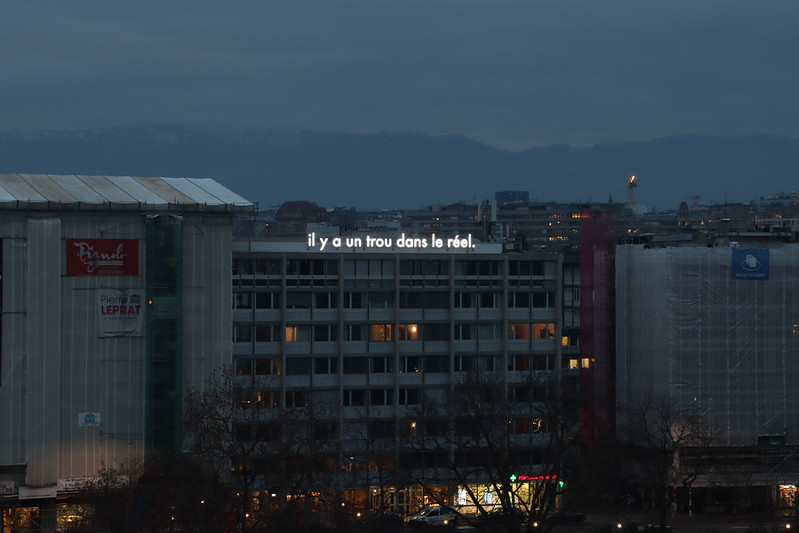
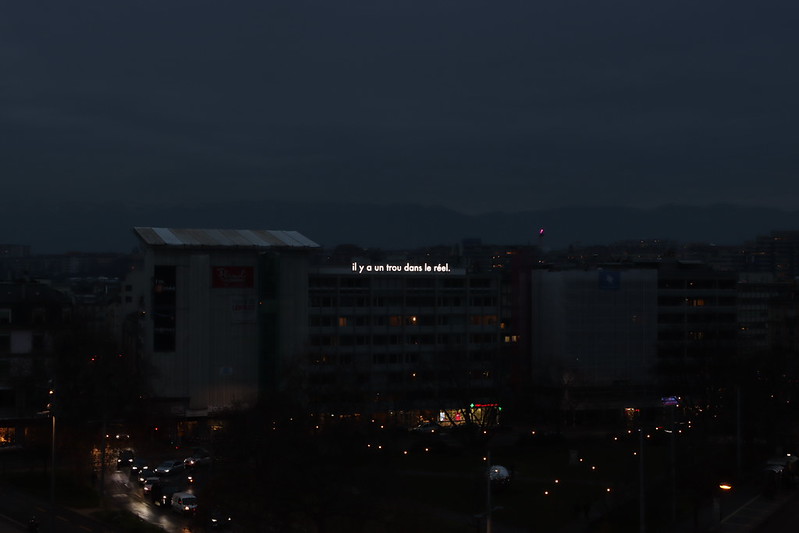
 il y a un trou dans le réel. (there is a hole in the real.)
Dora García
2025
Neon installation
led lights inside light boxes as letters
16 m x 1,5 m (approx.)
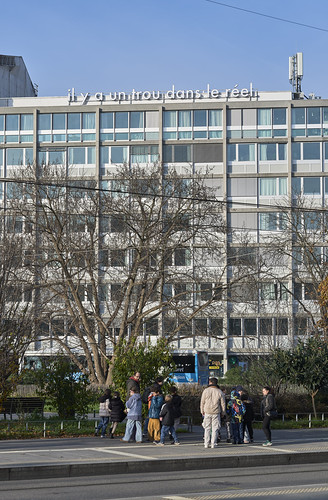
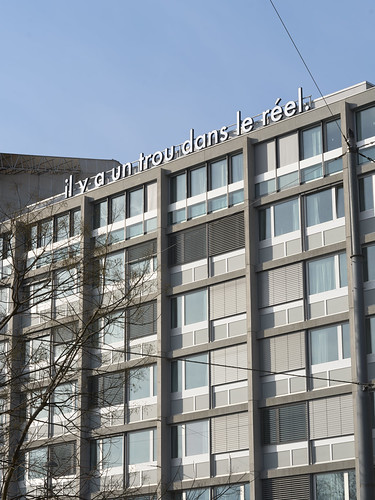
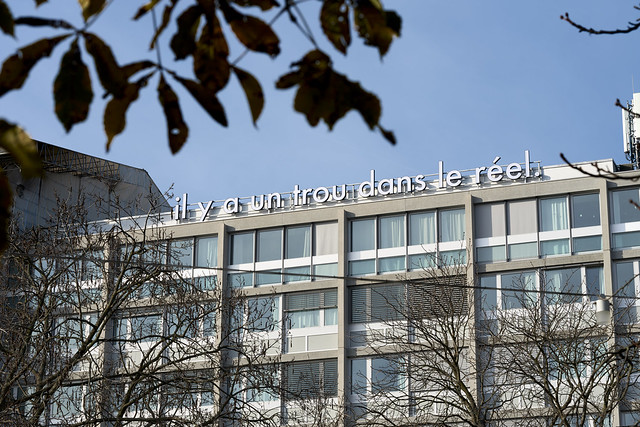
Since 15 January 2026, a huge neon sign is perched at the very top of the roof of the student housing of the Centre universitaire protestant in Geneva, Switzerland. It’s actually the sort of place where you might expect to see an advertisement. Also, the neon design would suggest this purpose. However, when you read the sentence, it becomes clear that it is by no means an advertisement: “il y a un trou dans le réel.” (there is a hole in the real.) does not promote any product, company, institution or interest group. It is an artwork by the Spanish artist Dora García, installed in the context of “Neon Parallax”. This public art project is organised by the Fund for Contemporary Art of the City of Geneva (FMAC) and the Cantonal Fund for Contemporary Art (FCAC). Since 2006, various international artists installed their creations in neon on various roof tops of buildings bordering the Plaine de Plainpalais in the Swiss city.
The words, illuminated in simple white are set in a plain, unadorned typeface. Herewith, they adapt the modernist architectural language of the building. At the same time, the sober execution and environment contrasts with the content. How can it be that the real – that which is supposed to exist truly – has a hole in it? Passers-by in 2026 may think of the current distortions of parallel realities, of fake news and alternative truths. However, Dora had already used this phrase in her art back in 2014.
Already in 2001, the artist started her series “Golden Sentences”. She “collected” sentences, perhaps sometimes taken from well-known personalities, but always devised by herself. They seem to be truisms, sometimes disturbing, sometimes ironic. She produced the phrases on walls, shopwindows and T-shirts, always golden coloured, often in gold leaf. In occasion of her exhibition “Philip K Dick and the vesica piscis” in 2014, Dora installed “il y a un trou dans le réel.” on the pane of the shop window of the gallery Michel Rein, Brussels, Belgium*. Executed in gold leaf, the inscription recalled the ones formerly used in elegant foresight vitrines. It is therefore not surprising that the artist reused the same phrase in a similar context, namely as neon sign in Geneva. Though the design has been adapted to the new situation. Does she also take the changed perception of the real 11 years later into account?
However, those familiar with the work of the French psychiatrist and psychoanalyst Jacques Lacan will recognise a modified quotation. In his Seminar XXIII (1975/76) on James Joyce and the Sinthome he spoke about his concept of the Real as a point of the impossible within the symbolic order. In this context, he stated that language is not a message in itself. Rather, it is supported by the function, which he describes as a hole in the real. So, through her work, Dora seems to point to the limitations of text. There is always a gap between the words and the real.
Until the end of December 2026, the neon installation “il y a un trou dans le réel.” will be on view in Geneva.
* “il y a un trou dans le réel.”, 2014, goldleaf letters on glass pane or on a wall, is now in the collection of FRAC Lorraine, Metz: https://www.fraclorraine.org/ancien-site/en/voyagez/autres/492.html
Born in 1965 in Valladolid, Spain Dora García studied fine arts at the University of Salamanca and at the Círculo de Bellas Artes, Madrid, both in Spain. Subsequently, she completed her Master’s degree with postgraduate studies at the Rijksakademie voor Beeldende Kunsten, Amsterdam, Netherlands. Afterwards she moved to Brussels, where she lived for 16 years.
In her work, Dora attempts to blur the boundaries between author and actor, reality and fiction and art and life. For this purpose, she uses various media and forms of expression like video, writing, performance and installation. Traditional forms of art presentation are questioned. For example, instead of a traditional sculpture, she “translated” John Gay’s “The Beggar’s Opera” into a street performance for the Skulptur Projekte Münster in 2007. Here the main protagonist walked through the town, tried to start conversations with passers-by, offering them advice or telling them stories. Accompanied by a daily online diary, the intervention functioned as both a fictional and a real-life narrative, the public converted to actors, so their daily life became part of the artwork.
Dora’s contribution to the 54th Venice Biennale in 2011, “The Inadequate” in the Spanish Pavilion was a kind of laboratory, where films and objects from the artist’s previous works met performances and discussion sessions around the title giving subject. Thus, the space was in a state of constant flux and could never be grasped as a whole, since no such whole existed. In consequence, any appreciation of art in the conventional sense was impossible.
For the dOCUMENTA (13) in Kassel, Germany in 2012, Dora produced the TV-talkshow “KLAU MICH: Radicalism in Society Meets Experiment on TV”. The programme was broadcasted weekly from the Ständehaus in Kassel on Offener Kanal Kassel. Many of the invited guests were familiar with the radicalisation of the late 1960s and 1970s. The genuine public debate was complemented by new forms of experimental narrative theatre. On the other days, the theatre rehearsals could be watched online. Here, too, the lines between reality and fiction became blurred. At the same time, socially relevant issues concerning radicalisation – whether political or directed against established institutions – were addressed. It was intended to challenge former viewers of public service television. Thus, the lives of the viewers were directly aimed.
By contrast, the work currently on display in Geneva is almost traditional. As part of the public art project “Neon Parallax”, “il y a un trou dans le reél”, a neon-installation at the top of a building, communicates gently with passers-by. The installation is our Artwork of the Month / June 2026.
Up to now, Dora has created many more works of art than those mentioned here by way of example. She has held numerous solo exhibitions and has taken part in many group exhibitions, mainly in Europe, but also far beyond. Her works entered important art collections like the Museo Nacional Centro de Arte Reina Sofía, Madrid, Spain; the Musée National d’Art Moderne – Centre Georges-Pompidou, Paris, France and the San Francisco MoMA, San Francisco, USA. Moreover, she was granted several awards and invited to renown art events, as mentioned above.
Besides her artistic vocation, she had guided and still teaches young artists at various European art schools. Early in the beginning of her career, she was professor at the Luca School of Arts, Brussels, Belgium, followed by the ENSBA Lyon, France. Subsequently, Dora entered the HEAD Genève, Switzerland, and three years later the Oslo National Academy of the Arts. In both institutions she is still active. Meanwhile, the artist was as leader of research workshops member of the teaching body of the PEI (Programa d’Estudis Independents, MACBA, Barcelona) for six years and one year resident professor at Le Fresnoy, France.
Dora lives and works in Oslo, Norway.