
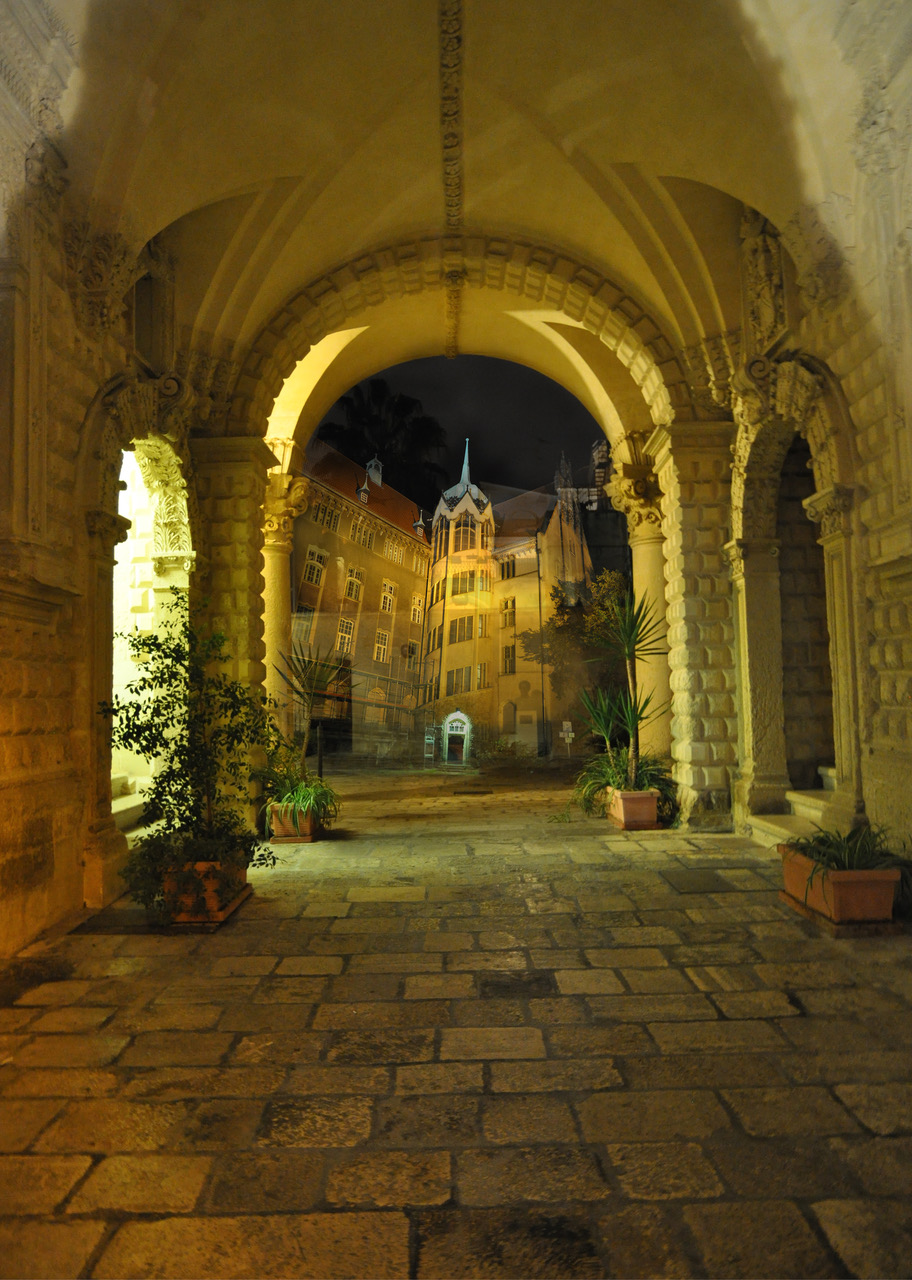
 Übergang zu Europa (Passage to Europe)
Betty Zanelli
2026
Digital print and mixed media on paper
82 cm x 62 cm
Edition 1/5
The image “Übergang zu Europa” (Passage to Europe) by Betty Zanelli seems to be a photography of a view through an archway into a courtyard with another building at the far end. Regarding the entrance hall, it suggests an origin in the Late Renaissance or even the Baroque period since it has square “cushion” bosses and floral ornamentation. Whereas the architectural elements of the rear building refer to another period. There is a stair tower with its upper windows and the spire hint to the Late Gothic style. Though, the windows of the construction could indicate the Early Renaissance at first glance. However, the large number of storeys does more point to the Neo-Gothic style around the turn of the 20th century. The night scene is bathed in a warm, yellowish light. Planters containing little palm trees lined laterally of the side entrances in the gateway area evoke, like the light, a southern atmosphere. In contrast, the whitish illuminated spire of the stair tower has a cool effect. It also seems that the whole construction is slightly tilted backwards. Furthermore, shadows of unclear origin are cast onto the façade of the rear building. The courtyard area behind the archway appears to be overlaid, as if the photograph had been taken with an analogue camera and the negative had been exposed several times.
In fact, “Übergang zu Europa” is a sort of photo collage in which Betty Zanelli combines several pictures. The gateway is part of the entrance of the Palazzo Adorno in Lecce, south of Italy, a landmark of the city. Built in 1568 to serve as the city residence of Ferrante Loffredo, former governor of Terra d’Otranto, it was still unfinished when it passed to Giovanni Matteo Adorno. Though, in the second half of the 18th century, the Personé family carried out design changes in Baroque style, which also affected the portal. Whereas the rear building is the very right part of the right-hand wing of the Court of Justice in the quarter Wedding in Berlin, Germany, built between 1901 and 1906 designed in Neo-Gothic style by Rudolf Mönnich and Paul Thoemer. It is said to have been inspired by the Albrechtsburg in Meissen around 1500.
Apart from the fact that the distance between the buildings is approximately 2000 km, it is striking that the five story Court of Justice must be situated much further from the archway of the Palazzo Adorno to be seen in its full height. Nevertheless, in the artist’s composition they form a harmonious ensemble. This is partly due to the mainly uniform lighting. Even though the flooring in the court could be taken from a third place, it continues similarly from the gateway right through to the rear building. Nor does any of the edifices dominate the other, even though the imposing entrance to the Palazzo Adorno is in the foreground. The chosen central perspective directs the viewer’s gaze towards the central stair tower with its brightly highlighted spire. On the other hand, the blocked look to the vanishing point draws the eye back to the more sharply depicted foreground. Furthermore, the bright light in the left-hand entrance draws the eye back to the archway. This, in turn, finds its counterpart in the illuminated door of the stair tower. The picture therefore invites the contemplator to linger and discover more and more details. Therefore, it is a balanced fusion between a place in the far south, and one situated far to the north-east of Europe.
Betty certainly did not choose the German title by chance, as the German word “Übergang” has various meanings. It could be a passageway like a bridge, a (border)crossing, or a doorway, as it is in the picture manifest. Moreover, “Übergang” could be a transition or development from one age to another, from one condition to another, or a transfer from goods, rights or ideas. Consequently, the title, and with it the image, can be read in different ways.
Regarding Europe, it could be interpreted as a metaphor for the continent or for European integration. It refers to the importance of connection and unity instead of division and conflict. Additionally, it points to the continuing process of transition initiated by the European integration. At the same time “Übergang zu Europa” is a utopia of Europe, just as the image harmoniously brings together two different places. An invitation …
“Übergang zu Europa” was presented for the first time in the exhibition “Passaggi/Übergänge” at the Goethe-Zentrum Bologna in February/March 2026, which was strongly inspired by Walter Benjamin’s “Das Passagen-Werk” (Arcades Project). Besides architectural passage like doors, archways and bridges, there were collages which link geographical locations or landmarks, like the presented “Artwork of the Month”.
Betty Zanelli
Born in Bologna, Italy, Betty Zanelli studied painting at the Accademia di Belle Arti in her hometown. In the 1980s, she moved to New York, where she lived for eight years. As multidisciplinary artist, her media varies from drawing, painting, photography to digital editing and site-specific installation, often containing found objects. In recent years she increasingly included musical elements in her work, due to an intensified collaboration with the composer and saxophonist Marco Visconti Prasca. Additionally, her teaching work as professor for fashion design directed her on curating fashion show performances with her students in Italy and abroad.
Doors are an exemplary recurring motive in the artist’s work. Already in 1985, she had the exhibition “Apparenze/Appearances” at the “Studio Mascarella” in Bologna, where she presented ancient doors, with artistic supplements like paintings and collages. A few months later, in January 1986, new old doors were on view at the P.S. 122 Art Gallery, East Village, New York. An example from this time is the preparatory sketch “Door, NY, 1986” made in summer 1986, which is our Artwork of the Month / March 2019. To this day, doors continue to feature prominently in her work. For example, in the exhibition “Passaggi – Übergänge” at the Goethe-Zentrum Bologna in February 2026. Alongside a wide variety of works featuring doors and landmarks from Europe and Asia, the picture “Übergang zu Europa” was on display, which is our Artwork of the Month / July 2026. As a tribute to Walter Benjamin and his unfinished project “Das Passagen-Werk” (Arcades Project), which had a significant influence on the presented works, Marco Visconti Prasca composed the saxophone performance “Flânerie”. The music was premiered by Sara Albani during the ART CITY White Night in Bologna.
In the first half of the 1990s, Betty participated in the Project Studio Space Program, offered by her first American exhibitor, the P.S. 122 Art Gallery. During this time, she presented her works in several personal and group exhibitions in New York and Los Angeles. Returning to her home country, she continued her artistic research and placed her works regularly in artistic shows in Italy and abroad, mainly in Berlin, London, Rome and Bologna.
Starting in 2000, the artist approached digital photography and digital print. Here she focused on popular iconography and pop culture, with a special attention to childhood. In 2011, during a period of research in Berlin, Betty discovered the Spreepark, the former DDR Kulturpark (the only permanent amusement park of the GDR). Deserted after several initiatives of revitalization, at the time there were still some of the old structures, struggling against the decay and the re-conquest by the nature. During two artist residencies in 2014 and 2015 at the Berlin based “Institut für Alles Mögliche”, she could deepen her research on inconsistent aspects in urban spaces and her particular interest on abandoned spaces of entertainment like amusement parks. Here she completed her shoots of the Spreepark series, from which our Artwork of the Month / April 2016 is taken.
Since 2017, Betty works on her Transboundary-Project, at first glance a documentation about migratory movements of birds of passage. Nevertheless, it is also about human migration and visible and invisible borders. Varying installations of the project were displayed at the Büro für Bestimmte Dinge, Berlin (2017), at the Biennale Disegno di Rimini (2018) and at the Cobalto Lab, Bologna (2019).
In 2023, the artist and some of her students participated with “Crossing Threads” at the Fiber Art Festival “Follow the Thread – New York”. Also, for her exhibition “Concert for a Dress” in the Palazzo Fava Marescotti in Bologna Betty cooperated with her students. Other protagonists of the show were disused violins to whom she gave a new life. Some of these instruments appeared in a different form a little later that year in the exhibition “Eingedenken – Recalling the Future”. This show at “The Rooom” in Bologna also served as a tribute to one of her installations in New York in the early 1990s, “Symphony of the Lost Ideal”. Dedicated to the fall of the Berlin Wall, this early intervention and its later citation underlines the importance of the city to the artist and points to another recurring subject in her oeuvre.
Despite the great diversity of media, there are consistently certain elements of continuity. Nevertheless, new elements also appear regularly, which the artist often incorporates as a result of her many travels. Exemplary are the Japanese doors and buildings featured in the Passage-exhibition, which she encountered during her stay there in occasion of her participation in EXPO 2025 in Osaka.
Her most recent exhibition in June 2026 “Score – A Visual Symphony” at the Pallavicini 22 Art Gallery in Ravenna, provided a good insight into the Betty’s working methods. The now familiar violins were on display as an installation, alongside with old and new drawings of the instrument. Also, doors, old maps and drawings of migratory birds were in the show. Familiar objects were combined with new ones and placed in a fresh context. Together with the musical performance “Flânerie” by the saxophonists Sara Albani and Marco Visconti Prasca, the exhibition was for people familiar with her work, like a party where you meet old acquaintances and new people.
Betty lives and works in Bologna.